Ahead of Bakri Eid, Maharashtra livestock panel urges week-long halt on animal markets
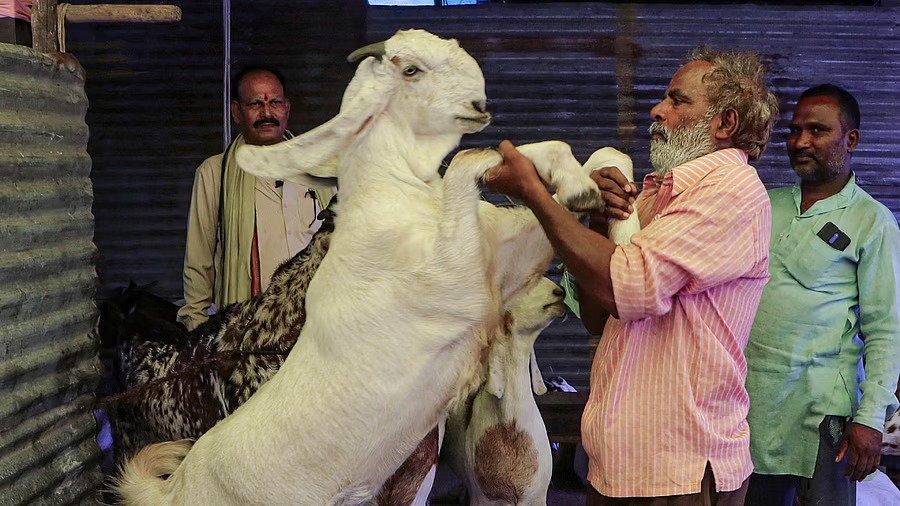
Mumbai: With Eid-ul-Adha (Bakri Eid) approaching on June 7, the Maharashtra Goseva Ayog, a commission for the welfare of indigenous cows, has issued a directive calling for a halt on all livestock markets regulated by Agriculture Produce Market Committees (APMCs) across the state from June 3 to June 8.
The directive has sparked sharp criticism from several quarters, particularly from members of the Muslim community, who have questioned the intent behind the suspension of sales of all animals, including goats, lambs, and sheep, ahead of the festival, with many also raising concerns about the timing and purpose of such a sweeping restriction, as reported by The Indian Express on Sunday.
According to a circular dated May 27 sent to all APMCs, the Goseva Ayog cited concerns over potential illegal bovine slaughter ahead of the festival and urged market committees to suspend livestock markets during this period. The circular referenced the Maharashtra Animal Preservation Act, which enforces a complete ban on the slaughter of bovine animals (cow progeny) in the state, and urged authorities to "stay vigilant in this matter."
Under current regulations in Maharashtra, the slaughter of cows, bulls, and bullocks is strictly prohibited, irrespective of their age or physical condition. Additionally, the possession of beef is classified as a criminal offence in the state.
Muslim community members argue that the ban will disrupt legitimate trade in non-prohibited animals such as goats, sheep, and buffaloes — animals traditionally sacrificed during Bakri Eid — and adversely impact the livelihoods of farmers, labourers, drivers, and traders who depend on these markets.
“The state needs to take steps to ensure that cow slaughter does not take place. But what is the intent behind shutting down the entire market? If the markets are not held, the trade of non-banned animals such as goats, buffaloes, and sheep will also come to a halt. As a result, daily wage income for farmers, porters, brokers, drivers, the Qureshi-Khatik community, and labourers will stop,” TIE quoted Farooq Ahmad, State Vice President, Vanchit Bahujan Aghadi, leading a protest against the circular in Nanded, as saying.
Ahmad further raised concerns about the Goseva Ayog’s authority, stating that the commission is only empowered to make recommendations, and that issuing direct instructions to APMCs to halt market operations amounts to an overreach of its authority.
Defending the directive, Shekhar Mundada, Chairman of the Goseva Ayog, clarified that the circular should be seen only as an advisory, not a binding order. “During the days preceding Eid, a lot of animal transactions—including for slaughter—are carried out with the intent of sacrifice. We only want to stop this from occurring. As far as the stoppage of sale of other animals is concerned, that will happen only for one week,” TIE quoted Mundada as saying.
Maharashtra currently has 305 principal and 603 secondary APMCs, regulated by the Maharashtra State Agricultural Marketing Board under the APMC Act. There are 292 livestock markets functioning across the state, and almost all are regulated by the APMCs.
Let the Truth be known. If you read VB and like VB, please be a VB Supporter and Help us deliver the Truth to one and all.
Heavy rain, hailstorms lash parts of Uttarakhand; all districts put on high alert
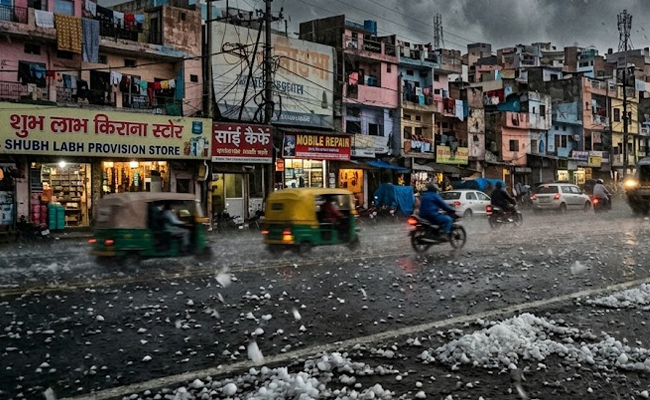
Dehradun (PTI): Heavy rain and hailstorms accompanied by strong winds lashed several districts of Uttarakhand on Sunday morning, prompting the state administration to put all district authorities on high alert.
The sudden change in weather caused uprooted trees to block roads and disrupted power supply at various locations.
Disaster Management and Rehabilitation Secretary Vinod Kumar Suman chaired a review meeting with district officials to assess the situation.
The India Meteorological Department (IMD) has forecast light to moderate rain and thunderstorms at most places across all districts for Monday and Tuesday. Snowfall is expected in regions situated at altitudes of 4,000 metres and above.
An 'orange alert' remains in place for Dehradun, Haridwar, Tehri, Pauri, Nainital, Champawat, and Udham Singh Nagar. These districts are likely to witness isolated heavy rain, hailstorms, and intense to very intense spells of rain accompanied by gusty winds reaching speeds of 40-50 kmph, the IMD said.
The weather office predicted that maximum temperatures across the state are likely to fall by 3-5 degrees Celsius over the next three to four days. During the past 24 hours, maximum temperatures remained "markedly below normal" in the plains and ranged from "markedly" to "appreciably" below normal in the hilly regions.
Dehradun experienced dark, overcast skies early Sunday, creating night-like conditions during morning hours. The city recorded a maximum temperature of 34.7 degrees Celsius, 5.3 degrees Celsius below the seasonal average.
For the state capital, the forecast predicts a partly to generally cloudy sky with a high of 31 degrees Celsius and a low of 19 degrees Celsius.
Significant rainfall was recorded across the state after 8.30 am on Sunday, with Jollygrant receiving 21.6 mm and Mohakampur recording 19.8 mm. Other areas, including Mukteshwar (15.0 mm), Mussoorie (13.4 mm), and Pithoragarh (8.5 mm), also saw measurable precipitation.
Secretary Suman directed officials to clear blocked roads on priority to ensure public convenience. Specific instructions were issued regarding the Char Dham Yatra, ordering that helicopter services must operate strictly according to weather conditions to ensure pilgrims' safety.
Isolated places in the remaining hilly districts are also expected to experience thunderstorms with lightning and intense rain spells.