AI plane crash: Govt says data extraction from black boxes underway; being analysed at AAIB Lab
_vb_14_vb_77.jpeg)
New Delhi (PTI): The government on Thursday said data is being extracted from black boxes, and analysis of cockpit voice recorder and flight data recorder is underway to reconstruct the sequence of events that led to the fatal crash of the Air India plane in Ahmedabad on June 12.
Providing a detailed update a fortnight after the fatal accident that killed 270 people, the civil aviation ministry said the Aircraft Accident Investigation Bureau (AAIB) promptly initiated an investigation and constituted a multi-disciplinary team headed by the AAIB chief on June 13 in line with prescribed norms.
The team includes an aviation medicine specialist, an Air Traffic Control (ATC) officer, and representatives from the US National Transportation Safety Board (NTSB), it said in a statement.
The ministry's statement came on a day when Opposition Congress on Thursday attacked the government over the lead investigator reportedly not being appointed till now for the probe into the Ahmedabad plane crash, saying the delay is "inexplicable and inexcusable".
Air India's Boeing 787-8 aircraft operating flight AI 171 en-route to London Gatwick crashed into a medical hostel complex soon after take-off from Ahmedabad on June 12, killing 270 people, including 241 people who were onboard the plane.
"On the evening of June 24, the team led by AAIB DG with technical members from AAIB and NTSB began the data extraction process. The Crash Protection Module (CPM) from the front black box was safely retrieved, and on June 25, 2025, the memory module was successfully accessed and its data downloaded at the AAIB Lab," the ministry said.
The AAIB Lab was inaugurated in the national capital in April this year.
"The analysis of CVR (Cockpit Voice Recorder) and FDR (Flight Data Recorder) data is underway. These efforts aim to reconstruct the sequence of events leading to the accident and identify contributing factors to enhance aviation safety and prevent future occurrences," the ministry noted.
Boeing 787 aircraft has two black boxes, each having a CVR and an FDR.
The ministry also emphasised that all actions have been taken in full compliance with domestic laws and international obligations in a time-bound manner.
Both the CVRs and FDRs were recovered within a week after the accident. One was retrieved from a rooftop of the building at the crash site on June 13, and the other from the debris on June 16.
"Standard Operating Procedures were issued for their secure handling, storage, and transportation. The devices were kept under 24x7 police protection and CCTV surveillance in Ahmedabad.
"Subsequently, the black boxes were brought from Ahmedabad to Delhi by IAF aircraft with full security on June 24, 2025. The front black box arrived at AAIB Lab, Delhi, with the DG, AAIB at 1400 hrs on June 24, 2025. The rear black box was brought by a second AAIB team and reached AAIB Lab, Delhi at 1715 hrs on June 24, 2025," the ministry said.
Regarding the probe, the ministry said the multi-disciplinary team has been constituted as per the international protocol.
The team includes "an aviation medicine specialist, an ATC officer, and representatives from National Transportation Safety Board (NTSB), which is a government investigative agency from the state of manufacture and design, (USA), as required for such investigations," the statement said.
GVG Yugandhar is the DG of AAIB.
India, as a signatory to the ICAO Chicago Convention (1944), investigates aircraft accidents in accordance with ICAO (International Civil Aviation Organization) Annex 13 and the Aircraft (Investigation of Accidents and Incidents) Rules, 2017, the ministry said.
Meanwhile, a high-level multi-disciplinary committee, headed by the Union Home Secretary, is examining the causes that led to the Air India plane crash in Ahmedabad, and also suggest comprehensive guidelines to prevent such incidents in the future.
Let the Truth be known. If you read VB and like VB, please be a VB Supporter and Help us deliver the Truth to one and all.
India should create strategic buffers to navigate 'most difficult' energy shock: CEA Nageswaran
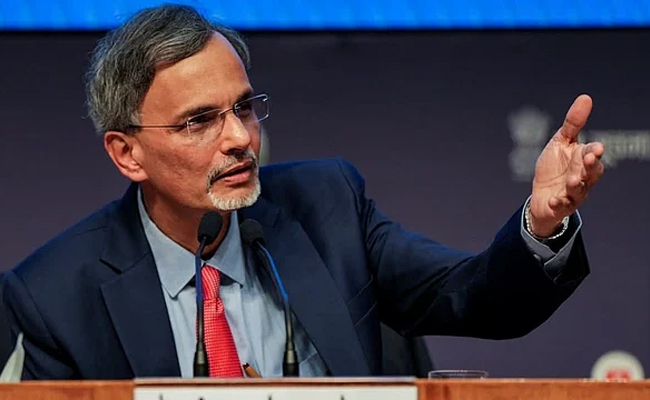
New Delhi (PTI): Chief Economic Advisor V Anantha Nageswaran on Saturday said India needs to create strategic buffers in the face of the "most difficult" energy shock that the country is facing amid the West Asia crisis.
Nageswaran also said the rising prices of fertiliser and petroleum products globally due to the crisis will make it challenging to achieve the 4.3 per cent fiscal deficit target for the current fiscal, while below normal monsoon and pass-through of higher energy prices could lead to "potential inflation spike".
He also said India has employment challenge emanating from AI, and there is a need to ensure that IT sector becomes more competitive and not lose jobs to AI, and instead create jobs that use AI within the IT sector or in other services.
Speaking at the ICPP Growth Conference organised by the Ashoka University, Nageswaran said the current account deficit (CAD) in the current fiscal could rise to over 2 per cent of GDP, from less than 1 per cent in FY'26.
"The ... priority for us is to create strategic buffers. This energy shock is the most difficult one compared to any other previous energy shock in terms of energy lost as a percentage of total global energy supply, not just oil, including gas.
"And we also need to use this occasion to think about other areas where we are vulnerable in terms of import dependence, nickel, tin, and copper. We need to build strategic buffers if we have to make a shot at manufacturing and becoming indispensable," Nageswaran said.
Since the beginning of the war in West Asia on February 28, crude oil prices soared to a four-year high of USD 126 per barrel on Thursday, from about USD 73 level before the war.
Stating that geopolitics will compel policymakers to be nimble and flexible and shed old model of thinking, Nageswaran said India is better prepared than many other countries to deal with the crisis because of the fiscal leeway that the country has due to lowering of fiscal deficit ratio to 4.4 per cent of GDP in FY'26.
Nageswaran said the West Asia conflict is more of a price shock than supply shock for India as the government is managing the supply side deftly.
"This particular conflict, which is going to be on a low simmer or a high flame situation, whatever it is, it is going to be there with us in some form or the other because the military conflict may be over, but the strategic conflict is well and truly alive. It will be so for some time," Nageswaran said.
He said the conflict has four channels of shock: price and supply shock, trade impact, sticky logistics costs and remittance shock.
India imports 60 per cent of its LPG usage and of that, 90 per cent flows through the now closed Strait of Hormuz.
Nageswaran said the pass-through of high global energy prices would have to be a "balancing act". He said some pass-through is already happening in commercial LPG, and the levy of export duty on diesel and ATF.
The government has cut excise duty on petrol and diesel to shield customers from the impact of the rise in petroleum prices. "We are coming around to arriving at a certain modus vivendi with respect to burden-sharing between the fiscal policy side, inflation, households and the oil marketing companies. So it has to be a balancing act," Nageswaran said.