AI ushers in hyper progress, can help emerging economies leapfrog: Google CEO Pichai
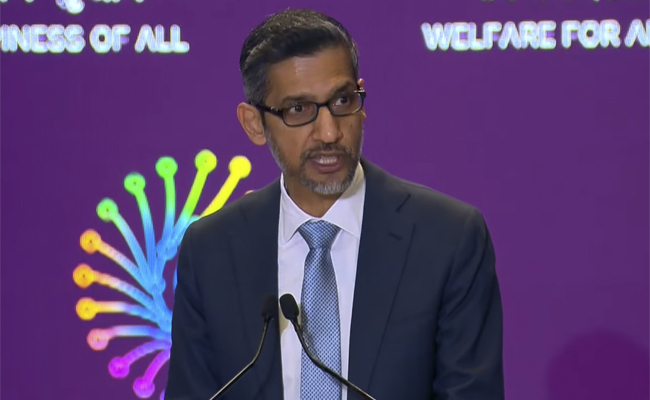
New Delhi (PTI): Google CEO Sundar Pichai on Thursday described artificial intelligence (AI) as ushering in an era of "hyper progress", with the potential to unlock new scientific discoveries and help emerging economies bypass traditional development stages.
Pichai said no technology has made him "dream bigger" than AI, highlighting its transformative potential across science, education, and economic growth.
Google will build four new subsea fibre optic cable systems between India and the United States, positioning the project as a cornerstone of broader AI and digital infrastructure expansion, he said.
Speaking at the AI Impact Summit, Google and Alphabet CEO outlined an ambitious vision for AI, calling it "the biggest platform shift of our lifetimes" and urging governments, companies and institutions to pursue the technology boldly and responsibly.
"It is the biggest platform shift of our lifetimes, we are on the cusp of hyper progress and new discoveries that can help emerging economies leapfrog legacy gaps. But that outcome is neither guaranteed nor automatic. To build AI that is truly helpful for everyone. We must pursue it boldly, approach it responsibly and work through this defining moment together," he said.
ALSO READ: UP: Girl raped by two youths, juvenile at Banda hotel, all accused held
Pichai said Google is establishing a full-stack AI hub in Visakhapatnam in Andhra Pradesh as part of its previously announced USD 15 billion infrastructure investment in India. The facility will house gigawatt-scale compute capacity and a new international subsea cable gateway, aimed at expanding jobs and AI access across the country.
"Technology brings incredible benefits, but we must ensure everyone has access to them. We cannot allow the digital divide to become an AI divide. That means investing in compute infrastructure and connectivity," he said, citing the Vizag investment as well as those in countries like Thailand and Malaysia.
"We're also building a vast network of subsea fiber optic cables, including four new systems between the US and India, as part of our America-India connect initiative," he said.
Pichai said AI will undeniably reshape the workforce, automating some roles, evolving others and creating entirely new careers. 20 years ago, the concept of a professional YouTube creator didn't exist and today there are millions around the world.
"It (AI) is the biggest platform shift of our lifetimes, we are on the cusp of hyper progress and new discoveries that can help emerging economies," he said.
He highlighted AI breakthroughs such as AlphaFold by Google DeepMind, which he said compressed decades of protein-structure research into a publicly available database used by millions of researchers worldwide.
For five decades, predicting protein structures was a grand challenge and a blind spot that stalled drug discovery. AlphaGo programme revealed millions of intricate 3D protein structures, helping scientists understand how life's molecules interact.
This breakthrough, he said, didn't just win a Nobel Prize but it also compressed decades of research into a database that is now open to the world today.
Over 3 million researchers in more than 190 countries are using it to develop malaria vaccines, fight antibiotic resistance and much more.
Pichai said AI is being deployed across healthcare, agriculture and language inclusion initiatives, citing partnerships in El Salvador to expand access to AI-powered medical diagnosis and in India, where AI-driven monsoon forecasts were delivered to millions of farmers.
"We cannot allow the digital divide to become an AI divide," he said, stressing the importance of expanding compute infrastructure and connectivity globally.
On the economic impact, Pichai said, "AI will undeniably reshape the workforce, automating some roles, evolving others and creating entirely new careers." He added that Google has trained 100 million people in digital skills and launched a Google AI Professional Certificate to help workers adapt to AI-driven changes.
Emphasising trust and governance, he said governments must act both as regulators and innovators to ensure AI benefits society at scale, while companies must build products that enhance knowledge, creativity and productivity.
"We have the opportunity to improve lives at a once-in-a-generation scale. I know we have the capability to do this. And looking at the leaders here today, I believe we also have the bill now. We must do the work together," Pichai said.
Pichai said AI can improve billions of lives and solve some of the hardest problems in science.
Let the Truth be known. If you read VB and like VB, please be a VB Supporter and Help us deliver the Truth to one and all.
Karnataka: Ex-Lokayukta Santosh Hegde collapses at event, hospitalised; condition stable

Bengaluru (PTI): Former Karnataka Lokayukta justice N Santosh Hegde collapsed during a public event in the city on Friday and was admitted to a private hospital.
The 85-year-old former Supreme Court judge fell ill at a felicitation programme for former minister P G R Sindhia, organised by the Bharat Scouts and Guides at Kondajji Basappa Auditorium.
“While delivering his speech, he appeared fatigued. After speaking for a while, he sat down, felt dizzy, vomited, and collapsed. Those present gave him water, but there was no improvement,” said Dr Ramesh Babu, who provided initial treatment at the venue.
Hegde was later rushed to a private hospital in the official vehicle of Legislative Assembly Speaker U T Khader.
Khader said, “He was given first aid and taken to the hospital in my vehicle.”
Doctors said Hegde, who is diabetic, may have suffered a sudden drop in blood sugar levels.
He is undergoing treatment at Manipal Hospital and is recovering.
In a bulletin, the hospital said, “Justice N Santosh Hegde is under medical supervision in the emergency room at Manipal Hospital, Millers Road, and is doing fine. He is likely to be discharged shortly.”