AIADMK says Hindi imposition unacceptable, A R Rahman's tweet triggers debate
Chennai, Apr 9: The main opposition in Tamil Nadu, AIADMK on Saturday said people may learn Hindi on their own volition but imposition of the language is unacceptable.
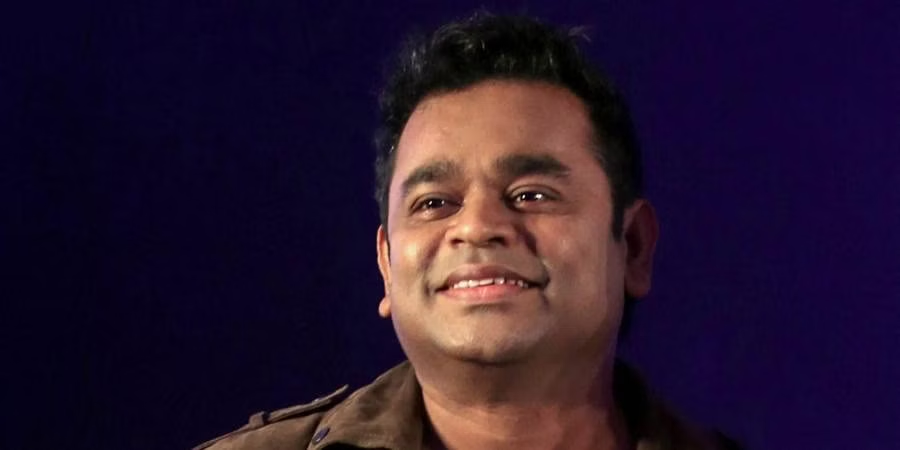
An image posted by Oscar winning music composer A R Rahman on Tamil language has meanwhile led to an animated debate in the social media on languages.
Quoting Dravidian icon, the late C N Annadurai, AIADMK top leader O Panneerselvam said if needed, people willing to learn Hindi may do so voluntarily. However, foisting Hindi on people is never acceptable, the AIADMK coordinator tweeted.
The former Chief Minister said his party stood firm in the two language policy of Tamil and English in keeping with the ideology of Annadurai. "#StopHindiImposition," Panneerselvam said.
Meanwhile, several twitter users linked Rahman's post apparently to Union Home Minister Amit Shah's remark on Hindi and subsequent reactions from several quarters.
Reacting to Amit Shah's statement on April 7 that Hindi should be accepted as an alternative to English and not to local languages, Chief Minister M K Stalin had said that it would wreck the nation's integrity.
The Rahman posted image's caption 'Tamizhanangu' is obviously a pointer to invocation song to mother Tamil.
A line, appearing as a footnote to the image, is from a popular poem of celebrated Tamil nationalist poet Barathidasan and it denotes that Tamil language serves as the root to the rights of the Tamil people.
An artistic depiction of a white saree clad woman in the centre, against a background of red is seen as a subtle reference to mother Tamil and opposition to imposition of Hindi.
While a section of social media users lauded Rahman saying he has posted this image with a red background to denote opposition to Hindi and full support to Tamil, there were others who questioned him on the intent behind posting the image.
A user, replying to the top notch musician alleged that Rahman built his career, earned money and fame and everything by doing Hindi movies and now started targeting Hindi.
On Thursday, Presiding over the 37th meeting of the Parliamentary Official Language Committee in Delhi, Shah had said Prime Minister Narendra Modi decided that the medium of running the government is in the official language and this would definitely increase the importance of Hindi.
— A.R.Rahman (@arrahman) April 8, 2022
Let the Truth be known. If you read VB and like VB, please be a VB Supporter and Help us deliver the Truth to one and all.
Health minister Wes Streeting's resignation piles pressure on UK PM Starmer
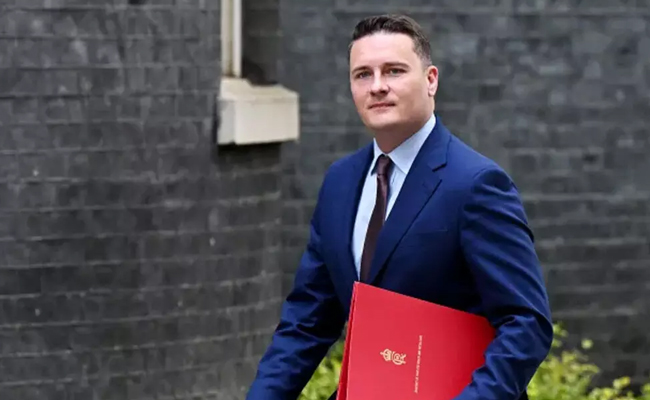
London (PTI): UK Health Secretary Wes Streeting resigned from the Cabinet on Thursday, declaring that he had lost confidence in the leadership of Prime Minister Keir Starmer.
As a frontrunner to replace Starmer at 10 Downing Street, Streeting is expected to launch his bid to be elected Labour leader if he can secure the backing of the party's requisite 81 members of Parliament.
It piles further pressure on Starmer, who has been attempting to quell an internal rebellion over the devastating results for the governing party in last week’s local elections.
“It is now clear that you will not lead the Labour Party into the next general election and that Labour MPs and Labour unions want the debate about what comes next to be a battle of ideas, not of personalities or petty factionalism," Streeting said in his resignation letter addressed to Starmer.
“It needs to be broad, and it needs to be the best possible field of candidates. I support that approach and I hope you will facilitate it,” he said.
The former minister accused his boss of lacking any vision and overseeing a power “vacuum” and also went on to highlight his own record of leading the Department for Health and Social Care and state-funded National Health Service (NHS).
Streeting added: “The National Health Service is the embodiment of all that is best about Britain and our values. Thanks to our Labour government, it is on the road to recovery: lots done, but so much more to do.
“These are all good reasons for me to remain in post, but as you know from our conversation earlier this week, having lost confidence in your leadership, I have concluded that it would be dishonourable and unprincipled to do so.”
His words are being interpreted as paving the way for a Labour leadership contest, with former deputy prime minister Angela Rayner, Mayor of Greater Manchester Andy Burnham and Energy Secretary Ed Miliband among his other expected rivals.
While some indications are that this process may not be triggered any time soon, Starmer's future as Labour leader is looking extremely tenuous if the party’s National Executive Committee (NEC) gets involved in a formal election process.
Meanwhile, Rayner issued a statement earlier to confirm that she had been cleared by the UK tax authorities of any wrongdoing over her financial affairs that had forced her to step down from the Cabinet last year.
"I took reasonable care and acted in good faith, based on the expert advice I received, and HMRC [His Majesty’s Revenue and Customs] has accepted this," she said.
This is seen as her declaring her intention to be ready to join the fray, should a Labour leadership election be launched.
The latest turmoil at the top of the British government comes after a series of junior ministerial resignations, with Starmer staying the course by announcing their replacements. Earlier his ally, Chancellor Rachel Reeves, cautioned her colleagues to refrain from plunging the country into chaos and putting the UK’s economic recovery at risk.
“We shouldn’t put that at risk by plunging the country into chaos at a time when there is conflict in the world, but also at a time when our plan to grow the economy is starting to bear fruit," she said.
However, the deep divisions within the Labour Party ranks are only expected to escalate further in the coming days and weeks.