AIIMS nurses call off strike
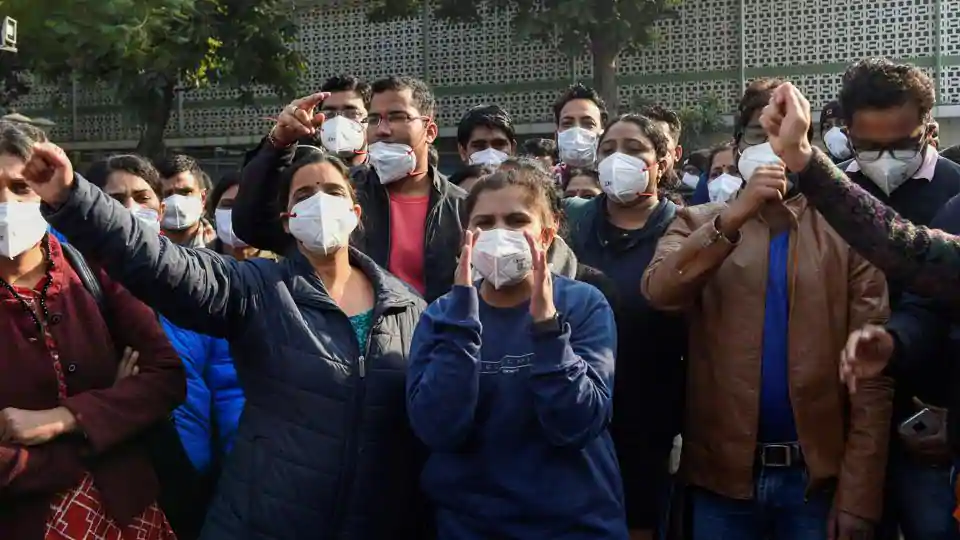
New Delhi, Dec 15: The Nurses Union of Delhi AIIMS called off their strike on Tuesday night after a meeting with the hospital administration, hours after the Delhi High Court restrained it from continuing its agitation.
On Monday, around 5,000 nurses of the All India Institute of Medical Sciences (AIIMS) here went on a strike over their long pending demands, including those with regard to the Sixth Central Pay Commission (CPC).
"They (nurses) have called off their strike and have joined their duties," AIIMS Director Dr Randeep Guleria told PTI.
The hospital administration, along with health ministry officials, held a meeting during which the union was assured that all "local issues" would be addressed immediately, while those pertaining to the ministry will be dealt separately as early as possible, sources privy to the development said.
Following the around two-hour meeting, the nurses' union called off its strike, they said.
The union's demands included correction of an anomaly in the fixation of the initial pay as per the sixth CPC, redressal of issues such as abolishment of gender-based reservation in the recruiting process of nursing officers and contractual appointments, enhancement of hospital accommodation and cadre restructuring.
Earlier in the day, the Delhi High Court restrained the nurses union from continuing with its indefinite strike.
Justice Navin Chawla passed the order on a plea moved by AIIMS against the strike by the nurses.
The court restrained the nurses from going on strike till further orders after AIIMS said it was considering the grievances of the union.
It also issued notice to the nurses union and listed the matter for hearing in January 2021.
AIIMS told the court that in view of the prevailing COVID-19 pandemic if the strike continued the hospital would come to a stand still which would be not in public interest as it is a COVID-19 facility as well.
After nurses went on strike, patient care services at the emergency, outpatient departments and operation theatres were curtailed and several patients were forwarded to other hospitals with only resident doctors and faculty members and senior nursing officers managing the rest of the operations on Tuesday.
The health ministry on Monday had issued an order stating that non-compliance of the "code of conduct", laid down as per a 2002 Delhi High Court judgment, whereby no AIIMS employee or staff or faculty member will cease work for any reason, will be treated as an offence under the Disaster Management Act.
In a video message on Monday, Guleria had termed the strike as "inappropriate and unfortunate" in the time of the COVID-19 pandemic and appealed to nurses to call off their agitation and return to work.
Let the Truth be known. If you read VB and like VB, please be a VB Supporter and Help us deliver the Truth to one and all.
Indian startup's 'Drishti' satellite launched aboard SpaceX rocket
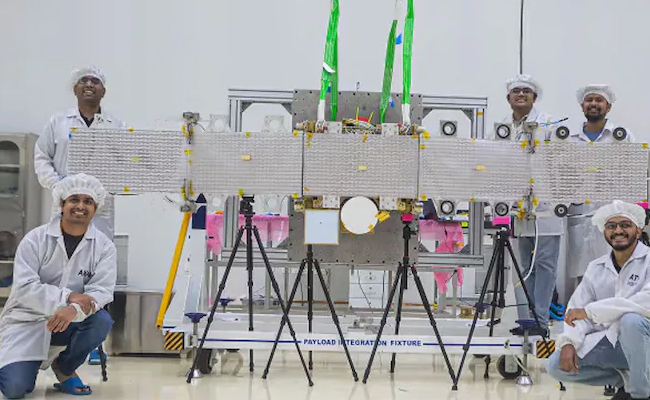
New Delhi (PTI): Bengaluru-based space start-up GalaxEye's Mission Drishti satellite was launched on Sunday aboard SpaceX's Falcon 9 rocket from California.
Mission Drishti is the world's first OptoSAR satellite, integrating electro-optical (EO) and synthetic aperture radar (SAR) sensors into a single operational platform, according to the company.
While EO sensors capture high-resolution images during sunlight and clear skies, SAR sensors provide all-weather and all-time images, using radar pulses.
In a statement, Suyash Singh, founder and CEO of GalaxEye, said, "With the satellite (Mission Drishti) now successfully in orbit, our immediate focus is on completing its commissioning. As we move through this phase, we are already witnessing strong global interest in the differentiated datasets enabled by our OptoSAR payload."
The satellite will help address long-standing limitations of conventional systems and enable more reliable and consistent data acquisition across diverse environmental conditions, the company said.
As a dual-use Earth observation satellite, the mission will support use cases across defence, agriculture, disaster management, maritime monitoring, and infrastructure planning.
The satellite is also expected to complement India's broader initiatives, including the 29 active Earth Observation satellites outlined in ISRO's recent annual report.
The launch came after five years of indigenous research and development, and extensive environmental testing and performance validation of the Mission Drishti.
In a statement, Lt Gen AK Bhatt (Retd), director general of Indian Space Association (ISpA), said, "GalaxEye has achieved what only a few global players have, which is seamlessly combining optical and SAR capabilities on a single platform to enable persistent, all-weather intelligence."
What stands out is not just the technology, but its broader impact on how downstream applications will increasingly define value in the space economy, particularly in Earth observation, where timely, decision-grade insights are critical," he added.
ISpA is the premier industry association of space and satellite companies in the country.
Union Minister Jitendra Singh also took note of the Mission Drishti launch, saying the development marked a significant milestone in India's space journey.
In a post on X, the minister said, "The successful launch of the world's first OptoSAR satellite, and the largest privately-built satellite in the country, reflects the immense potential of our young innovators driving nation-building."
GalaxEye aims to scale up Mission Drishti to a constellation of 10 satellites by 2030, developing a robust and sovereign Earth observation infrastructure for India.