AIMPLB delegation meets Rijiju, seeks extension for uploading Waqf properties on UMEED portal

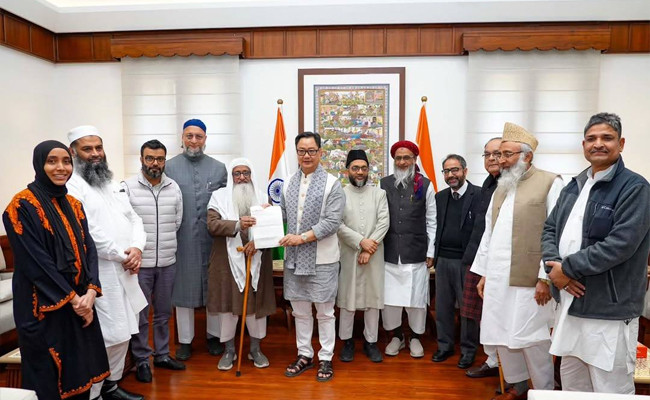
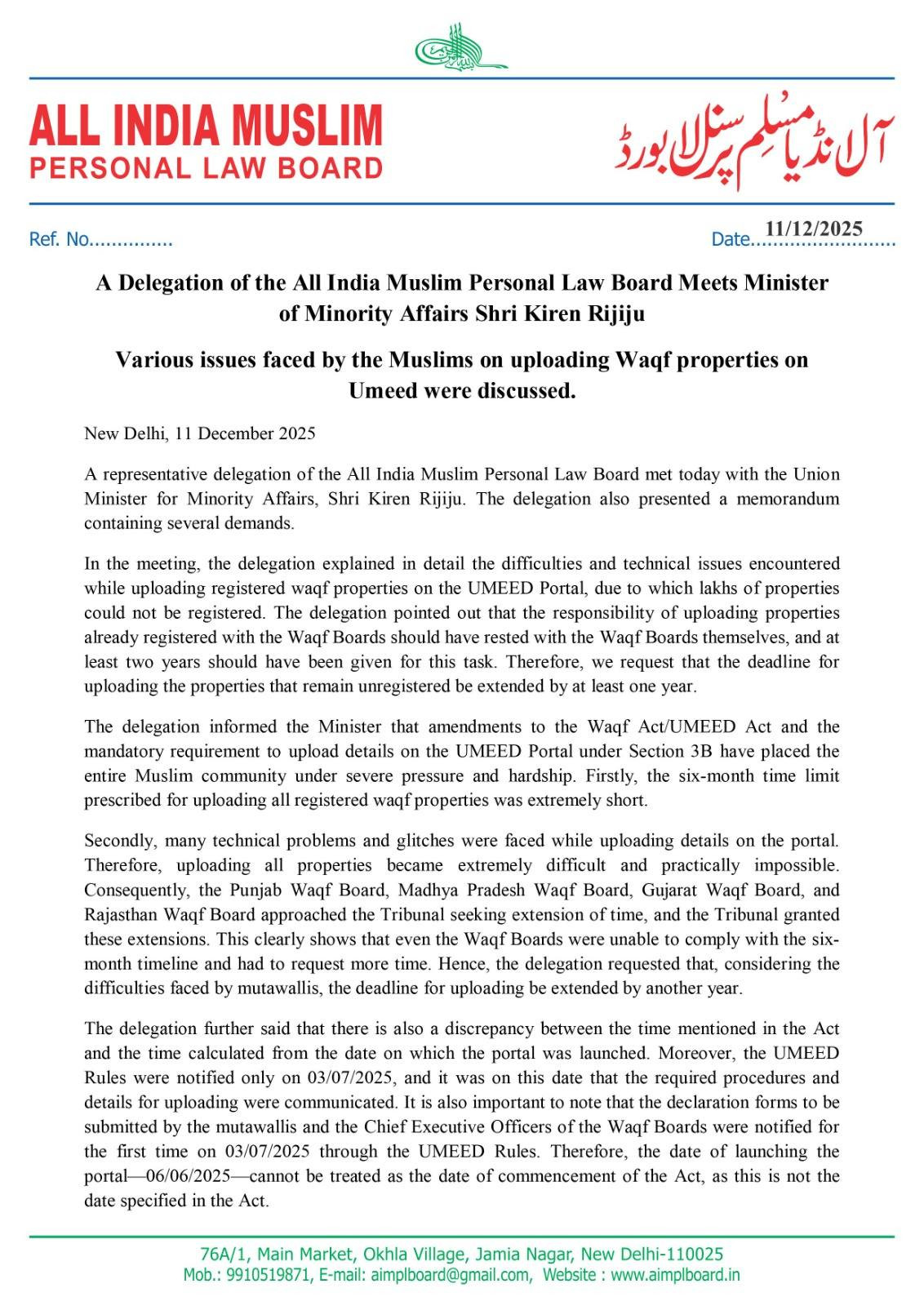
New Delhi: A delegation of the All India Muslim Personal Law Board (AIMPLB) met Union Minister for Minority Affairs Kiren Rijiju on Thursday to discuss the difficulties faced by mutawallis and Waqf Boards in uploading property details on the UMEED portal. The delegation also submitted a memorandum outlining several demands.
According to the Board, lakhs of registered waqf properties could not be uploaded due to severe technical issues and the short deadline prescribed under Section 3B of the amended Waqf/UMEED Act. The representatives argued that the responsibility for uploading already-registered properties should have been assigned to the Waqf Boards, and sought at least a one-year extension for uploading unregistered properties.
The delegation highlighted that the six-month timeline mandated under the Act has caused widespread hardship, as both mutawallis and State Waqf Boards struggled with glitches and procedural delays. They noted that even the Punjab, Madhya Pradesh, Gujarat, and Rajasthan Waqf Boards approached the Tribunal seeking additional time, extensions that were subsequently granted, indicating that compliance within six months was not feasible.
The AIMPLB also pointed out a key discrepancy: although the UMEED portal was launched on 6 June 2025, the UMEED Rules and declaration forms required for uploading were notified only on 3 July 2025. Therefore, the Board argued, the portal’s launch date cannot be treated as the commencement date for calculating compliance timelines.
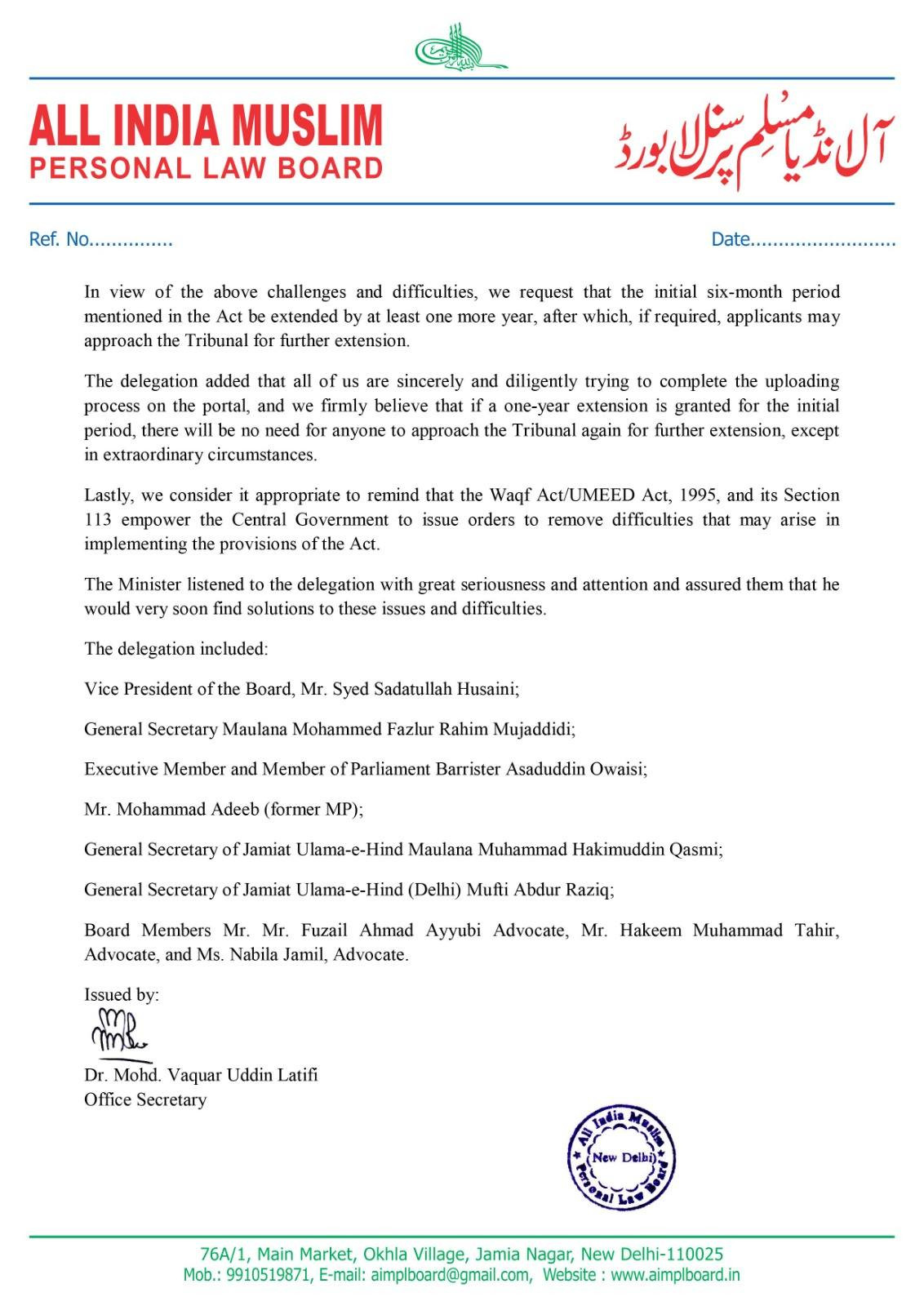
Given these challenges, the delegation urged the government to extend the initial six-month deadline by at least one more year. They expressed confidence that such an extension would prevent repeated approaches to the Tribunal except in exceptional circumstances. The Board further reminded the Minister that Section 113 of the Waqf Act empowers the Centre to issue orders to resolve difficulties arising during implementation.
Minister Rijiju heard the delegation’s concerns “with seriousness and attention” and assured them that the issues would be addressed soon.
The delegation comprised AIMPLB Vice President Syed Sadatullah Husaini; General Secretary Maulana Mohammed Fazlur Rahim Mujaddidi; Executive Member and MP Barrister Asaduddin Owaisi; former MP Mohammad Adeeb; Jamiat Ulama-e-Hind leaders Maulana Muhammad Hakimuddin Qasmi and Mufti Abdur Raziq; and Board members Fuzail Ahmad Ayyubi, Hakeem Muhammad Tahir, and Nabila Jamil.
The statement was issued by Dr. Mohd. Vaquar Uddin Latifi, Office Secretary of the AIMPLB.
Let the Truth be known. If you read VB and like VB, please be a VB Supporter and Help us deliver the Truth to one and all.
Four children drown in lake while trying to catch ducks in Chikkamagaluru

Chikkamagaluru: Four children drowned in a lake in Aralaguppe village after reportedly going to catch ducks, police said.
The deceased have been identified as Mahdia, Arunus, Nayus, and Abdul Rehman. The children were aged between 5 and 14 years. Another child, Armaan (4), escaped unhurt.
Police said the incident occurred at Karanji Lake in Aralaguppe village. Rural police visited the spot and are investigating the case. A case has been registered at the local rural police station.