Air India pilot gave Mayday call to Ahmedabad ATC before crash, says DGCA
Ahmedabad (PTI): Soon after the takeoff, the pilot of ill-fated Air India aircraft gave a Mayday call to the Ahmedabad air traffic controller.
However, thereafter no response was given by the aircraft to the calls made by ATC, aviation regulator DGCA said in a statement.
At around 2 pm, the London-bound Air India plane carrying 242 passengers and crew crashed moments after taking off from the Ahmedabad airport. Several casualties are feared.
The aircraft was under the command of Capt Sumeet Sabharwal with First Officer Clive Kundar, DGCA said. Capt Sumeet Sabharwal is a LTC with 8200 hours of experience. The co-pilot had 1100 hours of flying experience.
As per ATC, the aircraft departed from Ahmedabad at 1339 IST (0809 UTC) from Runway 23. It gave a MAYDAY Call to ATC, but thereafter no response was given by the aircraft to the calls made by ATC, according to the DGCA statement.
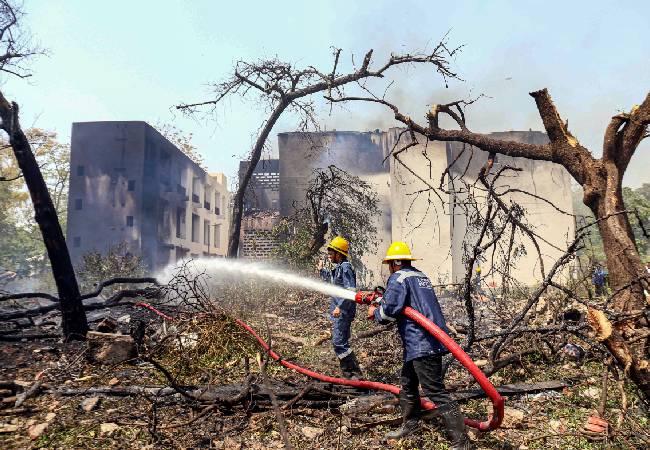
The aircraft immediately after departure from Runway 23 fell on the ground outside the airport perimeter, it said adding heavy black smoke was seen coming from the accident site. The Boeing aircraft, which could be seen losing altitude quickly, crashed in Meghaninagar area near the airport.
“On Jun 12, 2025, Air India B787 Aircraft VT-ANB while operating flight AI-171 from (Ahmedabad to Gatwick) has crashed immediately after takeoff from Ahmedabad. There were 242 persons on board the aircraft consisting of 2 pilots and 10 cabin crew,” DGCA said in the statement.
Let the Truth be known. If you read VB and like VB, please be a VB Supporter and Help us deliver the Truth to one and all.
Tribals, Scheduled Castes preserved India's identity and soul despite foreign invasions: Bhagwat
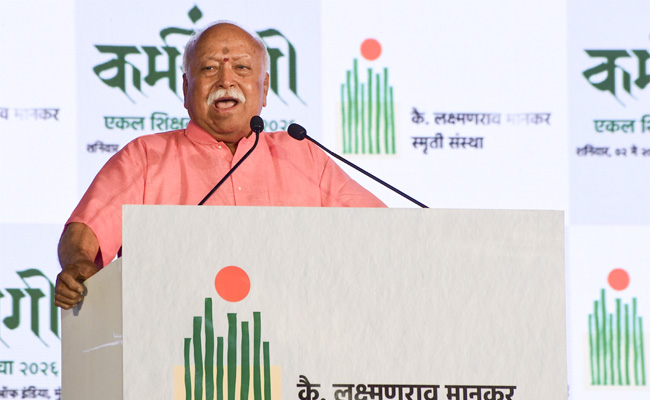
Mumbai (PTI): RSS chief Mohan Bhagwat has said that despite foreign invasions and hardships, tribal communities and Scheduled Castes preserved the country's identity and soul, stressing the need to integrate them into the mainstream development process.
He was speaking on Saturday at the Karmayogi awards ceremony in Mumbai, where Union Road Transport and Highways Minister Nitin Gadkari was also present.
"Human life is defined by giving back to the world, as we are all part of one great family. A person works and spends for the betterment of society, not as a favour, but out of duty. In serving others, we foster our own development. By helping others to thrive, we elevate ourselves and grow as human beings. This principle is the core value of this Indian land, commonly known as a Hindu society," Bhagwat said.
"This is the society's enduring ethos, which has survived for thousands of years. For various reasons, partly because of our indifference and partly because of foreign invasion, those who preserved this ethos paid a heavy price," he said.
The foreign invaders found that this ethos, this value system of the society is its soul and the key to keeping it alive. So they ensured that those who tried to preserve this soul would be uprooted and face extreme hardships, the Rashtriya Swayamsevak Sangh (RSS) chief noted.
But despite foreign invasions and hardships, tribal communities and Scheduled Castes preserved the country's identity and its soul, he said.
"Despite such adversities, the country's core identity remained intact among tribal communities and those belonging to SC and ST groups," he said, emphasising the need to integrate them into the mainstream development process while ensuring they receive equal access to services and facilities.
Referring to global developments, Bhagwat said the present world is "stumbling forward" and struggling to maintain balance, and asserted that India could emerge as a stabilising force.
The country must not only safeguard its own interests but also extend support to the world, he said.
"The world should get to see that the country is not only solving its own misery and sorrow but also helping the world to address similar issues," he said.
The RSS chief stressed that service to society is not a favour but a duty that contributes to one's own development.
Helping others grow also elevates individuals and strengthens the collective fabric of society, he said.
The so-called educated and developed sections have, over time, distanced themselves from these communities, Bhagwat pointed out, and called for the need to bridge this gap.
The identities preserved by these communities represent the true identity of Indian society, he said and underlined that without identity, existence itself is at risk.