Alka Lamba says it's time to say goodbye to AAP, asks party to accept Twitter resignation
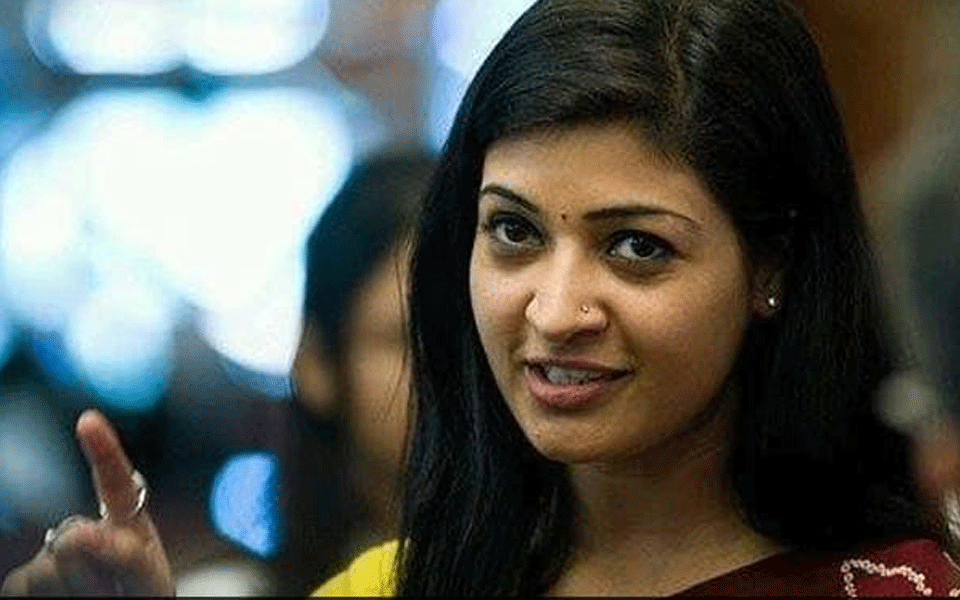
New Delhi: The time had come to say goodbye to the Aam Aadmi Party, disgruntled MLA Alka Lamba said on Friday while quitting the primary membership of the party three days after she met Congress president Sonia Gandhi.
Lamba, whose meeting with Gandhi on Tuesday fuelled speculation that she will be joining the Congress, asked the AAP leadership to accept her resignation on Twitter and said it had now become the "Khas Aadmi Party".
She took a swipe at AAP spokesperson Saurabh Bhardwaj who had said the party would accept her resignation even on Twitter.
"@ArvindKejriwal Ji, your spokespersons asked me as per your desire, with the full arrogance that the Party will accept My resignation even on the Twitter. So pls Kindly accept My resignation from the primary membership of the 'Aam Aadmi Party', which is now a 'Khas Aadmi Party'," she said on Twitter.
The past six years, she said, had been a period of great learning, Lamba said. "The time has come to say Good Bye to #AAP and to resign from the primary membership of the Party," she added.
The AAP MLA from Chandni Chowk last month announced that she had made up her mind about leaving the party and contesting the upcoming Assembly election as an Independent.
Lamba, who started her political career with the Congress, has been at odds with the AAP for a while. After the party's defeat in the Lok Sabha polls, she had sought accountability from its national convener Kejriwal. She was then removed from the official WhatsApp group of the party's lawmakers.
She had also refused to campaign for the party in the Lok Sabha polls and did not participate in Kejriwal's roadshow after she was asked to walk behind his car during the event.
Lamba first hit a rough patch when she objected to the party's decision to pass a resolution to revoke Rajiv Gandhi's Bharat Ratna. In December 2018, she said in a tweet that AAP had asked her to support the resolution, which she refused. Lamba then added that she was ready to face any punishment for her actions.
She was in the Congress for about 20 years before joining the AAP.
Let the Truth be known. If you read VB and like VB, please be a VB Supporter and Help us deliver the Truth to one and all.
Man arrested with Rs 2.54-crore heroin in Mumbai

Mumbai (PTI): Police have arrested a man and seized over 500 grams of heroin worth Rs 2.54 crore in the illicit market from him in Mumbai, officials said on Friday.
The police's Anti-Narcotics Cell (ANC) made the drug seizure in Santacruz in the western suburbs. The operation was conducted by the Kandivali unit of the ANC on Thursday as part of a special crackdown against drug trafficking in the area, they said.
Acting on specific inputs, an ANC team conducted a raid in Santacruz (East) and intercepted a man. During a search, the team recovered 508 grams of high-grade heroin from his possession, an official said.
The seized contraband, a highly addictive, opioid drug derived from morphine, is estimated to be worth Rs 2.54 crore in the international market, he informed.
Following the seizure, a case was registered against the man under relevant sections of the Narcotic Drugs and Psychotropic Substances (NDPS) Act, 1985, and he was formally placed under arrest in the early hours of Friday.
The police are currently investigating the source of the drug and trying to identify the intended recipients of the consignment, he said.