All 22 accused, including 21 cops, acquitted in controversial Sohrabuddin encounter case
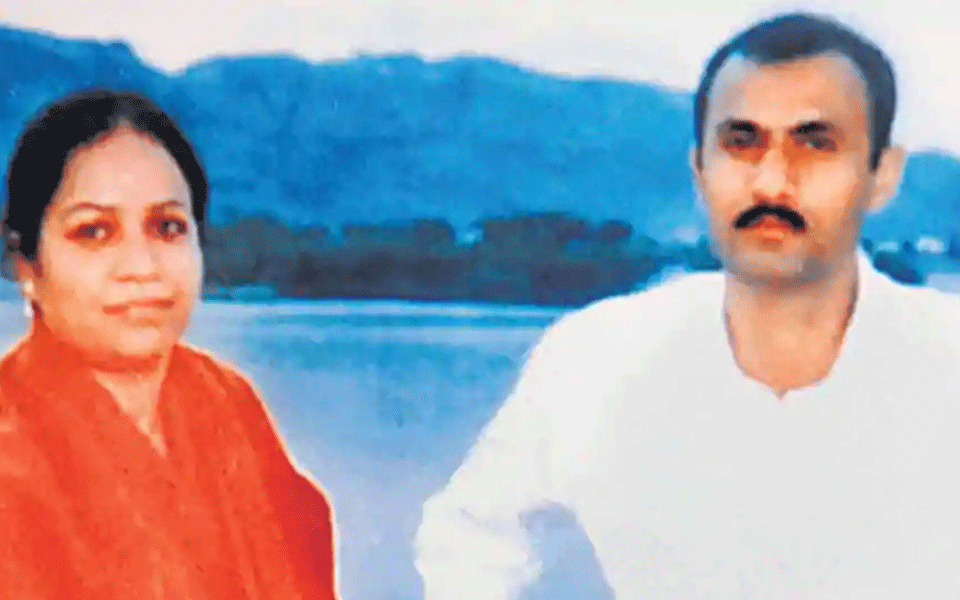
Mumbai, Dec 21: A special CBI court on Friday acquitted all 22 accused in the alleged fake encounter killings of gangster Sohrabuddin Shaikh, his wife Kausar Bi and his aide Tulsi Prajapati, citing insufficient evidence.
Special CBI Judge S J Sharma in his ruling said the court felt sorry for the families of Shaikh and Prajapati as "three lives were lost". But the system demands that the court go solely by evidence, he added.
All the accused, who were mostly police officials from Gujarat and Rajasthan, were out on bail during the year-long trial. The 13-year-old case saw several twists and turns, including 92 prosecution witnesses turning hostile. At one point, BJP president Amit Shah was also arrested in the case in July 2010 but was discharged in December 2014.
Judge Sharma said the prosecution had failed to establish a cogent case to suggest that there was any conspiracy to kill the three people, or that the accused persons had any role in it.
He said that while there was no denying that Shaikh and the others were killed, "going by the evidence on record, the court could not conclude that the present accused persons could be questioned, or, held accountable for those deaths."
The three victims were taken into custody by a police team from a bus while returning to Sangli in Maharashtra from Hyderabad on the night of November 22-23, 2005. The couple were taken in one vehicle and Prajapati in another. CBI, the prosecuting agency, said Shaikh was killed on November 26, 2005,allegedly by a joint team comprising Gujarat and Rajasthan police, and Kausar Bi three days later. Prajapati, who was lodged in an Udaipur central jail, was killed in an encounter on the Gujarat-Rajasthan border on December 27, 2006.
Of the 22 accused, 21 are junior-level police officials from Gujarat and Rajasthan, who the CBI said were part of the teams that abducted the three and later killed them in staged encounters.
The remaining accused was the owner of the farm house in Gujarat where Shaikh and Kausar Bi were illegally detained before they were killed.
"The prosecution has failed to put forth any documentary or substantive evidence to suggest or establish the conspiracy theory against the 22 accused. It has failed to establish all charges levelled against them. Hence all the accused stand acquitted," the judge said.
The court cannot rely solely on "circumstantial and hearsay evidence", he said.
Police said Sohrabuddin was linked with terror groups like Lashkar-e-Taiba and was allegedly conspiring to assassinate Prime Minister Narendra Modi, who was then the chief minister of Gujarat.
Despite sincere efforts made by the prosecution, a cogent case could not be established since the CBI lacked documentary evidence and reliable witnesses, the judge said.
"Two main prosecution witnesses turned hostile. What could the prosecution have done? It couldn't have forced them not to turn hostile," the judge said.
"Therefore, when this court ultimately went through all the evidence and testimonies on record, it concluded that no case of conspiracy could be established. Also, no link between these 22 persons and the three deaths could be established," he said.
When the CBI took over the case, it had charged 38 persons, including Amit Shah, who was then Gujarat home minister, Gulabchand Kataria, the then Rajasthan home minister, and and senior IPS officers like D G Vanzara and P C Pande. The prosecution had examined 210 witnesses, of which 92 turned hostile.
Sixteen people, including Shah, Kataria, Vanzara and Pande were earlier discharged by the CBI court due to lack of evidence against them.
The case was initially probed by the Gujarat CID before the CBI took over in 2010. The Supreme Court in 2013 directed that the trial be shifted to Mumbai from Gujarat on the central agency's request to ensure a fair trial.
The CBI had claimed that Vanzara had summoned Gujarat IPS Ashish Pandya while the latter was on leave, to be part of Prajapati's alleged encounter.
"The CBI failed to produce any substantial evidence, phone records etc to prove that Vanzara called Pandya for this specific purpose. There is nothing to conclude that Vanzara had any knowledge of the alleged conspiracy," the court said.
Shaikh's brother Rubabuddin, who was present in court Friday, said he was disappointed at the verdict and would appeal against it in the Supreme Court.
After the judge pronounced the verdict, all the accused, who were present in court, congratulated and hugged each other with relief writ large on their faces.
Let the Truth be known. If you read VB and like VB, please be a VB Supporter and Help us deliver the Truth to one and all.
Man arrested with Rs 2.54-crore heroin in Mumbai

Mumbai (PTI): Police have arrested a man and seized over 500 grams of heroin worth Rs 2.54 crore in the illicit market from him in Mumbai, officials said on Friday.
The police's Anti-Narcotics Cell (ANC) made the drug seizure in Santacruz in the western suburbs. The operation was conducted by the Kandivali unit of the ANC on Thursday as part of a special crackdown against drug trafficking in the area, they said.
Acting on specific inputs, an ANC team conducted a raid in Santacruz (East) and intercepted a man. During a search, the team recovered 508 grams of high-grade heroin from his possession, an official said.
The seized contraband, a highly addictive, opioid drug derived from morphine, is estimated to be worth Rs 2.54 crore in the international market, he informed.
Following the seizure, a case was registered against the man under relevant sections of the Narcotic Drugs and Psychotropic Substances (NDPS) Act, 1985, and he was formally placed under arrest in the early hours of Friday.
The police are currently investigating the source of the drug and trying to identify the intended recipients of the consignment, he said.