'All services rendered by Airport Authority of India taxable': SC upholds service tax demand
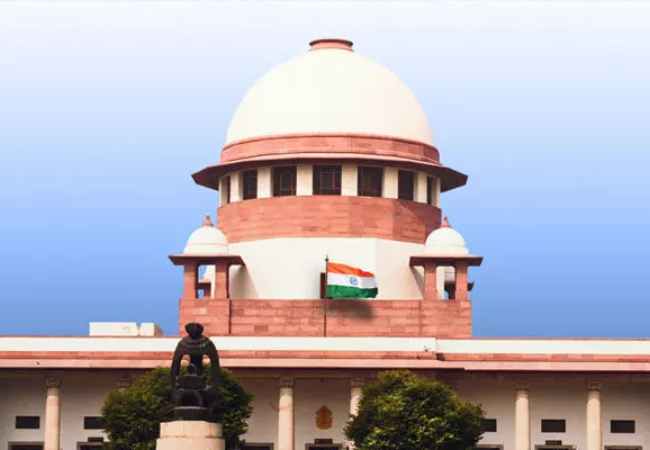
New Delhi (PTI): The Supreme Court has said all kinds of services rendered by the Airports Authority of India (AAI) in any airport are taxable and liable to service tax as it dismissed the appeal of the airport regulator against the service tax liability between 2003 and 2007.
A bench of Justices Pankaj Mithal and P B Varale upheld the March 1, 2017 order of Customs, Excise & Service Tax Appellate Tribunal (CESTAT) that approved the service tax demand from the AAI on services, including export cargo, it provides.
The AAI in discharge of its duties, handles cargo on airports including export cargo which involves a number of activities like unloading, carting, X-ray, export packing, etc.
These services are rendered from the time the cargo is accepted for shipment till it is placed on the aircraft.
The AAI contended that the service tax demand was raised for services, including handling of export cargo which was excluded under Sub section (23) of Section 65 of the Finance Act, 1994.
The bench after analysing the provisions of the law said the definition of the taxable service is very wide and takes into its fold any kind of service that may be provided to any person by the Airports Authority at any airport.
"Accordingly, all kinds of services rendered by the Airports Authority in any airport are taxable services and are chargeable to service tax under Section 66 of the Act," the bench held in a recent verdict.
"It may be pertinent to note that sub-clause (zzm) was introduced with effect from September 10, 2004. Accordingly, any kind of services whether in respect of export cargo provided by the Airports Authority to any person after inclusion of sub clause (zzm) would be taxable service," the top court said.
The bench observed that the intent of the charging Section 66 of the Act, which provides for tax on the services, refers to in sub-clauses including sub-clause (zzm).
"In short, any kind of services which are covered under any of the sub-clauses of Section 66, including (zzm) are chargeable to tax and are taxable service," the top court said, while rejecting AAI's argument that handling of export cargo does not incur service tax liability.
While upholding the decision of the CESTAT, the bench said, "CESTAT or the authorities below have not erred in taxing the services rendered by the appellant in relation to export cargo as taxable service under sub-clause (zzm) of Sub-section (105) of Section 65 of the Act with effect from September 10, 2004."
On March 17, 2010, the Commissioner (Adjudication), Service Tax at Delhi confirmed the service tax liability upon the airport regulator for the period October 1, 2003 to March 31, 2007 under the category of "Storage and Warehousing Service" up to September 9, 2004 and thereafter from September 10, 2004 under the category "Airport Services" introduced in Finance Act of 1994.
Aggrieved by the order, the AAI moved the CESTAT on the ground that the order of the Commissioner (Adjudication), Service Tax was flawed in view of the exemption from service tax on services rendered on export cargo.
Let the Truth be known. If you read VB and like VB, please be a VB Supporter and Help us deliver the Truth to one and all.
Bengal CM Mamata Banerjee holds roadshow in south Kolkata to end campaign
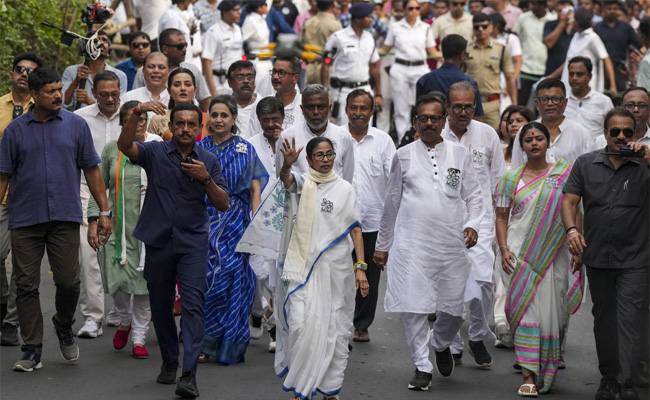
Kolkata (PTI): Chief Minister Mamata Banerjee undertook a roadshow in south Kolkata spanning over six kilometres on Monday afternoon at the fag end of campaigning for the second and final phase of the West Bengal assembly election.
The TMC chief was accompanied by party Rajya Sabha MP Sagarika Ghose and candidates Aroop Biswas and Debasish Kumar from Tollygunge and Rashbehari, respectively.
People waiting on the roadside and on rooftops and balconies waved at Banerjee as she greeted them with folded hands, walking briskly, as her party compatriots had a tough time keeping pace with her.
The chief minister is contesting from the Bhabanipur assembly seat, where she is pitted against her bete noire, Suvendu Adhikari of the BJP, who defeated her in the 2021 elections in Nandigram.
Banerjee was subsequently elected from Bhabanipur in a byelection.
The roadshow started at Sukanta Setu in the Jadavpur area and culminated at Gopalnagar crossing, past her Kalighat residence, with two small stopovers in between.
TMC flags, festoons, cutouts of Banerjee and banners with slogans in favour of the candidates adorned the roadsides through which the road show passed and culminated at around 5.30 pm.
A large number of TMC supporters participated in the roadshow that Banerjee conducted to end her campaign for the 2026 assembly election in West Bengal.