
All seven on board Ranchi-Delhi air ambulance killed in crash near Simaria in Jharkhand's Chatra: DC
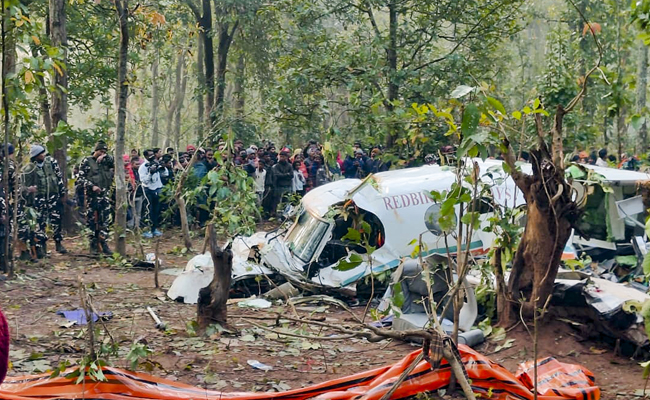
Ranchi (PTI): All seven persons on board an air ambulance were killed after the aircraft crashed near Simaria in Jharkhand’s Chatra district on Monday evening while en route to Delhi from Ranchi, a top state government official said.
The crash took place shortly after the aircraft operated by Redbird Airways Pvt Ltd took off from Ranchi airport at 7.11 pm.
"All seven on board the air ambulance were killed in the crash. The plane was on the way to Delhi from Ranchi," Chatra Deputy Commissioner Keerthishree G told PTI.
ALSO READ: J’khand: All 7 on board air ambulance killed in crash, bodies brought to hospital for post-mortem
"The aircraft went missing around 7.30 pm. It crashed at Bariatu Panchayat area in Simaria," she said, adding that the site of the crash is located deep inside a forest.
SDPO Shubham Khandelwal told PTI that the bodies of all the seven persons on board have been retrieved. They have been identified as Captain Vivek Vikas Bhagat, Captain Savrajdeep Singh, Sanjay Kumar, Dr Vikas Kumar Gupta, Sachin Kumar Mishra, Archana Devi, and Dhuru Kumar.
According to the DGCA website, Delhi-based non-scheduled operator Redbird has six aircraft in its fleet, including the one that crashed.
Anant Sinha, CEO of Devkamal Hospital in Ranchi, told PTI that the air ambulance was arranged by one of their patients.
"The patient, Sanjay Kumar (41), a resident of Chandwa in Latehar district, was brought to the hospital with 65 per cent burn injuries on February 16. He was being treated in the hospital," he said, adding that the family members decided to take him to Delhi for better treatment.
"They arranged an air ambulance on Monday. The patient left the hospital for Delhi around 4.30 pm," he said.
In a post on X, former chief minister and BJP leader Champai Soren said he was deeply saddened by the news of the crash.
"I pray for the deceased individuals, including the crew members aboard the plane from Marang Buru (the supreme tribal deity), and for strength to their families during this difficult time," he posted.
Earlier, Ranchi airport director Vinod Kumar told PTI that the plane lost contact with air traffic control around 20 minutes after takeoff.
"Inclement weather could be a reason behind the crash, but the actual cause will be ascertained only after a probe," he said.
In a statement, the DGCA said, "On 23.02.2026 Redbird Airways Pvt Ltd Beechcraft C90 aircraft VT-AJV operating medical evacuation (Air Ambulance) flight on sector Ranchi-Delhi crashed in Kasaria Panchayat of Chatra district, in Jharkhand. There were seven people on board, including two crew members."
"The aircraft was airborne from Ranchi at 19:11 IST. After establishing contact with Kolkata at 19:34 IST, aircraft lost communication and RADAR contact with Kolkata at approximately 100 NM South-East of Varanasi," it added.
The district administration's search and rescue team has already reached the location, and an Aircraft Accident Investigation Bureau (AAIB) team is being dispatched, the statement said.
Let the Truth be known. If you read VB and like VB, please be a VB Supporter and Help us deliver the Truth to one and all.
Karnataka sees drop in groundwater use, surge in recharge capacity: 2025 report
_vb_86.jpeg)
Bengaluru (PTI): Karnataka has recorded a significant decline in groundwater usage alongside a notable increase in annual recharge capacity, reflecting the impact of sustained water conservation efforts and good rainfall, Minister N S Boseraju said on Wednesday.
Releasing the 2025 Groundwater Assessment Report at Vikas Soudha, he said the gains are the result of good rainfall, focused policy interventions, and large-scale water conservation initiatives implemented over the past two years under the leadership of Chief Minister Siddaramaiah and Deputy Chief Minister D K Shivakumar.
According to the report, overall groundwater extraction has reduced from 68.44 per cent in 2024 to 66.49 per cent in 2025, indicating more responsible and sustainable usage patterns across the state.
At the same time, annual groundwater recharge capacity has increased from 18.74 billion cubic metres (BCM) in 2024 to 19.28 BCM in 2025, while annual extractable groundwater resources rose from 16.88 BCM to 17.41 BCM, the minister’s office said in a statement.
“This simultaneous reduction in usage and increase in recharge reflects our government’s commitment to long-term water sustainability,” the Minor Irrigation, Science and Technology Minister said.
The improvement has been driven largely by the expansion of water conservation structures (WCS) across the state.
Recharge through such structures increased by 29.11 per cent, from 0.81 BCM to 1.04 BCM within a year, the report stated.
Notably, the number of water conservation works has risen sharply from 3.15 lakh in 2024 to 3.94 lakh in 2025, strengthening the state’s groundwater recharge ecosystem.
The report indicates improvement in groundwater status across 11 taluks, with several regions moving to safer categories.
Highlighting these changes, the minister pointed out that Chamarajanagar taluk has improved from "over-exploited" to "critical".
Similarly, taluks including Athani, Channapatna, Molakalmuru, Ranebennur, Savanur, and Shiggaon have successfully transitioned from "semi-critical" to "safe" status.
Domestic groundwater extraction has also declined by 0.58 per cent, dropping from 1,21,731 hectare-metres (ham) in 2024 to 1,21,023 ham in 2025. Officials attribute this to increased reliance on surface water under the Jal Jeevan Mission (JJM).
Boseraju said that initiatives such as lake rejuvenation, year-round water supply through treated and surface water, sustained public awareness campaigns, and good rainfall have played a key role in reducing over-extraction and enhancing recharge.
“Instead of depending solely on the 120-day monsoon, we are ensuring water availability throughout all 365 days through scientific management. This has strengthened long-term water security for both farmers and urban residents,” he said.
Announcing a major technological step forward in future governance, the minister added, “To further safeguard our resources, we are rolling out the Digital Water Stack (DWS) initiative. Under this framework, we will soon initiate space technology and AI-based satellite surveillance to obtain real-time data for continuous groundwater monitoring.”
_vb_85.jpeg)
_vb_92.jpeg)
_vb_51.jpeg)