Allahabad HC orders scientific investigation of shivling-like structure in Gyanvapi mosque
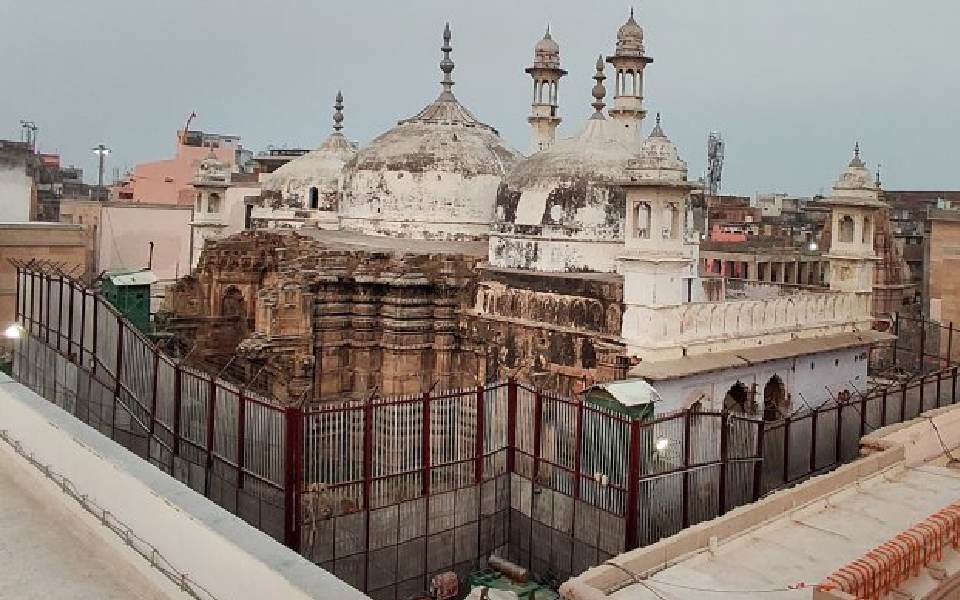
Prayagraj (UP), May 12: The Allahabad High Court on Friday ordered determination of the age of the structure claimed to be a shivling in the Gyanvapi mosque in Varanasi using modern technology.
It set aside an October 14 order of the Varanasi District Court that rejected a plea for scientific investigation, including carbon dating, of the structure found in May 2022 during a court-mandated survey of the Gyanvapi mosque located next to the Kashi Vishwanath temple.
The high court directed the Varanasi district judge to proceed, in accordance with law, on the application by the Hindu worshippers for conducting a scientific probe of the shivling', paving the way for determining the age of the structure.
The order said no harm should be done to the structure, which the Hindu petitioners claim is a shivling. However, the mosque authorities say it is part of a fountain in the 'wazu khana', where ablutions are performed before namaz.
Justice Arvind Kumar Mishra passed the order on a revision petition filed by Laxmi Devi and three others challenging the Varanasi court order.
The high court had obtained a report from various institutions, including the IITs in Kanpur and Roorkee and Birbal Sahni Institute of Lucknow, before ordering for determination of the age of the structure.
The report says direct dating of the structure is not possible and the age can be ascertained with proxy dating of materials, which can "correlate with the establishment of the lingam if there is any". "This needs a thorough study of the materials surrounding the lingam," it adds.
The report also suggests the dating of some organic materials below the surface can ascertain the age but it needs to be established that they are related to the structure.
The court considered suggestions of Prof Javed N Malik of Department of Earth Sciences, IIT Kanpur.
Prof Malik suggested that to understand the buried material and structure it would be essential to undertake a detailed subsurface survey through Ground Penetrating Radar (GRP). This will be helpful towards identifying the remains of the ancient structures buried if any at the site, he added.
The Archaeological Survey of India (ASI) in its 52-page report had given the opinion that the age of the structure can be determined through scientific method without causing any harm to the structure. Its opinion was based on studies conducted by IIT Kanpur, IIT Roorkee, Birbal Sahni Institute, Lucknow, and one more educational institute.
Advocate Vishnu Shankar Jain appearing for the revisionists argued that the district judge had "passed the impugned order without any basis" and it should have called for expert opinion from the ASI on whether carbon dating could be done without causing any harm.
Additional Advocate General MC Chaturvedi, assisted by Chief Standing Counsel Bipin Bihari Pandey, appeared for state government. He said, "If carbon dating and nature of the structure can be determined without causing any harm to the structure then the state has no objection to it so that real nature of structure could be found."
On November 4, 2022, the high court had sought the response of ASI in the matter and directed the ASI Director General to submit his opinion whether investigation of the said structure, if examined through carbon-dating, ground-penetrating radar (GPR), excavation and other methods adopted to determine its age, nature and other relevant information, is likely to damage it or a safe evaluation about its age can be done.
A suit was filed in the Varanasi District Court seeking the right to regular worship of Ma Shringar Gauri and other deities whose idols the petitioners said are located in the mosque complex.
Let the Truth be known. If you read VB and like VB, please be a VB Supporter and Help us deliver the Truth to one and all.
Woman's decomposed body found at rented flat in Bengaluru

Bengaluru (PTI): The body of a 34-year-old woman was found in a decomposed condition at her rented flat in Bengaluru, police said on Tuesday.
The deceased was identified as Pooja Dutta, a native of Dhanbad in Jharkhand, who was employed with a private company here, they said.
The incident in Adugodi came to light on Monday after neighbours alerted police about a foul smell emanating from her flat, police added.
Police said a team reached the spot, broke open the door and found Dutta's body in a nude and decomposed state, lying in a pool of blood. Preliminary suspicion is that the death may have occurred two to three days earlier, they said.
According to police, no death note was recovered from the spot, though torn papers were found scattered inside the house, prompting suspicion that she may have died by suicide after locking the door from inside.
The body has been sent for post-mortem examination to ascertain the exact cause of death. Once the autopsy report is received, it will be confirmed if it was a suicide or a murder, a senior police officer said, adding that all angles are being probed.
According to the landlady, Dutta had been living in the rented flat for the past three years and was last seen on April 23 when she went out to buy groceries.
The Adugodi police have registered a case of unnatural death, and further investigation is underway.