Alliance with BSP will help Congress in MP: Digvijaya
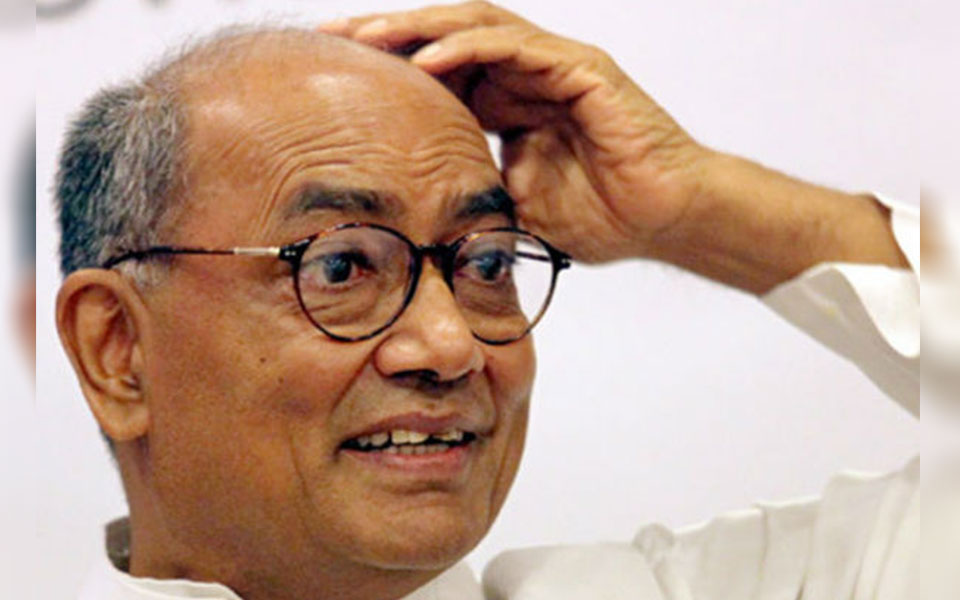
New Delhi, June 11: A pre-poll alliance with the Bahujan Samaj Party (BSP) will help the Congress in the upcoming Madhya Pradesh assembly election, senior Congress leader Digvijaya Singh has said.
In an interview to NDTV telecast on Monday, the former Chief Minister spoke in favour of alliance with the Mayawati-led party citing its strength to get Dalit votes in certain regions in the state.
"If you seek an alliance on election results in Madhya Pradesh... from Morena division to Gwalior division to Sagar division to Rewa division, there is a belt bordering Uttar Pradesh, where BSP gets 10-30,000 votes.
"If you see that these votes which are primarily from Dalits.. who have been been overwhelmingly voting for Congress from 1952 onwards... if we have a tactical alliance, a pre-poll alliance with BSP, it will certainly help," he said.
Asked whether Congress is ready to take a back seat and cede more ground to alliance partners as the 2019 general elections nears closes in, Digvijaya Singh said it depended on numbers and that each state had a different character which has to be factored in.
"It depends on numbers. Prior to 2004 elections there was no pre-poll alliance... political arithmetic works at some places but doesn't work at all places... There are number of factors which come to the fore when it comes to forming alliance.
"Every state has its strength and weakness. Therefore I think you have to go state-wise to see which are the parties with which Congress can come together," he said.
Commenting on Pranab Mukherjee's much-talked about address at RSS headquarter in Nagpur, Singh said that it was very courageous of the former President to challenge the RSS in their own "den" and that what he said was amounted to hitting at the "core ethos of the RSS".
Let the Truth be known. If you read VB and like VB, please be a VB Supporter and Help us deliver the Truth to one and all.
Right to vote under threat, must be made fundamental right: Cong's Jairam Ramesh
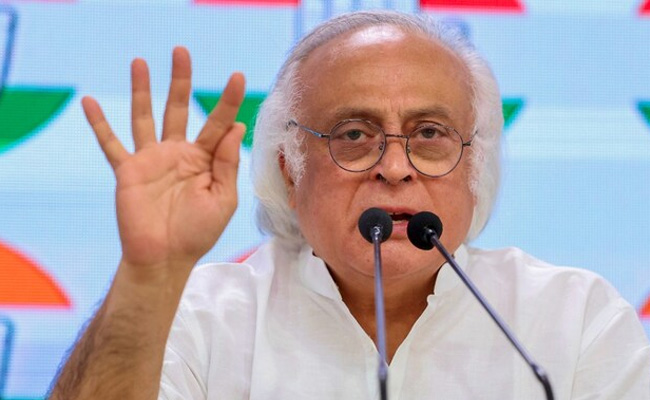
New Delhi (PTI): Congress leader Jairam Ramesh alleged on Thursday that the right to vote is under threat and the time has come when it should be made a fundamental right for citizens.
Speaking with reporters, Ramesh lashed out at Chief Election Commissioner (CEC) Gyanesh Kumar, saying the Election Commission (EC) has never been as compromised as it has been under him.
"The rot started under his predecessor. This man is a player and not a neutral observer," the Congress leader said, slamming Kumar.
Kumar is completely compromised and has become a player in elections, he alleged.
"Home Minister Amit Shah had talked about three Ds -- detect, delete and deport. So we want to know how many non-Indian citizens have been detected, how many have been deleted and how many have been deported," Ramesh said, adding that the right to vote is now under threat.
On opposition parties submitting a fresh notice in the Rajya Sabha, seeking to move a motion for the CEC's removal, the Congress leader said they will continue to make efforts for Kumar's removal as he is "compromised".
Ramesh also batted for the right to vote to be recognised as a fundamental right.
"I believe that the time has come that the right to vote should be made a fundamental right. It is a statutory right, it is not a fundamental right. Fundamental rights are justiciable," he said.
The former Union minister said this was discussed in the Constituent Assembly, but it was eventually decided that it should be made part of the Constitution.
B R Ambedkar and Jagjivan Ram had warned that in the future, governments might try to disenfranchise voters, he added.
"Once and for all, include the right to vote as a fundamental right for Indian citizens," Ramesh asserted.