
Almost every day, a Bihar kid gets rescued from the clutches of traffickers: NCRB
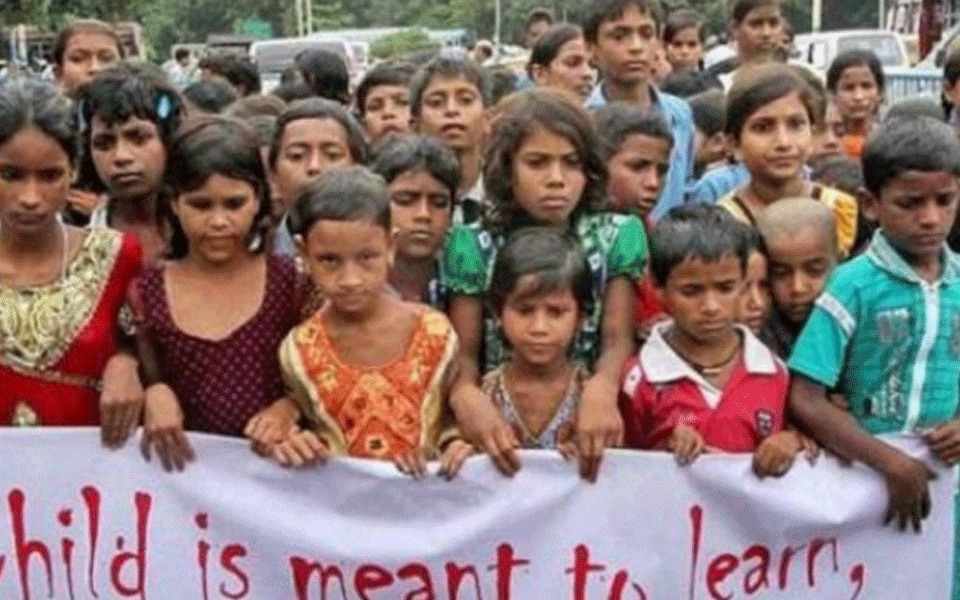
Patna: A high incidence of child trafficking has been reported from Bihar in the latest National Crime Records Bureau (NCRB) Report which puts the rate, at over one per day, among the highest in the country.
According to the NCRB figures, the state ranked third just behind Rajasthan and West Bengal in 2017 when 362 boys and 33 girls below 18 years of age were rescued from the clutches of traffickers.
Out of these 395 children, 366 were put into forced labour, the NCRB report says, adding that Rajasthan topped the list in the country with 886 cases of child trafficking during the period followed by West Bengal with 450.
The report, released in October last, also says that Bihar police registered 121 FIRs in 2017 against traffickers but could not file a single charge-sheet, thus resulting in zero conviction in trafficking cases.
The NCRB report called Crime in India presents annual statistics of various crimes recorded in the country in a given year. The report is released every year usually but this time, it has been issued almost after two years.
Asked about the number of FIRs and charge-sheets being far less than the reported cases, Additional Director General of Police (CID) Vinay Kumar said, "if a child is trafficked from Bihar to any other state, the case gets lodged in the latter. Police rescue the child from the other state and bring him or her back".
Moreover, he said the data collated in the NCRB report is based on inputs provided by the police only once during the compilation and that there was a need for "a system to feed real-time data".
"Work is on to implement online Crime and Criminal Tracking Network and Systems in the state, which would serve the purpose", he added.
Asked about measures taken to rehabilitate a rescued child, the ADGP (CID), who counts "poverty and illiteracy" as the two primary factors responsible for child trafficking, said "the state's labour and social welfare departments have come out with a slew of schemes specifically for such juveniles".
Moreover, the state also has in place a "Child Labour Tracking System" which keeps a track of a rescued child till he/she attains 18 years of age. Their rehabilitation is ensured with the help of funds from the state government while the labour department comes out with "skill development" programmes.
However, Suresh Kumar, who runs a Patna-based NGO Centre Direct rues that "poverty, involvement of huge money and weaknesses in prosecution" have contributed to child trafficking becoming a huge problem in the state.
Kumar, who claims to have been involved in rehabilitation of more than 500 children rescued from Jaipur since 2014, added "the prosecution is very weak in cases of human trafficking because cases are of inter-state nature and there is no mechanism for coordination among the states to deal with such cases and hence traffickers often get away with impunity".
Let the Truth be known. If you read VB and like VB, please be a VB Supporter and Help us deliver the Truth to one and all.
Karnataka issues nutrition advisory for govt events; recommends millets, healthier options
_vb_61.jpeg)
Bengaluru (PTI): The Karnataka government on Monday issued a nutrition advisory recommending healthier food and beverage options at meetings, functions, and other official gatherings held in the state.
The advisory has been issued by the Department of Karnataka Health and Family Welfare Services to promote healthy dietary and nutritional habits among officials and staff, noting that food, refreshments and beverages served in government offices and official programmes are "often not aligned with nutrition standards."
The advisory recommends serving snacks such as millet-based, low-fat and low-sugar foods, fresh fruits, vegetable salads, sprouts, roasted nuts and seeds during in-house office meetings and breaks.
Beverages such as green tea, low-fat buttermilk, and locally filtered or boiled water served in glass bottles or steel flasks have also been suggested.
According to the advisory, for larger government events, conferences and exhibitions, departments have been advised to include at least one millet-based item during snacks and a minimum of two millet dishes in meals, along with local cuisine and at least one regional recipe.
It also recommends the use of brown rice instead of white rice, freshly prepared vegetable salads, and fresh fruits or low-sugar fruit juices.
If non-vegetarian food is served, it should consist of well-cooked lean or white meat, the advisory stated.
In eateries operating within government office campuses, the department has recommended millet-based foods, fresh vegetable salads, boiled pulses such as horse gram or chickpeas, and low-fat beverages.
It suggests serving food using reusable metal plates and glasses.
The advisory also recommends avoiding microwave-heated food, industrially processed food, fried snacks, high-fat or heavily spiced dishes, carbonated drinks, high-sugar fruit juices, and alcoholic beverages.
It further discourages serving milk-based tea or coffee and plastic-bottled water during official events.
“Overall, hygiene and cleanliness should be maintained while serving food and water. Local cottage industries, self-help groups, prison kitchens, nutri-gardens and others should be preferred for placing food and beverage orders,” the advisory added.
_vb_54.jpeg)
_vb_07.jpeg)
_vb_34.jpeg)