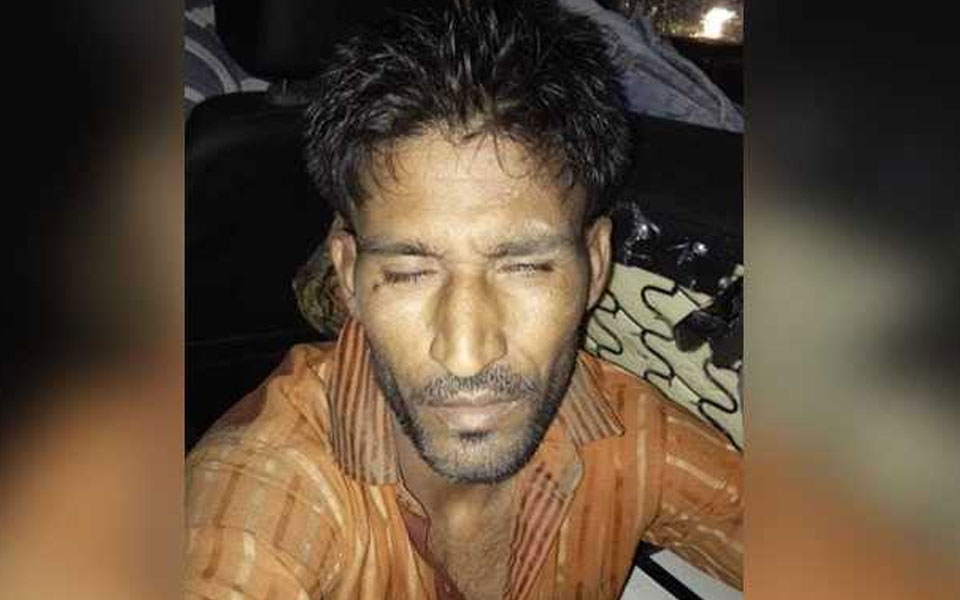
ALWAR: A photograph of Rakbar Khan -- the man who died in Rajasthan's Alwar allegedly after being beaten up by cow vigilantes -- sitting upright inside a police car has raised further questions about the role of the police in the attack. The photo has been circulated by Naval Kishore, the man who had placed a call to the police about the attack and accompanied them for most of their three-hour journey through the area before Rakbar Khan was taken to the hospital -- dead.

"We have no information yet about the victim being thrashed in custody, but yes, prima facie we have found that there was indeed an error in judgement in deciding what was important at that point," news agency ANI quoted NRK Reddy, Special Director General of Police, as saying on the role of the police a day after an NDTV investigation detected lapses on their part.

A doctor at the hospital told NDTV that the postmortem report shows he died of internal bleeding after a severe beating. Rakbar's brother said even his neck was broken. A woman witness, Maya, has told NDTV that the police were "beating the man in the vehicle and abusing him".

The photograph of Rakbar in the police car, however, proved that he was not grievously injured, contended Naval Kishore. "See I took this picture in the police vehicle. See, he looks fine," said Naval Kishore, implying that the man was fine before he was taken to the police station -- their last stop before he was taken to the hospital at 4 am.

Naval Kishore had parted company with the police after they had tea midway. As the police headed for the police station, he had taken the two cows that Rakbar Khan and his friend Aslam were accused of smuggling, to a local cow shelter.

At 4 am, Rakbar Khan was taken to a local hospital -- a journey that should have taken no more than 20 minutes after he was rescued from the mob at Alwar's Lallanwadi village around 1 am.

Action has been taken against three policemen. Assistant sub-inspector Mohan Singh was suspended and two constables were shifted to Police Lines as investigation into the matter confirmed lapses on their part.

Amid countrywide outrage over mob killings, the Centre said a group of ministers led by Home Minister Rajnath Singh would study the recommendations of a high-level panel to discuss ways to stop the attacks and then submit a report to Prime Minister Narendra Modi.

courtesy : ndtv.com


Let the Truth be known. If you read VB and like VB, please be a VB Supporter and Help us deliver the Truth to one and all.


Bengaluru (PTI): India is planning to collect samples from the Moon and bring them back to Earth under Chandrayaan-4, while Chandrayaan-5 will involve a heavier lander with a longer mission life, ISRO Chairman V Narayanan said on Wednesday.

He also spoke about ISRO's future missions including the one to study Venus and the other on Mars landing mission. 

"Now we are working on the continuation of the Chandrayaan programme. In Chandrayaan-4, we plan to collect samples and bring them back. Chandrayaan-5 will involve a heavier lander with a longer mission life," he said at the inaugural ceremony of ISRO's fourth edition of the Space Science and Technology Awareness Training (START 2026) programme here. 

He recalled that in Chandrayaan-3, the lander's mission life was only 14 days. 

"In the future mission, we are talking about a life of around 100 days. The rover will also be heavier. Chandrayaan-3 had a rover of about 25 kg, while the future mission will have a rover of about 350 kg," Narayanan said. 

Referring to ISRO's future programmes like the Venus Orbiter Mission, he said, "We have already accomplished the Mars Orbiter Mission, and now we are working on a Mars landing mission."

"These are some of the projects being discussed for government approval. So there is a lot of interest in the science area." 

He noted that under Prime Minister Narendra Modi, the vision of the space programme has been expanded and said, "We are currently working on the Gaganyaan programme and are planning to send our own astronauts into space and bring them back safely, possibly within the next two years." 

"We are also planning to build our own space station by 2035. Additionally, we are working on landing Indians on the Moon and bringing them back safely by 2040. Brainstorming activities have already begun. So there are many activities happening in the space sector. Apart from application-related activities that ensure food security, water security, communication, and safety for citizens, there are many initiatives planned in the science area as well," he added. 

Narayanan noted that India's space programme has accomplished 10 scientific missions so far, including AstroSat, which recently completed a decade in orbit and was still functioning very well.

He also highlighted India's various lunar exploration missions -- Chandrayaan-1, Chandrayaan-2, and Chandrayaan-3 -- saying they led to many scientific discoveries. 

"We are progressing in a big way," he added.

Highlighting the successful Chandrayaan-3 mission in the year 2023, the ISRO chairman said that India became the first country to successfully achieve a soft landing near the south pole of the Moon.

"Not only did we achieve the landing, but many discoveries were made. Around eight minerals were identified, seismic activity was studied, and the thermal profile of the Moon's surface was understood. Electron clouds were also studied. So many discoveries have come from that mission," he added. 

Referring to the launch of Aditya-L1, the ISRO chairman said, "India is the fourth country to successfully place a satellite to study the Sun, and a large amount of data has already come out, and we have released the data as well." 

Emphasising India's Space Vision 2047, he recalled that the country, which started with very humble beginnings, has developed significant capabilities.

"Today, we have the capability to conceive, design, and build our own launch vehicles, as well as conceive, build, and place satellites in orbit. Fifty years ago, we did not have this capability. Today, we can build satellites and the payloads required for them," Narayanan said.

Citing an example, he said that earlier optical cameras used lenses that were only about one inch in diameter. 

"But today, in ISRO, cameras with optics of about 1.7 metres in diameter and almost one foot in thickness are being developed. These optics are being built at the LEOS (Laboratory For Electro Optics Systems) laboratory in Bengaluru for space observation. Many such activities are happening in the space sector," he noted. 

He pointed out that the US, after 1969 and almost after 50-55 years, has again shown interest in landing on the Moon. 

"The Artemis programme is already a very vibrant programme, with many activities going on. An accord was signed in 2023, and India is also a signatory to that accord," he said. 

Speaking about China and Russia leading efforts to build the International Lunar Research Station (ILRS), the ISRO chairman noted, "When we talk about such space stations, one aspect is technology development. The second aspect is the large number of scientific experiments that will take place there. There is also a lot of competition today." 

"There was a time when only government organisations across the world carried out space activities. Today, companies like SpaceX have advanced significantly. In fact, they have overtaken many others in terms of launches," he added. 

He said that the main idea behind programmes like START 2026 is to encourage the next generation of youngsters to develop interest in this field and to build scientific temper so that they can become great leaders in building the nation.