Amarnath Yatra: Pilgrims leave twin base camps for shrine, second batch starts journey from Jammu
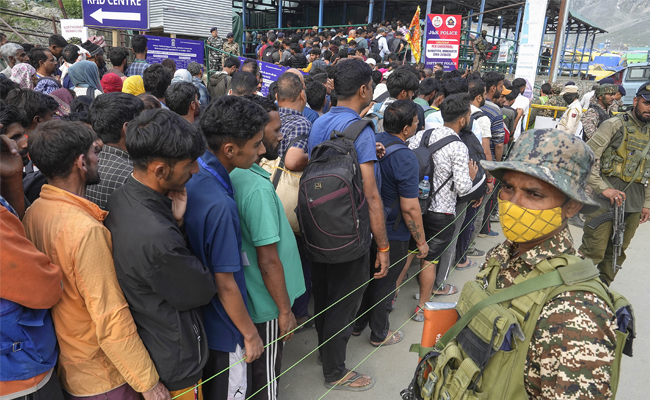
Srinagar/Jammu (PTI): The annual Amarnath Yatra began on Saturday as the first batch of pilgrims left the twin base camps in Baltal and Nunwan to start their journey to the 3,880-metre-high cave shrine in the south Kashmir Himalayas, officials said.
The yatra started early morning from the twin tracks -- the traditional 48-kilometre Nunwan-Pahalgam route in Anantnag and the 14-kilometre shorter but steeper Baltal route in Ganderbal.
The officials said the pilgrims on the twin routes were flagged off by the respective deputy commissioners along with senior police and civil administration officials.
Lt Governor Manoj Sinha had flagged off the first batch of 4,603 pilgrims from the Yatri Niwas base camp in Bhagwati Nagar in Jammu on Friday.
The pilgrims reached the Kashmir Valley in the afternoon and received a rousing welcome from the administration and locals.
They will pay obeisance at the cave shrine, which houses the naturally ice-lingam formation.
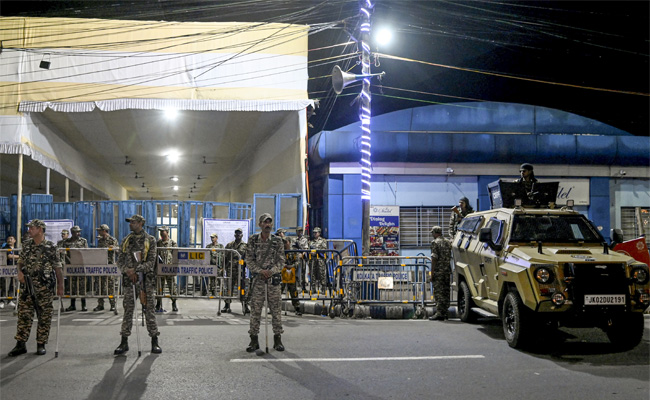
Stringent security arrangements have been put in place for the smooth conduct of the yatra.
Thousands of security personnel from the police, Central Reserve Police Force, Indo-Tibetan Border Police and other paramilitary forces have been deployed to ensure security. Aerial surveillance will also be carried out.
The 52-day pilgrimage will conclude on August 19.
Meanwhile, the second batch of 1,881 pilgrims left the Bhagwati Nagar base camp amid tight security on Saturday, officials said.
The second batch, which included 427 women and 294 seers, left in 200 vehicles in two separate convoys escorted by security forces, the officials said.
While the first convoy carrying 1,069 devotees to Baltal left at 4 am, the second with 812 pilgrims started its journey to Pahalgam 30 minutes later.
More than 4.5 lakh pilgrims paid their obeisance at the cave shrine last year.
Let the Truth be known. If you read VB and like VB, please be a VB Supporter and Help us deliver the Truth to one and all.
NIA court to complete framing of charges against 2010 hand-chopping case accused on May 15

Kochi (PTI): A special court here will complete proceedings for framing charges against the prime accused in the 2010 hand-chopping case involving professor T J Joseph, in which PFI activists were accused of attacking him at Muvattupuzha.
Ernakulam Special Court for NIA cases judge P K Mohandas, on April 30, heard the arguments of counsel for accused Savad and Shafeer C and decided to proceed with framing charges against the duo.
A group chopped off Thodupuzha Newman College professor Joseph's right hand in July 2010, accusing him of religious blasphemy in a question paper he had prepared.
The case, later taken over by the National Investigation Agency (NIA), resulted in the conviction of 19 accused.
The first accused, Savad, who allegedly chopped off Joseph’s palm, was arrested in Berram in Mattannur, Kannur, in January 2024, where he had allegedly been hiding under the pseudonym Shajahan.
The NIA also arrested Shafeer, who allegedly arranged shelter and provided logistical support to Savad at Chakkad and Mattannur in Kannur since 2020.
On April 30, the court heard the counsel for the accused and the NIA prosecutor on framing charges against the duo.
"On going through the documents and evidence in the case and on hearing the counsel for the accused and the prosecutor, I am of the opinion that there are grounds for presuming that the first accused has committed offences punishable under provisions of the IPC, the Explosive Substances Act and the Unlawful Activities (Prevention) Act, and that the second accused has committed offences punishable under the IPC and the UAPA, and there are materials for framing charges under these provisions against the accused," the court said.
The court directed that Savad be produced and Shafeer, who is on bail, appear before it on May 15 for recording their pleas as part of the charge-framing process.
After framing the charges, the court will schedule the trial in the case.