Amid row, Hindi clause removed in revised education policy draft
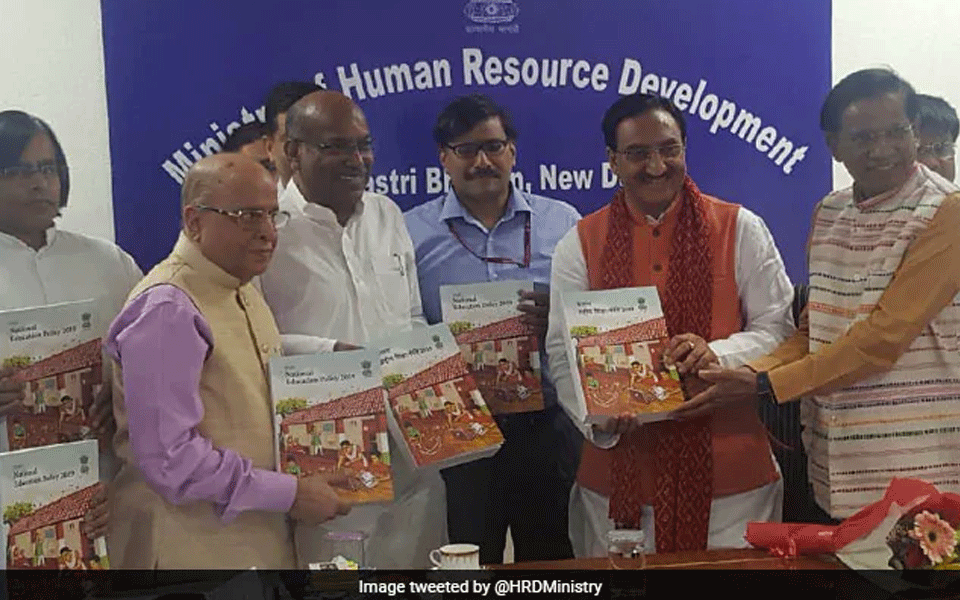
New Delhi: Amid controversy over the recommendation of an HRD Ministry panel to teach Hindi in non-Hindi speaking states, a revised draft education policy was issued on Monday that did not have a mention of the language being compulsory.
The DMK and other parties in Tamil Nadu had strongly opposed the three-language formula in the draft National Education Policy and alleged that it was tantamount to thrusting the Hindi language.
"Students who wish to change one or more of the three languages they are studying may do so in Grade 6 or Grade 7, so long as they are able to still demonstrate proficiency in three languages (one language at the literature level) in their modular Board Examinations some time during secondary school," the revised draft of the NEP said.
In the earlier draft, the panel had suggested mandatory teaching of Hindi in non-Hindi speaking states.
"Students who wish to change one of the three languages they are studying may do so in Grade 6, so long as the study of three languages by students in the Hindi-speaking states would continue to include Hindi and English and one of the modern Indian languages from other parts of India, while the study of languages by students in the non-Hindi-speaking states would include the regional language, Hindi and English," the draft policy had earlier said.
The PMK, an ally of the BJP, had also alleged that the recommendation was imposition of Hindi and wanted the scrapping of the proposal.
"It was a draft report and not a policy yet. We have sought feedback from various stakeholders. The committee has modified the earlier draft and made some changes," a Human Resource Development Ministry official said.
According to the revised draft, the modular board examinations for language proficiency would test only basic proficiency in each language. "Such a change in language choice in Grade 6 would certainly be feasible if the student so desires and would in such cases be supported by teachers and the schooling system."
Union minister Prakash Javadekar, who had the formed the panel when he was the HRD minister in the previous term, had earlier asserted that no language should be imposed on anyone. He clarified that the committee had only prepared a draft report and no decision had been taken on implementing it.
Let the Truth be known. If you read VB and like VB, please be a VB Supporter and Help us deliver the Truth to one and all.
TN CM Vijay’s first orders include 200 units free power for domestic consumers
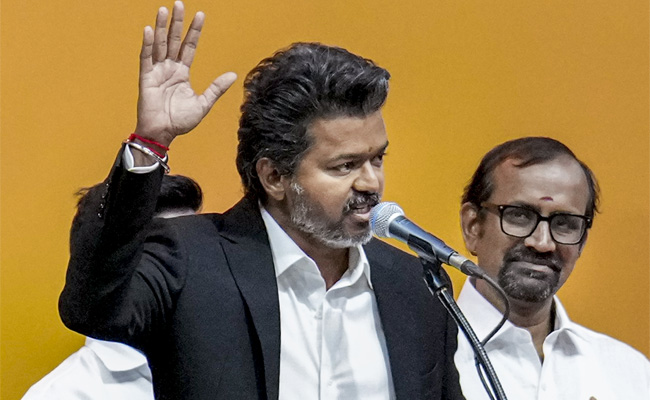
Chennai: Tamilaga Vetri Kazhagam (TVK) founder C Joseph Vijay began his tenure as Tamil Nadu Chief Minister on Sunday by signing his first set of files, approving 200 units of free electricity for domestic consumers, forming a special force for women’s safety, and setting up anti-drug units across the state.
In his first address after assuming office, Vijay said his government would work for “real secularism and social justice” and promised transparent administration. He further said his government would focus on the implementation of manifesto promises, with priority to education, healthcare, food supply, and women’s safety. He also said there would be no power centres other than the Chief Minister in the government.
He also announced a white paper on the state’s finances for the 2021-2026 period, referring to the financial situation of the previous DMK government.
He thanked alliance parties including the Congress, VCK, IUML, and Left parties for supporting the formation of the government.
Vijay also acknowledged voters and party cadres, saying their efforts contributed to the party’s victory.