Amit Shah a key conspirator in Prajapati killing, investigating officer tells court
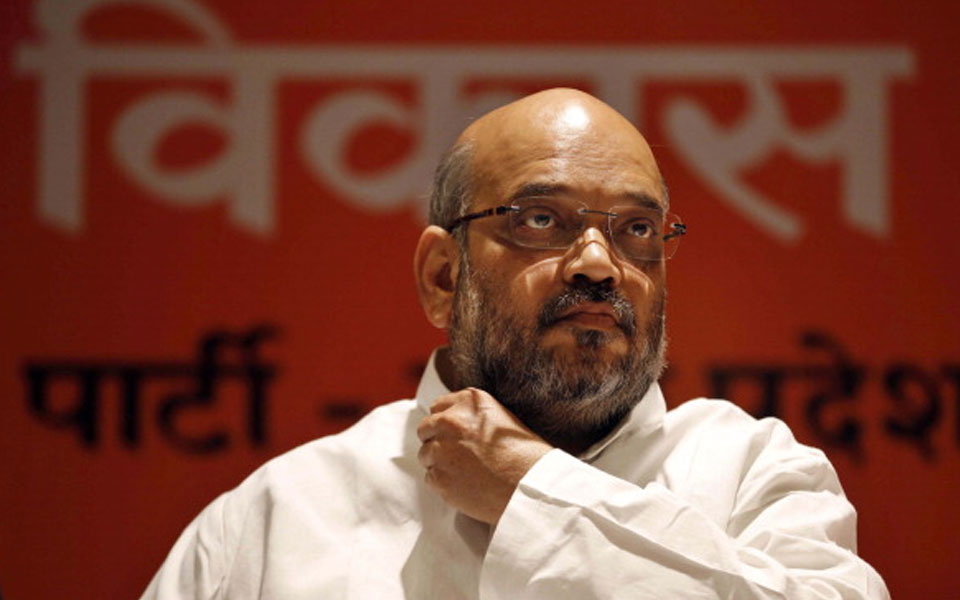
Mumbai: In explosive testimony before the special Central Bureau of Investigation court here on Wednesday, Sandeep Tamgadge, chief investigating officer in the 2006 Tulsiram Prajapati fake encounter case, has said that Bharatiya Janata Party president Amit Shah and IPS officers D.G. Vanzara, Dinesh M.N. and Rajkumar Pandiyan were the “principal conspirators” in the controversial killing.
In his deposition recorded on November 21, the 2001 batch IPS officer told the court that Shah was a part of the “criminal-politician-police nexus” and Prajapati, his associate Sohrabuddin Shaikh and Sohrabuddin’s wife Kausar Bi were killed as the behest of this nexus.
Elaborating on his claim, which was also made in the chargesheet Tamgadge filed in 2012, the officer said, “Shah and Gulab Chand Kataria (now the Rajasthan home minister) were the politicians who gained from the nexus.” He further named Sohrabuddin, Prajapati, their close associate Azam Khan and others as the “criminals” in this link. The CBI’s claim is that Shaikh and Prajapati ran an extortion racket in connivance with the police and politicians. When Shaikh decided to go against his alleged masters, a conspiracy to eliminate him was hatched on November 23, 2005.
Tamgadge’s statement comes at a very crucial time in the trial, since one witness after another has been turning hostile. Although his predecessor, also a senior IPS officer, Amitabh Thakur, did not turn hostile, he failed to reiterate the evidence from his investigation when he took the witness stand. On November 19, Thakur told the court that the CBI did not have evidence to prove that Shah and senior IPS officers received “monetary and political benefits” from these alleged fake encounters. In addition, Thakur even claimed that the CBI did not have any motive to show for the 22 people presently facing trial.
Shah, Kataria and several top IPS officers including Vanzara, Pandiyan and Dinesh have already been discharged from the case. Only 22 men – 21 low-rung policemen and the owner of the guest house where Kausar Bi was allegedly kept before she was killed – are currently facing trial, though 35 people had been accused of the crime at the start.
While Shah was first named as an accused in Thakur’s investigation, it was Tamgadge who questioned and eventually arrested him. Shah, however, was discharged from the case by a special CBI judge, M.B. Gosavi, on December 30, 2014, a decision made all the more controversial by the CBI’s refusal to appeal it.
Tamgadge, a police officer from the Nagaland cadre, was the 210th witness in the case. At present, he is posted in Kohima as deputy inspector of police. From 2011 to 2015, he held multiple posts in the CBI, the most important of which was as superintendent of police of the special crime branch of CBI, Mumbai.
Following a few questions by chief public prosecutor B.P. Raju, Tamgadge was exposed to a series of questions by defence lawyers. His deposition went on for over nine hours.
Answering a question posed by defence lawyer Abdul Wahab Khan on whether call data records (CDRs) of the accused established the conspiracy, Tamgadge named Shah, Vanzara and several other officers from Gujarat, Rajasthan and Hyderabad.
“The CDRs of Amit Shah, Dinesh M.N., Vanzara, Pandiyan, Vipul Agarwal, Ashish Pandya, N.H. Dhabi and G. Srinivasa Rao were available with us along with other substantial evidence to prove that there was a conspiracy hatched before the murders.” Of those named, Pandya, Dabhi and Rao continue to face trial; the others have been discharged for lack of evidence.
CDRs form a crucial part of the chargesheets filed by both Tamgadge and Thakur before him. The CBI had included calls between these men, before and after the alleged offence, in its chargesheet. However, the trial court, while discharging 13 of the 35 accused, had said there was insufficient evidence against them.
According to the CBI, Sohrabuddin, Kausar Bi and Prajapati had travelled together on a bus on November 23, 2005, when Sohrabuddin and Kausar Bi were allegedly kidnapped by a police detachment. Shaikh was later shown killed in an alleged encounter on November 26, 2005. Kausar Bi’s body was never recovered but the CBI, on the basis of circumstantial evidence and statements of witnesses, said in its chargesheet that she was abducted and eventually killed too. Prajapati was arrested and sent to an Udaipur prison, and later killed in an encounter in 2006.
Thakur, who was deputed to the CBI between 2010 and 2012, had filed the main chargesheet in the Sohrabuddin-Kausar Bi case. Tamgadge took over the investigation in April 2012, and filed a concluding supplementary chargesheet. At that time, the investigation into Prajapati’s killing was separate and Tamgadge, along with his team, filed a different chargesheet in the case in September 2012. Later, both cases were clubbed as they were treated as a part of a “larger conspiracy”.
Another crucial revelation made in Tamgadge’s deposition was the role played by Dinesh M.N., then the superintendent of police, Udaipur, in forming a police escort team which eventually killed Prajapati on December 28, 2006. Tamgadge explained how the police escort team was handpicked by Dinesh, and assigned the job to ferry Prajapati from Udaipur prison to the court and back. The same team had ferried him twice before he was finally killed. Tamgadge detailed the sequence of events that led up to Prajapati’s killing.
According to Tamgadge, Ashish Pandya, police sub-inspector in the special operation group, Palanpur, shot himself in the left arm to show that he was injured during the alleged encounter. He substantiated his claims with forensic reports and expert findings which said that such an injury is possible even when it is “self- inflicted”.
Ishrat inquiry
Besides these alleged encounters, Tamgadge also supervised the investigation into the killing of Ishrat Jahan. Under his supervision, the agency had filed two chargesheets in this case arraigning a slew of senior Gujarat police officers who were considered close to then Gujarat chief minister Narendra Modi and home minister Shah.
In 2014, just a few weeks before Modi was sworn in as the prime minister, Tamgadge was removed as supervising officer from several encounter cases in Gujarat. He was eventually repatriated to his home cadre, Nagaland.
In 2015, his security cover was withdrawn and an attempt made by the CBI to prosecute him in two cases that critics said were trumped-up – one of dereliction of duty and another of falsely implicating the subject of an anti-corruption investigation.
courtesy : thewire.in
Let the Truth be known. If you read VB and like VB, please be a VB Supporter and Help us deliver the Truth to one and all.
Focus on Vijay's poll promises; TVK assured 8 gm gold for women
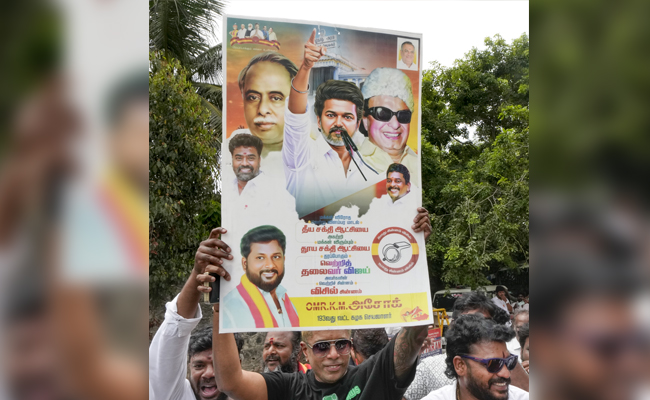
Chennai (PTI): As the new-entrant TVK appears likely to emerge as the single largest party and form the government, the focus has now turned into actor-politician Vijay's poll promises, including 8 gm gold for marriage, which is worth about Rs 14,000 per gram (22 carat).
Vijay's assurances in the party manifesto include Rs 2,500 monthly assistance for women below 60 years, 8 gm gold for marriage and six free cooking gas cylinders a year, per family.
By 3 PM, as per EC data, Vijay's party is leading in 105 constituencies and it falls short of a simple majority (118) in the Assembly.
The actor-turned-politician also assured a quality silk saree in addition to gold for indigent brides and interest-free loans up to Rs 5 lakh for women-run SHGs. He assured corruption-free good governance if voted to power in his maiden electoral fight.
The manifesto also laid importance on education. To prevent school dropouts, mothers or guardians of children studying in government and state-aided schools will receive Rs 15,000 annually.
Vijay promised 100 special residential schools named after iconic leader K Kamaraj, credited with revolutionising education in the state, and higher education loans of up to Rs 20 lakh. The TVK founder also assured AI Ministry, AI University and AI City.
The manifesto placed a strong emphasis on agrarian welfare, too.
The party promised a full waiver of agricultural cooperative crop loans for farmers owning less than five acres of land, while those holding more than five acres will receive a 50 per cent waiver. Additionally, the party promised a Minimum Support Price (MSP) of Rs 3,500 per quintal for paddy and Rs 4,500 per tonne for sugarcane.
Addressing youth unemployment, Vijay pledged to create five lakh new government jobs and offer as many stipendiary internships. Unemployed graduates will be provided a monthly aid of up to Rs 4,000. For government employees, the party assured consideration of the Old Pension Scheme and the regularisation of contract workers, including nurses.
On the health front, he promised a drug-free Tamil Nadu. Vijay also committed to modernising hospitals, providing free annual health checkups, and introducing a Rs 25 lakh family health insurance scheme.
The manifesto also included a Rs 3,000 monthly pension for the elderly and the differently-abled, 200 units of free power, patta (land deed) regularisation, and 100 per cent piped drinking water supply for all households.
Some of the policy intereventions promised by TVK include a legal guarantee to provide essential government services like community certificates, and land pattas, within a strictly specified timeframe.
Vijay also promised doorstep delivery of governance by implementing a system to deliver services, such as ration supplies, directly to the people. He also assured that ease of doing business will be paramount to his government and promised a strict guarantee that business licences will be issued within 21 days.
Elections to 234 Assembly seats in Tamil Nadu were held on April 23.