Amit Shah arrives in Manipur to set tone for 2019 polls
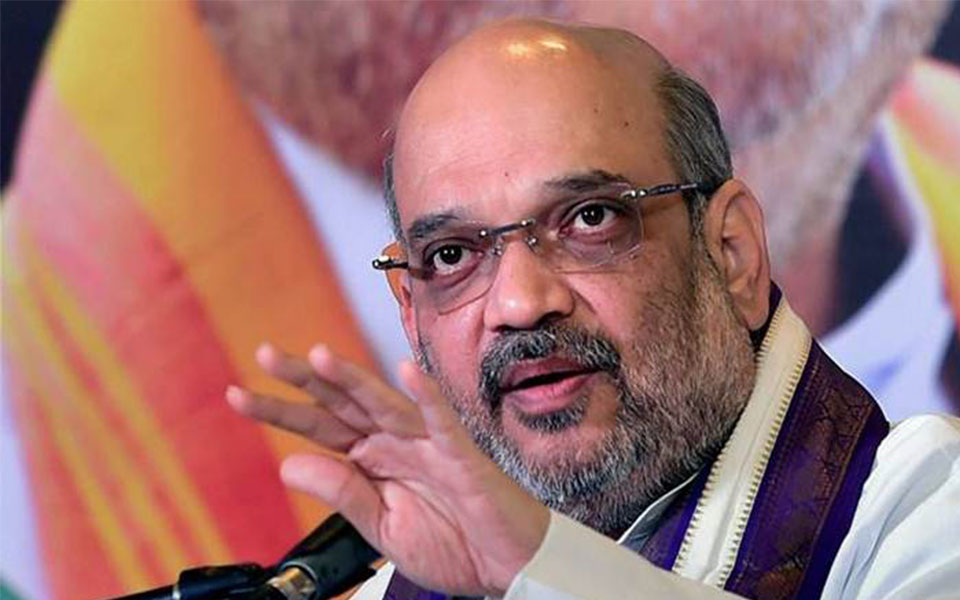
Imphal, June 30: As part of the exercise to prepare strategy for the parliamentary elections next year, BJP President Amit Shah on Saturday arrived in the city. He will hold meetings with the BJP chief ministers of the northeastern states.
Shah is also scheduled to hold meetings with the party presidents of states in which the BJP is not in power. Bharatiya Janata Party (BJP) sources said the party is launching an all-out pre-election exercise to win all Lok Sabha seats in the Northeast.
All chief ministers, ministers and party functionaries are putting up in a three-star hotel in Imphal for holding the meetings round-the-clock.
Manipur unit BJP chief and Rajya Sabha MP K. Bhabananda said: "Amit Shah held talks with the leaders of every northeastern state, discussing how to win all Lok Sabha seats in all the eight states."
Both Manipur Chief Minister N. Biren Singh and Bhabananda met Shah.
Manipur has been organising the people through "Go to Hills" and "Go to Village" missions. Under these projects, selected persons are given various benefits, including free gas connections.
However, senior Congress leader and former Manipur Chief Minister Okram Ibobi Singh said: "All developmental projects had been started during the Congress rule of 15 years. All that the BJP-led government has done now is that it inaugurated those projects."
He said that a party which restricts the food habit of communities cannot find a permanent foothold in the Northeast. He recalled how some BJP functionaries had resigned in Meghalaya in protest against ban on cow-slaughter, and added that "beef is a part of culture of the people of the state".
Another senior Congress leader and former Manipur Deputy Chief Minister Gaikhangam said: "Despite all the eye dazzlings, BJP will be wiped out in the 2019 parliamentary elections."
Let the Truth be known. If you read VB and like VB, please be a VB Supporter and Help us deliver the Truth to one and all.
25 lakh properties in Bengaluru brought under e-Khata system: Shivakumar
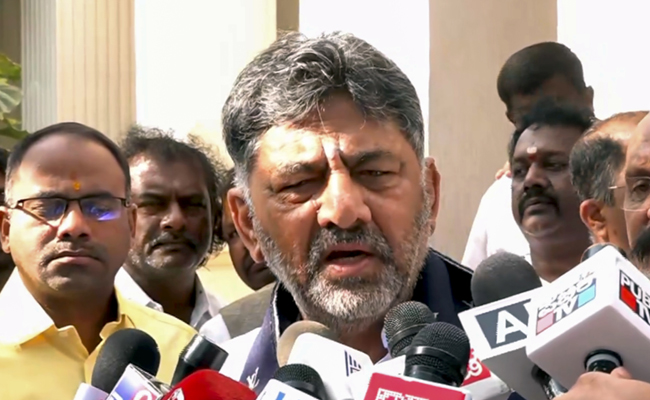
Bengaluru (PTI): Karnataka Deputy Chief Minister D K Shivakumar on Friday said that the state government has brought over 25 lakh properties under the e-Khata system in Bengaluru.
e-Khata is an electronic property certificate that maintains ownership information in an online database.
The e-Khata initiative aimed to ensure accuracy, transparency and universal coverage for property owners, he said.
Addressing a press conference here, Shivakumar, who is also the Bengaluru in-charge Minister, said over 25 lakh properties are being brought under the e-Khata system. Of them more than 7,000 applications have been processed, and additional outreach measures being planned for those yet to obtain their e-Khata.
"Twenty five lakh e-Khatas is a great number which has created history," he said.
The Deputy CM said the government is ensuring that every e-Khata will have its GPS, the shape of the property, and the measurement with every photo and document.
He explained that the government is integrating Aadhaar details, digital documentation, GPS mapping and property sketches to create a robust database.
"We want to see that every record is filled right. They (officials) are asking for documentation, stamp, digital documents. We wanted to connect every Aadhaar card and have it online," Shivakumar said.
To facilitate access, the Deputy CM announced the opening of more than 50 centres across Bengaluru, many of them in government schools, where citizens can apply for or rectify their e-Khata records.
"All of them will be working this Saturday. This 'Khata Mela' will be done. It is 'Nanna Khata, Nanna Swathu'," he said.
Applicants whose documents require verification will be given an acknowledgement and asked to return after 15 days, during which officials will conduct site inspections, he said.
Shivakumar said the government has also taken steps to identify and reclaim properties recorded as roads in revenue documents, asserting that such lands belong to the government.
"We have decided through the law that all the roads in the revenue records have been taken out. Those properties belong to the government itself," he said.
He noted that the initiative has received recognition from the Union government. "The Government of India has awarded us. It said that it is the model for the entire country," he said, while thanking officials involved in the project.
The Deputy CM said the government expects around 10 lakh additional households to benefit from the drive and assured that even those who have not downloaded their documents will receive printed copies free of cost at their residences.
"We will see that all the 25 lakh people will get their e-Khata to their home free of cost," Shivakumar said.
On apartment properties, he said all flats that have obtained occupancy certificates have been cleared.
"All the 37,460 flats (who have applied for e-Khata) have been issued an occupancy certificate. We have cleared all of them," the Deputy CM said.