Amit Shah's appeal on Hindi Diwas: Respect all Indian languages
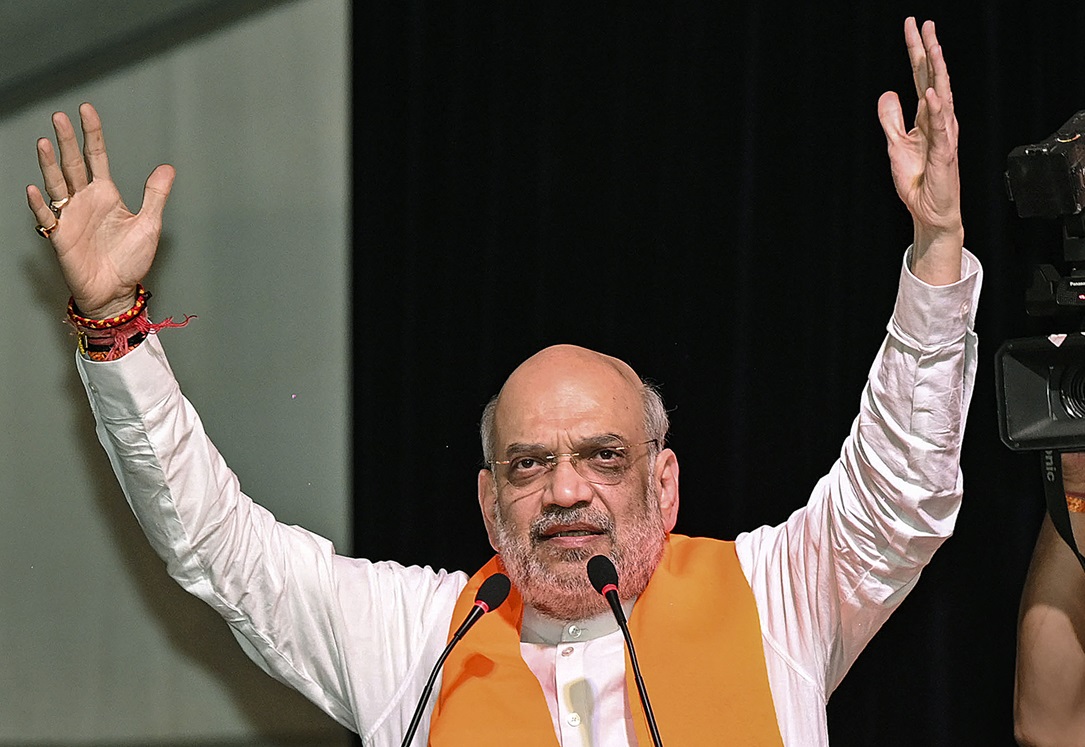
New Delhi, Sep 14 (PTI): Union Home Minister Amit Shah on Sunday extended Hindi Diwas greetings, and asked everyone to respect all Indian languages and move forward towards a self-reliant, self-confident and developed country.
Shah noted that from the heights of the Himalayas to the vast beaches of the South, from the desert to the rugged forests and village 'chaupalas', languages have shown the way to a man in every situation to stay organised and move forward unitedly through communication and expression.
He also said that the greatest strength of India's languages is that they have provided every class and community with an opportunity for expression.
"Our country is fundamentally a language-oriented nation. Our languages have been a powerful medium for carrying forward culture, history, traditions, knowledge, science, philosophy, and spirituality from generation to generation," he said in a message on the occasion of Hindi Diwas.
Extending Hindi Diwas greetings, the home minister said he firmly believed that languages, by becoming companions of one another and bound in the thread of unity, were moving forward together.
"On this occasion of Hindi Diwas, let us respect all Indian languages, including Hindi, and move forward towards a self-reliant, self-confident and developed India," he said.
Shah said "walk together, think together, and speak together" has been the core mantra of India's linguistic-cultural consciousness.
He said the songs of Bihu in the Northeast, the voice of Oviyalu in Tamil Nadu, the songs of Lohri in Punjab, the verses of Vidyapati in Bihar, the hymns of Baul saints in Bengal, Kajri songs, and Bhikari Thakur's 'Bidesia' - all these have kept the country's culture vibrant and welfare-oriented.
The home minister said Saint Thiruvalluvar's verses are sung with as much devotion in the South as he is read with interest in the North and Krishnadevaraya was as popular in the South as he was in the North.
"The patriotic compositions of Subramania Bharati ignite national pride in the youth of every region. Goswami Tulsidas is revered by every Indian, and the couplets of Saint Kabir are found in translations in Tamil, Kannada, and Malayalam," he said.
Shah said Surdas's poetry remains prevalent in the temples and musical traditions of South India even today.
"Srimanta Sankardeva and Mahapurush Madhavdeva of Assam are known to every Vaishnav, and Bhupen Hazarika's songs are hummed even by the youth of Haryana," he said.
The home minister said even during the difficult period of slavery, Indian languages became the voice of resistance.
"Our languages played a significant role in making the freedom movement a nationwide endeavour. Our freedom fighters connected the languages of the regions and villages with the freedom struggle," he said.
Along with Hindi, the home minister said, poets, litterateurs, and playwrights of all Indian languages strengthened the resolve for independence among every age group, class, and community through folk languages, folktales, folk songs, and folk plays.
"Slogans like 'Vande Mataram' and 'Jai Hind' emerged from our linguistic consciousness and became symbols of pride for independent India," he said.
Shah said when the country gained independence, the Constitution makers extensively deliberated on the potential and importance of languages and, on September 14, 1949, adopted Hindi written in the Devanagari script as the official language.
He said Article 351 of the Constitution assigns the responsibility of promoting and spreading Hindi to make it an effective medium of India's composite culture.
"In the last decade, under the leadership of Prime Minister Narendra Modi, a golden era of renaissance for Indian languages and culture has emerged. Whether it is the platform of the United Nations, the G-20 summit, or addressing the SCO, Modi Ji has enhanced the pride of Indian languages by communicating in Hindi and other Indian languages," he said.
In the 'Amrit Kaal' of independence, the home minister said, Modi has taken the 'Panch Pran' (five pledges) to free the country from the symbols of slavery, in which languages have a significant role.
"We must adopt Indian languages as the medium of communication and interaction," he said.
Shah said the official language Hindi has completed 76 glorious years and the Department of Official Language, having completed 50 golden years of its establishment, has done remarkable work in making Hindi the language of the masses and public consciousness.
"Since 2014, the use of Hindi in government work has been continuously promoted," he said.
The home minister said in 2024, on Hindi Diwas, the Bharatiya Bhasha Anubhag was established with an aim of ensuring seamless translation between all major Indian languages.
"Our goal is to ensure that Hindi and other Indian languages become not just a medium of communication but the cornerstone of technology, science, justice, education, and administration," he said.
Shah said in this era of Digital India, e-Governance, Artificial Intelligence and Machine Learning, the government is developing Indian languages as future capable, relevant and a driving force in making India a leader in global technological competition.
"Mithila's poet Vidyapati ji rightly said: 'Desil bayana sab jan mittha' means, one's own language is the sweetest," he said.
Let the Truth be known. If you read VB and like VB, please be a VB Supporter and Help us deliver the Truth to one and all.
Karnataka rolls out climate action plan to tackle global warming: Minister Khandre
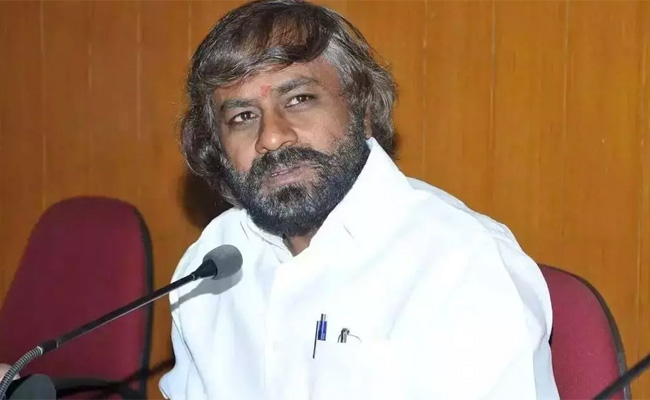
Bengaluru (PTI): Minister Eshwar Khandre on Tuesday said that a Karnataka state action plan on climate change has been formulated to mitigate the impact of global warming and climate change, and directions have been issued to ensure its proper implementation.
Speaking after presiding over a seminar on extreme heat and its impact on Bengaluru, organised by the Karnataka Media Academy, he said the Environmental Management and Policy Research Institute (EMPRI), which comes under the environment department, has taken steps to implement the action plan in coordination with various state government departments.
He said training programmes are being organised in cooperation with zilla panchayat offices for district officials and other related institutions regarding the implementation and progress of the Karnataka state action plan on climate change.
The Forest, Ecology and Environment minister said such programmes will be conducted in all 31 districts of Karnataka.
According to a statement issued by the minister’s office, in terms of climate resilience, Khandre said a dedicated radio programme, “Havamaana Mitra” (weather friend), was launched in April 2025 to share information on best practices, and 24 programmes have so far been broadcast on Akashvani.
ALSO READ: Passenger held at BLR airport with hydroponic ganja worth Rs 1.28 crore
He said these efforts aim to create public awareness.
Khandre emphasised that due to global warming and climate change, even seasons are changing today.
“Keeping this in mind, after becoming Forest Minister, I have been making every effort to increase green cover, especially in Bengaluru city,” he said.
He noted that during the last three years, about 11 crore saplings have been planted in the state, and information on their survival rate has been made available on the Forest Department website.
According to him, encroachments on about 250 acres of forest land worth around Rs 10,000 crore in several parts of Bengaluru, including Kothanur, Kadugodi, B M Kaval, and Turahalli, have been cleared.
Thousands of saplings have been planted and groves created on the cleared land, thereby preserving lung spaces essential for Bengaluru city.
The minister also recalled that more than 400 acres of forest land in Peenya plantation had earlier been allotted to the central government-owned HMT for industrial purposes.
He said HMT had sold 160 acres of this land, while 280 acres remain, and a decision has been taken to reclaim it for the department to preserve an essential lung space for Bengaluru. A legal battle is underway, and the case is currently in the Supreme Court.
In addition, he said 444 acres in the Jarakabande area had been allotted to the Indian Air Force. Under the Forest (Conservation) Act, 1980, forest land cannot be diverted without due process. Hence, in 2017, the then Deputy Commissioner cancelled the land allotment.
“Steps are now being taken to reclaim this forest land and preserve the green space,” he said.
Khandre also highlighted that the Yelahanka Air Force Station in Gantiganahalli, where the international air show is held once every two years in Bengaluru, is on forest land.
He said 159 acres in Gantiganahalli village is classified as a reserved forest area.
“If the Air Force submits a proposal for diversion and provides alternative land, this area may be considered for transfer; otherwise, steps will be taken to reclaim it for the forest department,” he said.
“The Indian Air Force is presently using this area as a runway. However, the RTC and mutation records are in the name of the Forest Department, and the land has not been legally converted. Hence, this forest land will be reclaimed,” he said.
He added that the government has resolved to construct a major biological park on 153 acres at Madappanahalli in Bengaluru North taluk, and cabinet approval has been obtained.
“The CM will lay the foundation stone next month. This will be the largest park after Lalbagh and Cubbon Park. It would not be incorrect to call this an achievement of the century,” he said.