Amritsar train accident: Probe gives clean chit to Sidhu's wife
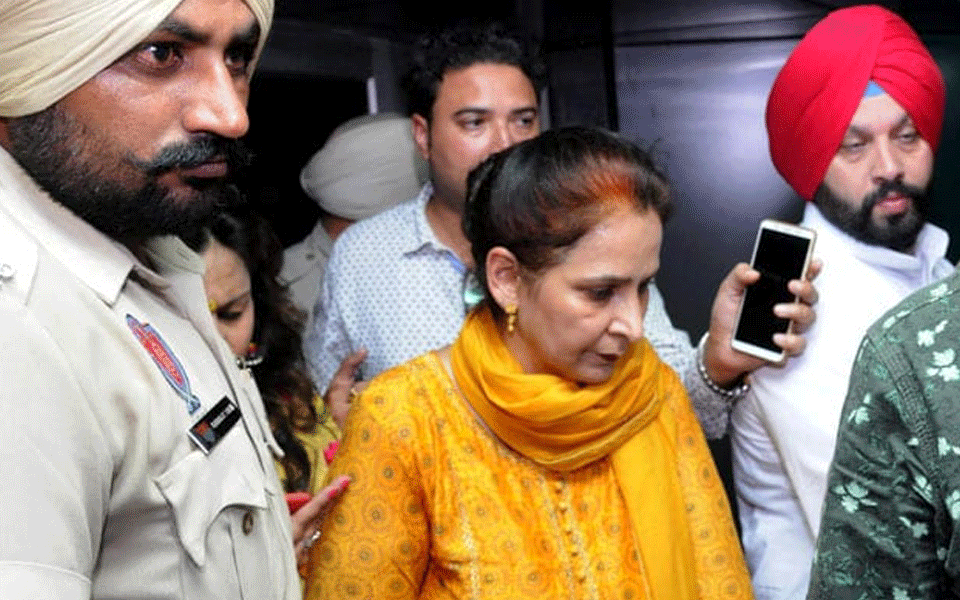
Chandigarh, Dec 6: A magisterial probe into the Amritsar train tragedy in which around 60 people died, has apparently given a "clean chit" to Navjot Kaur Sidhu, wife of Punjab minister Navjot Singh Sidhu, who was the chief guest at the Dussehra event.
Jalandhar Divisional Commissioner B Purushartha-- appointed the special executive magistrate by the government to probe the accident-- indicted the son of a Congress councillor, who organised the event as well as officials of Amritsar district administration, municipal corporation, railways and local police, official sources said.
The crowd was watching the burning of a Ravana effigy near Joda Phatak on October 19 when they were mowed down by a passing train.
A 300-page report of magisterial probe into the accident was submitted to the Punjab Home Secretary last month.
The report stressed that Saurabh Mithu Madan, son of the Congress councillor and a close aide of the Sidhu's, should have ensured safety of people at the venue, official sources said.
The report also blamed Amritsar administration and municipality officials over safety measures and permission given for holding the event.
The role of railways also came under the scanner for giving the green signal to a fast train despite the presence of a huge crowd on the tracks.
The Home department has put up the file pertaining to the report before Chief Minister Amarinder Singh for further action.
Notably, an inquiry conducted by the Chief Commissioner of Railway Safety into this incident had blamed "negligence" of people, standing on the railway track, for the tragic incident.
Meanwhile, Additional Director General of Police (Railways) Iqbal Preet Singh Sahota is conducting a separate inquiry into the accident to fix responsibility.
The statements of over 150 people including railway officials and Navjot Kaur Sidhu were recorded by Purushartha, while Navjot Singh Sidhu, who had questioned the Railways for giving clean chit to loco-pilot of the train, had submitted his statement in writing.
Opposition Akali Dal had earlier rejected the institution of the magisterial probe and sought registration of case against Navjot Kaur Sidhu and the event organiser, claiming that she allegedly left the venue without bothering about the victims.
Let the Truth be known. If you read VB and like VB, please be a VB Supporter and Help us deliver the Truth to one and all.
4 workers die after being buried under coal slurry in Jharkhand's Dhanbad

Dhanbad (Jharkhand) (PTI): At least four workers died after being buried under coal slurry in Jharkhand's Dhanbad district on Saturday, a police official said.
The incident took place at Moonidih coal washery in the command area of Bharat Coking Coal Limited (BCCL).
"Bodies of all four workers were dug out of debris during a rescue operation," Putki police station in-charge Waqar Hussain told PTI.
The incident took place when coal slurry was being loaded into trucks by workers, during which a large chunk of slurry fell and trapped several workers underneath, officials said.
The deceased have been identified as Manik Bauri, Dinesh Bauri, Deepak Bauri, and Hemlal Gope.
Meanwhile, the family members of the deceased and local villagers placed the bodies in front of the washery gate and began a protest.
They demanded compensation, jobs for dependents and action against those responsible for the incident.
Police and administration officials are trying to pacify the protesters, an official said.