Amul hikes milk prices by Rs 2/ltr in Delhi & other major markets from tomorrow
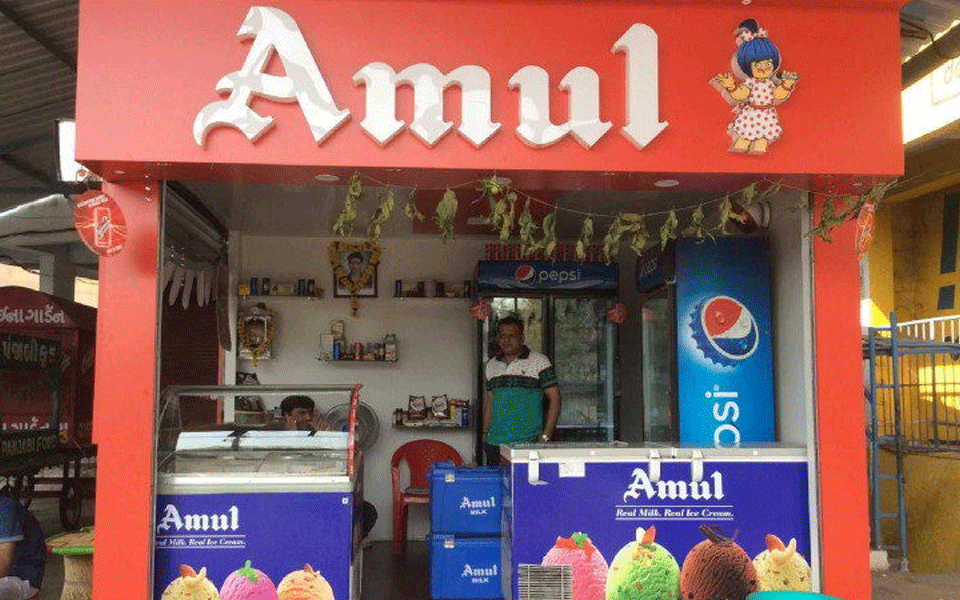
New Delhi, May 20: Dairy major Amul said Monday it will increase milk prices by Rs 2 per litre in Delhi NCR, Maharashtra and other states from Tuesday due to an increase in production cost.
Milk prices were last revised two years back in March 2017, Gujarat Cooperative Milk Marketing Federation (GCMMF), which sells milk and milk products under the Amul brand, said in a statement.
The new price will come into effect from May 21 onwards and on all six brands being sold in major markets of Delhi-NCR, Gujarat, West Bengal, Kolkata, Uttaranchal, Maharashtra and other states, the GCMMF said in a statement.
The revised price of 500 millilitre (ml) pack of 'Amul Gold' in Ahmedabad will be Rs 27, 'Amul Shakti' at Rs 25, 'Amul Taaza' at Rs 21 and 'Amul Diamond' at Rs 28, it said.
There has been no change in cow milk prices in Gujarat, the cooperative added.
"This increase in milk prices by Rs 2 per litre has happened after a gap of two years with an aim to provide remunerative milk purchase price to our milk producers owing to drop in milk production and increase in cost of production," GCMMF said.
Considering the increase in the cost of milk production, all member milk unions of Gujarat have increased milk purchase price by a minimum of Rs 30-50 per kg fat (5-8 per cent) over the last few months, it said.
This will motivate milk producers to keep inducting new animals and to keep producing milk and support their livelihood, it added.
Stating that national and international dairy markets have witnessed adverse conditions in the last two years, GCMMF said there has been a steep decline in the prices of commodities such as skimmed milk produce (SMP) and butter oil. This has resulted in a decline in producer prices of milk across India, leading to adverse impact on milk producers.
"However, the milk cooperatives of Gujarat continued to pay remunerative prices of milk to its producers and the average final price of milk paid to our producers has increased to Rs 710 per kg fat in 2017-18 to Rs 730 per kg fat in 2018-19," it said.
Unfortunately over the last one year, GCMMF said, there has been a major increase in prices of major cattle feed ingredients such as de-oiled rice bran by 61 per cent, rice polish fine by 22 per cent, molasses by 82 per cent, maize by 63 per cent etc, which has resulted in increase in the cattle feed price by over 15 per cent.
Similarly, the rate green fodder has seen hike of more than 100 per cent in this summer.
Amul, as a cooperative, passes on almost 80 paise of every rupee paid by consumers to the milk producers, the cooperative added.
Let the Truth be known. If you read VB and like VB, please be a VB Supporter and Help us deliver the Truth to one and all.
Primary accused in 96.6 pc POCSO cases were close acquaintances: NCRB

New Delhi (PTI): In 96.6 per cent of 44,126 cases of sexual abuse of minors, close acquaintances have emerged as the primary offenders, according to the latest data released by the NCRB.
In its report 'Crime in India 2024' released by the National Crime Records Bureau (NCRB), 44,126 total cases have been registered under the Prevention of Children from Sexual Offences (POCSO) Act under Sections 4 and 6 which pertain to penetrative sexual assault on minors during the year across the country.
The figures present a grim picture as close acquaintances emerged as primary accused in 42,634 (around 96.6 per cent) of the 44,126 total cases falling in that category, according to the latest NCRB data.
The data shows that family members were involved in 3,658 cases, while family friends, neighbours, employers or other known persons were named in 16,668 cases.
The largest share came from friends, online friends or live-in partners acting on the pretext of marriage, with 22,308 cases.
Cases where the offender was unknown or not identified stood at mere 1,492, or 3.4 per cent of the total.
Among states, Tamil Nadu reported the highest number of POCSO cases at 5,320, followed by Maharashtra at 4,829 and Madhya Pradesh at 3,721. Uttar Pradesh was next with 3,671 cases.
In Union territories, Delhi accounted for the highest number of cases at 1,038, followed by Jammu and Kashmir at 228 and Puducherry at 82. The Andaman and Nicobar Islands reported 77 cases.
The data also shows that Andhra Pradesh, Arunachal Pradesh, Himachal Pradesh, Nagaland, Sikkim, Uttarakhand, Tripura and several Union territories, including Chandigarh, Andaman and Nicobar Islands, Dadra and Nagar Haveli and Daman and Diu, Lakshadweep, Ladakh and Puducherry, reported 100 per cent of cases involving known offenders.