Anganwadi centres, schools, panchayat buildings to be used as COVID-19 vaccination sites
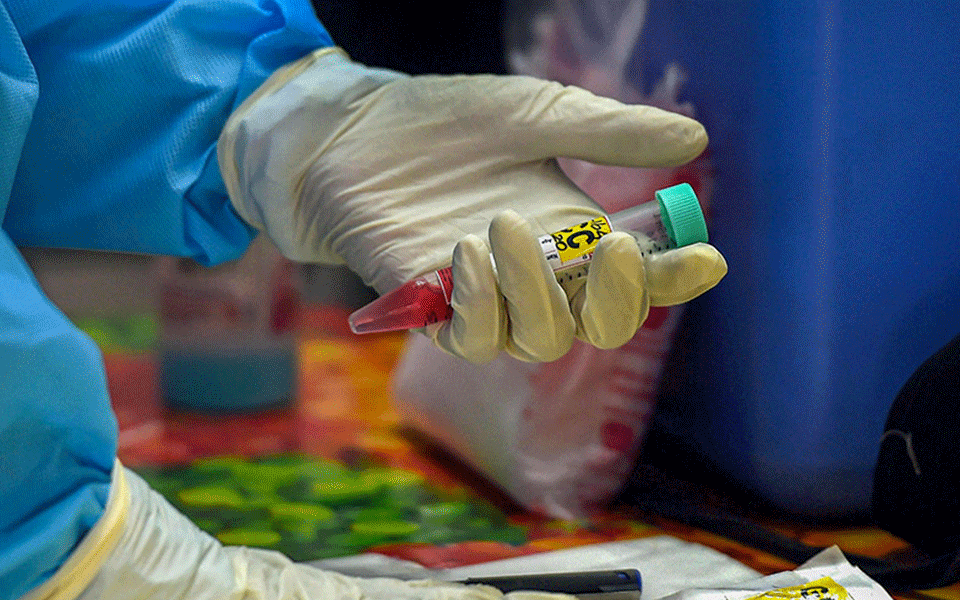
New Delhi: Anganwadi centers, schools, panchayat buildings, and other such setups would be used extensively in addition to healthcare facilities as vaccination sites in the anti-coronavirus inoculation drive which would be monitored by the Union health ministry's digital platform and would involve sending SMSes and generating a QR code after each jab to track the beneficiaries.
According to a blueprint deliberated upon by an expert group, state governments would identify buildings that can be used as vaccination booths under the special COVID-19 immunization program that would run parallel to the existing Universal Immunisation Programme (UIP).
"The vaccination sites will not be limited to just healthcare facilities. Such centers would also be set up in Anganwadi centers, schools, panchayat buildings, and other such setups as identified by state governments," a source said.
The health ministry's existing digital platform eVIN which is being used for the UIP is being enhanced for COVID-19 vaccine distribution and delivery, through which SMSes would be sent to recipients informing the time, date, and venue to get the shots and digitally connect them and also track them, the source said.
Each person in the immunization list would be linked with their Aadhaar cards to avoid duplication and to track beneficiaries. However, in case a person doesn't have an aadhaar card, a government photo identity can be used, sources said.
The Electronic Vaccine Intelligence Network (eVIN) system provides real-time information on vaccine stocks and storage temperatures across all cold chain points in the country under the UIP.
The prime minister, during a review meeting last month, had suggested making use of the experience of the successful conduct of elections and disaster management, for developing the vaccine delivery and distribution system, involving the participation of states/UTs/district-level functionaries, civil society organizations, volunteers, citizens, and experts from all necessary domains.
The coronavirus vaccine, once available, would be distributed under a special COVID-19 inoculation program, using the processes, technology, and network of the existing UIP, official sources had said earlier.
According to them, the Centre will procure the vaccine directly to make it available to the priority groups through the existing network of states and districts.
The vaccine is being planned to be administered to the priority groups free-of-cost.
States have been asked not to chart separate pathways of procurement, they said.
The Centre, with the help of state and UT governments, has started the process of identifying around 30 crore priority beneficiaries who would be given the vaccine dose in the initial phase.
The government has demarcated four categories which include around 1 crore healthcare professionals including doctors, MBBS students, nurses, and ASHA workers, etc, around two crore frontline workers, including municipal corporation workers, personnel of the police and armed forces, about 26 crore people aged above 50 and a special category of those below 50 with co-morbidities and requiring specialized care.
States have been asked to enlist by mid-November the priority population groups to receive the vaccine.
The National Expert Committee on Vaccine Administration for COVID-19 has already mapped the existing cold chain presently being utilized under the government's immunization program and has also made a projection of the additionality that will be required.
Presently facilities of cold chain in over 28,000 locations are being used under the UIP. Presently the group is engaged with mapping the private sector facilities for augmenting the capacity.
Union Health Minister Harsh Vardhan had said in October that the Centre estimates to receive and utilize 40-50 crore doses of COVID-19 vaccine covering 20-25 crore people by July next year.
Stating COVID-19 vaccine introduction will span over a year with multiple groups being included "sequentially starting from health care workers", the health ministry has sought constitution of committees at the state and district level which will review preparatory activities in terms of cold chain preparedness, operational planning, strategies for state-specific challenges in terms of geographical terrain and hard to reach areas, etc.
The ministry has suggested setting up of a state steering committee (SSC) chaired by the chief secretary, a state task force (STF) led by Additional Chief Secretary or principal secretary (health), and a district task force (DTF) to be headed by the district magistrate.
Let the Truth be known. If you read VB and like VB, please be a VB Supporter and Help us deliver the Truth to one and all.
Representative of Iran's Supreme Leader in India calls current situation 'no war, no peace'
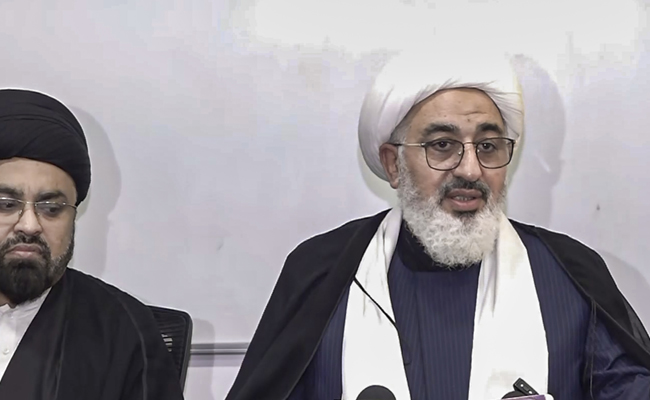
Bengaluru (PTI): Representative of Iran's Supreme Leader in India, Abdul Majeed Hakeem Ilahi on Saturday characterised the ongoing tensions between his country and the Israel-US alliance as a state of “no war, no peace”.
Calling for an immediate halt to the conflict, he said the global stability hinges on those who initiated the war.
He questioned why countries affected by the war and suffering from the energy crisis are not pressuring the US and Israel to stop the aggression.
Addressing a press conference here, Ilahi said Iran did not want the conflict, but was compelled to respond amid continued attacks, even as negotiations were expected to continue.
"Iran didn't want this war, but Iran was forced by the war and several times Iran tried to avoid this war... I don't know what is the condition of these people and these countries (US-Israel)... they want to impose on other countries what they want, and who gave them this authority?" he questioned.
Recalling the negotiations Iran held in Oman, he said talks later moved to Geneva and made progress before being disrupted by sudden attacks.
Ilahi claimed that airstrikes and missile attacks led to the deaths of Iran’s supreme leader Ayatollah Ali Khamenei, ministers, commanders and civilians.
"They killed a lot of civilians… They attacked a primary school, and they killed 175 innocent girls," he said, claiming over 4,000 deaths, more than 40,000 injuries, and widespread damage to houses, hospitals, universities and public infrastructure.
Despite these losses, he said Iran resisted calls for “unconditional surrender” and stood firm and defended itself.
"They wanted unconditional surrender. Which no one—no one can accept it. Iran said, 'Okay, we are ready to be sacrificed,' but we are not ready to submit ourselves," he added.
He argued that they (US-Israel) proposed the current ceasefire only after realising that they could not achieve any of their objectives after 40 days of conflict.
The envoy further claimed that the ceasefire is not an actual ceasefire, but a “no war, no peace” situation.
Explaining the current situation in Iran, he said conditions remain stable and people are going about their daily lives.
"They are working ....(leading) their ordinary life. They are working—they're going farming and they do everything....and they aren't scared of anything. And they are ready to defend themselves," he added.
Addressing the crisis in the Strait of Hormuz, he said the situation was stable before February 28 and all countries benefited from it.
"(For) 10,000 years, the Strait of Hormuz was open...and Iran daily yearly spent a lot for providing security in the Strait of Hormuz... so no one even complained anything about the Strait of Hormuz. Everyone was free...and even our enemies their warship was passing through the Strait of Hormuz," he said.
However, he linked the current maritime instability to the actions of the US and Israel.
"So Iran cannot do anything. Those people who initiated, created and started this war, they have to stop it. And everything will go back to normal," he said.
Criticising the mentality of the "great powerful country", Ilahi said, "they think they have the right to do whatever they want. It should change."
He sought to know why the countries affected by the conflict are not exerting pressure on the US and the "Zionist" regime to halt the war.
"Why are they not asking them? This crisis and problem by which a lot of countries are affected was created by them. A lot of factories are closed and even working days in some countries reduced... A lot of restaurants are closed," he said.
Seeking fairness and justice, Ilahi said instead of asking Iran, all those nations should ask those who initiated this war to stop it, by telling them, "we are suffering."
To a query on international mediation, Ilahi, referring to the US, asked, "Is it acceptable and reasonable that one country orders all countries -- you should not deal with this country, You should not purchase from this country. You should not have business with this country. You should not buy from this country."
Ilahi also highlighted Iran's long-standing ties with India and said, "It is a great country and we respect India and Indians."
"We have 5,000 years relationship and friendship. We are connected to India by education, by philosophy, by culture, by civilisation and by the economy," he said.
According to him, the bilateral cooperation remains strong, citing diplomatic engagement.
"At the moment also, our relationship, collaboration, cooperation with India is very good," he said, adding Iran allowing Indian ships to pass through Strait of Hormuz reflects the ties.
"Iran allowed Indian ships to pass through the Strait of Hormuz. Why? A lot of countries couldn't get this permission?... The relationship between Iran and India is very good," he added.
He expressed confidence that in future too, the ties between Iran and India will be strong.