Anna Hazare complains of cough and weakness, hospitalised
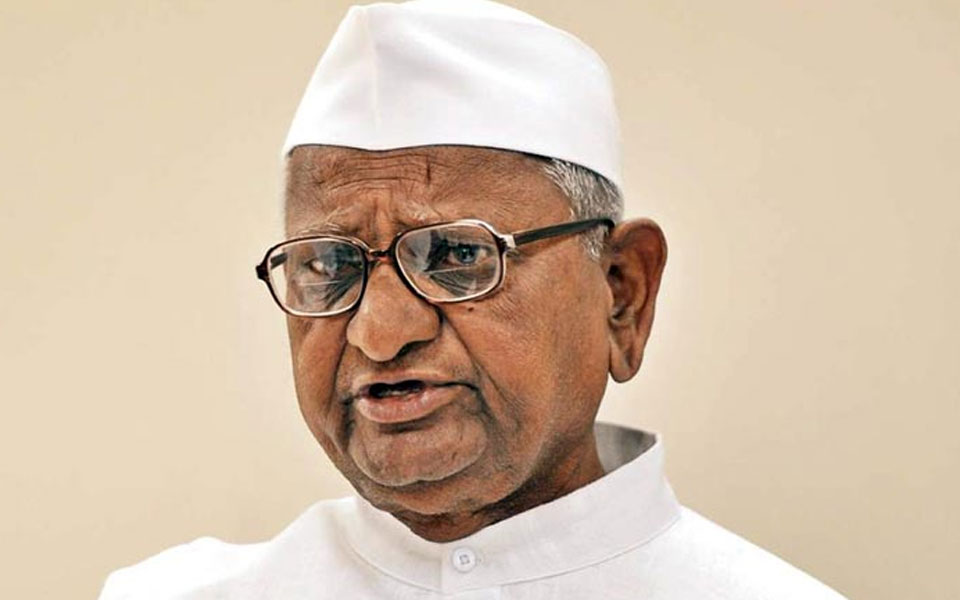
Pune: Anti-corruption crusader Anna Hazare was on Tuesday admitted to a hospital in Pune district of Maharashtra after he complained of cold, cough and weakness, his close aide said.
According to doctors, there is "nothing to worry" and they have advised the 82-year-old social activist to take complete rest, he said.
Hazare was taken to Vedanta Hospital in Shirur taluka of Pune from his native Ralegan Siddhi village in neighbouring Ahmednagar district on Tuesday morning for a check-up after he complained of cold and cough.
He was examined by a team of doctors and later admitted to the hospital, the activist's close associate said.
"Due to cold, he had some infection in the chest and because of this, he complained of cough and weakness. However, doctors have said that Hazare is stable and there is nothing to worry," he said.
As a precautionary measure, Hazare's routine check-ups are being conducted and he has been advised complete rest, he said, adding that the activist is likely to be discharged by Wednesday evening.
After the Lok Sabha passed amendments to the Right to Information (RTI) Act in July, Hazare had accused the Union government of betraying Indian citizens through the move.
He then said his health is not in a good condition but if people of the country take to the streets to safeguard the sanctity of the RTI Act, he would be ready to join them.
Hazare's movement earlier prompted the then state government to enact a revised Maharashtra Right to Information Act which was considered as the base document for the RTI Act 2005.
Let the Truth be known. If you read VB and like VB, please be a VB Supporter and Help us deliver the Truth to one and all.
Man arrested with Rs 2.54-crore heroin in Mumbai

Mumbai (PTI): Police have arrested a man and seized over 500 grams of heroin worth Rs 2.54 crore in the illicit market from him in Mumbai, officials said on Friday.
The police's Anti-Narcotics Cell (ANC) made the drug seizure in Santacruz in the western suburbs. The operation was conducted by the Kandivali unit of the ANC on Thursday as part of a special crackdown against drug trafficking in the area, they said.
Acting on specific inputs, an ANC team conducted a raid in Santacruz (East) and intercepted a man. During a search, the team recovered 508 grams of high-grade heroin from his possession, an official said.
The seized contraband, a highly addictive, opioid drug derived from morphine, is estimated to be worth Rs 2.54 crore in the international market, he informed.
Following the seizure, a case was registered against the man under relevant sections of the Narcotic Drugs and Psychotropic Substances (NDPS) Act, 1985, and he was formally placed under arrest in the early hours of Friday.
The police are currently investigating the source of the drug and trying to identify the intended recipients of the consignment, he said.