Answer to 'abject surrender' lies in 'grips', 'chokes' placed on PM: Rahul on India-US trade deal
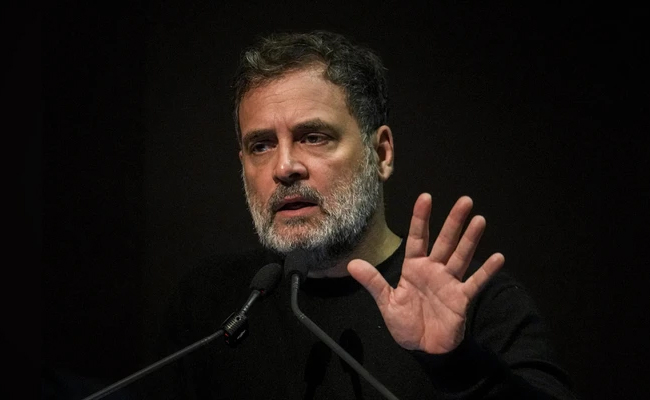
New Delhi (PTI): Stepping up his attack on the government over the interim US trade deal, Congress leader Rahul Gandhi on Friday said the answer to why Prime Minister Narendra Modi agreed to a deal, where India gives so much and appears to get so little, and make an "abject surrender" lies in the "grips" and "chokes" placed on him.
The leader of opposition (LoP) in the Lok Sabha also claimed that with this deal, India is going to become a "data colony".
Gandhi, who has been attacking the BJP-led government and accusing it of a sell-out through the deal, posted a video on X in which he invoked his recent speech in Parliament in which he had drawn a Jiu-Jitsu analogy.
ALSO READ: Defamation case: Rahul to appear before Sultanpur court
In his post on X, Gandhi said, "Why did I use a Jiu-Jitsu analogy in my Parliament speech on the trade deal? Why were our farmers sacrificed to please the Americans? Why was India's energy security compromised by allowing the US to dictate our oil supplies?"
"Why agree to increase US imports by $100 billion a year without a reciprocal promise? Why did I say this deal could turn India into a data colony? Why would Modi ji agree to a deal where India gives so much and appears to get so little? The answer to this abject surrender lies in the "grips" and "chokes" placed on the PM.
In the video, Gandhi said a lot of people have asked him why he used a Jiu-Jitsu analogy in his Parliament speech.
"The reason I used the idea of a grip and a choke is because these exist in Jiu-Jitsu and how you control an opponent in that sport. But they also exist in the political realm. And in my experience of politics, I have seen political grips and political chokes are mostly hidden. The average person cannot see them," he said.
"And you have to look carefully to see where the choke is being applied and where the grips are placed. So that was the idea behind using this. It expressed very powerfully what our prime minister is going through," he said.
The LoP said that on the one hand is the criminal case against businessman Gautam Adani in the US and on the other hand is the Epstein scandal.
"Three million files not released. We all know that (Union minister) Hardeep Puri is involved in the files, we know Mr. Anil Ambani is involved in the files and we also know the prime minister's name appears and the PM is most likely involved in the files," he said.
On the other side, there is China, Gandhi said and referred to the unreleased book of former Army chief MM Naravane.
"So on one side there is the Chinese who are sitting in our border and on the other side there is the US. Our PM is torn between these grips. He is trapped, everybody knows it, everybody can see it. The problem is that the real grip on Mr Narendra Modi is the fake image that he has built, that has been built for him, an image that has required huge amounts of money," he said.
"The key to that image is now in the hands of the US and that is why Indian farmers are going to suffer, Indian textile is going to suffer, we will be forced to buy imports from the US.
"But most important is the data. The fact that our data is being handed over by Mr Narendra Modi to American companies, to the US, for a pittance. Mark my words, we are going to become a data colony. Why did a country of the size of India hand away everything, including our data, textile industry and our agriculture sector, for what and why? The answer is in the grips and chokes that are applied on the PM," Gandhi added.
The Congress has alleged that Modi has "surrendered" before US President Donald Trump in agreeing to the deal, which, it claimed, will "devastate" the livelihoods of crores of farmers across states and sacrifice India's energy security, digital sovereignty and economic self-reliance.
It said trade agreements should not become a path to slavery by "sacrificing a country's sovereignty", and asserted that national interest cannot be mortgaged under the guise of a trade pact.
Let the Truth be known. If you read VB and like VB, please be a VB Supporter and Help us deliver the Truth to one and all.
4 held for sexually assaulting woman, girl on moving bus after social media alert in UP's Agra

Agra (UP) (PTI): Four people were arrested, after a prompt response by police following a social media alert, for allegedly sexually assaulting a woman and a girl inside a moving bus here, officials said on Tuesday.
According to an official police statement, at 12:27 am on April 27, information was received on the social media platform X about an incident of sexual assault on a bus travelling from Kanpur to Ahmedabad, which was approaching Namner crossing in Agra.
Acting under the direction of Police Commissioner Deepak Kumar, the Agra Police social media team immediately alerted the Rakabganj police station within minutes and coordinated with the victims to confirm the incident and obtain the exact location, it stated.
Police teams launched intensive checking at Namner crossing and intercepted the bus as it reached the spot. The four accused involved in the incident were apprehended on the spot, and legal action was initiated against them, the statement said.
The police said the swift response and coordination between the social media team and field units ensured timely action, bringing relief to the victims and other passengers, who expressed gratitude towards the police, it added.