Anti-corruption bill amendments correct 2 major flaws: Jaitley
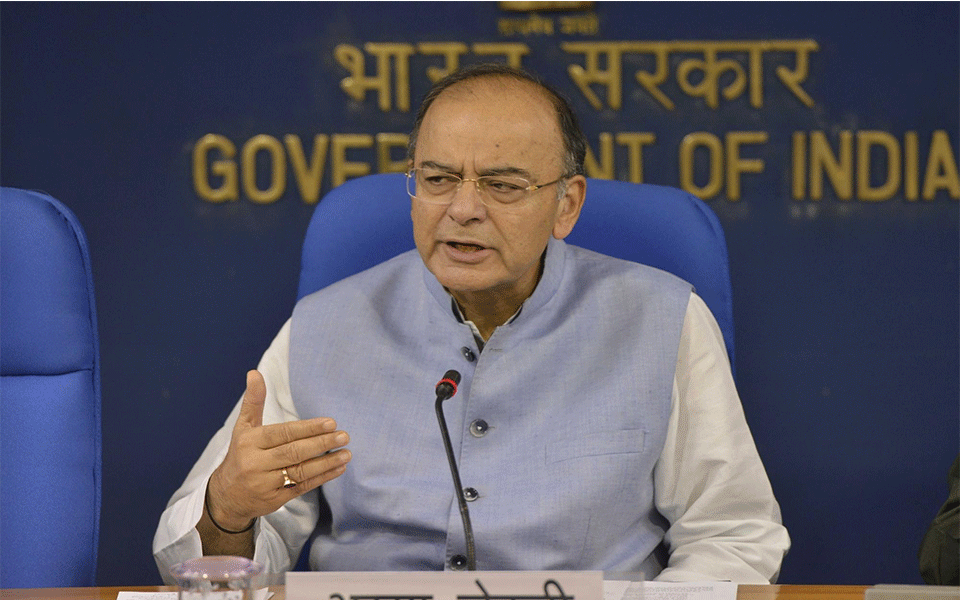
New Delhi, July 27 : The passage of the Prevention of Corruption (Amendment) Bill, 2013, corrects two fundamental flaws in the earlier Act by providing for punishment to both bribe givers and takers and requiring the element of dishonest intention of the public official to be proved for an offence, Finance Minister Arun Jaitley said on Friday.
Writing in a Facebook post following the passage of the amendments in the Lok Sabha on Tuesday, Jaitley said the present Prevention of Corruption Act, 1988, legislated in the pre-liberalisation era had not visualised the changes in the economy, "when higher participation of the private sector would take place" and neither "anticipated the kind of risk that it could put honest decision makers to".
"The Bill seeks to punish both - the bribe giver and bribe taker. It provides protection if the briber assists the investigative agency. Even non-monetary gratification has been included within the ambit of the Bill.
"Promoters of companies have been made more accountable. Since the company cannot be sent to jail, the individual in the management responsible for the corruption will be held liable," he said.
The Minister noted that the wide definition of corruption referred to as "criminal misconduct" in the original Act had a potential for including in its ambit also a "honest decision taken by honest individuals which subsequently turn out to be erroneous".
He said there were instances of loans given by an honest bank management in accordance with the rules which were subsequently questioned if the recipient of the loan defaulted "and the entire process of the banker-lender relationship was referred to an investigative agency".
"Reputations were ruined and a fear amongst decision makers was created. This witnessed a tendency where civil servants would postpone decision making to their successor rather than take the risk upon themselves.
"The new Bill, besides correcting the somewhat loose language, now requires the element of mens rea i.e. the dishonest intention to be proved for an offence of criminal conduct to be made out. This will ensure that bonafide actions of public servants are not called into question," he said.
The period of trial for corruption is now required to be completed within two years.
"The Prevention of Corruption Act merely provided for sanction for serving civil servants and not retired civil servants. On the contrary, Indian Penal Code required a sanction for those who are or have been public servants. The two Acts have now been brought at par," Jaitley wrote.
The scare created amongst the civil servants, bankers, heads of public sector undertakings and other decision makers, who have seen in the last few years professional investigation graduating into investigating adventurism, have a reason to be relieved, he added.
The Bill provides for imprisonment from three to seven years, besides fine, to those convicted of taking bribes. Bribe givers have also been included in the legislation for the first time and they can be punished with imprisonment up to seven years, fine, or both.
Let the Truth be known. If you read VB and like VB, please be a VB Supporter and Help us deliver the Truth to one and all.
4 workers die after being buried under coal slurry in Jharkhand's Dhanbad

Dhanbad (Jharkhand) (PTI): At least four workers died after being buried under coal slurry in Jharkhand's Dhanbad district on Saturday, a police official said.
The incident took place at Moonidih coal washery in the command area of Bharat Coking Coal Limited (BCCL).
"Bodies of all four workers were dug out of debris during a rescue operation," Putki police station in-charge Waqar Hussain told PTI.
The incident took place when coal slurry was being loaded into trucks by workers, during which a large chunk of slurry fell and trapped several workers underneath, officials said.
The deceased have been identified as Manik Bauri, Dinesh Bauri, Deepak Bauri, and Hemlal Gope.
Meanwhile, the family members of the deceased and local villagers placed the bodies in front of the washery gate and began a protest.
They demanded compensation, jobs for dependents and action against those responsible for the incident.
Police and administration officials are trying to pacify the protesters, an official said.