Any individual with fever to be considered Covid suspect: Government
Set up 24x7 RAT booths at different locations, encourage self-test: Centre to states, UTs
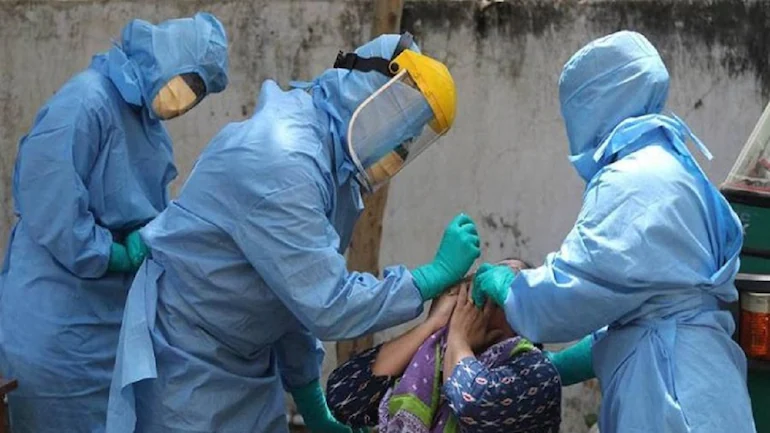
New Delhi, Jan 1: Amid the new surge in Covid cases, the Centre has asked all states and union territories to set up round-the-clock Rapid Antigen Test booths at different locations, engage medical and paramedical staff, and encourage the use of home test kits for symptomatic individuals.
In a letter to all chief secretaries, Union Health Secretary Rajesh Bhushan and ICMR Director General Balram Bhargava said any individual having fever with/without cough, headache, sore throat, breathlessness, body ache, the recent loss of taste or smell, fatigue, and diarrhoea should be considered as a suspect case of COVID-19 unless proven otherwise.
"All such individuals must be tested. While awaiting the test results, they should be advised to immediately isolate themselves and follow the home isolation guidelines of Ministry of Health & Family Welfare," the letter said.
It said that as of now, India has a network of 3,117 molecular testing laboratories, which includes 2014 RT-PCR, 941 TrueNat, 132 CBNAAT and 30 other testing platforms.
The estimated national daily molecular testing capacity is more than 20 lakh per day, the letter to the chief secretaries said. "You are advised to upscale testing for Covid-19 in your State/UT by fully utilizing the existing molecular testing capacity."
"In addition, you may also expedite procurement of necessary testing equipment and establish BSL-2 laboratory infrastructure from the funds sanctioned to your State/UT by the Ministry of Health and Family Welfare, under the Emergency COVID-19 Response Plan (ECRP)," it said
The letter said that RTPCR-based testing leads to delays in confirming diagnosis due to its turnaround time of about 5-8 hours. "Therefore, you are encouraged to increase testing by widespread use of rapid antigen tests (RATS) in such specific situations where RTPCR testing poses challenges," the two senior health officials said in the letter.
In such specific situations, it is recommended to increase rapid antigen testing for COVID-19 through multiple RAT booths in identified geographies and operationalised on a 24x7 basis to offer widespread testing and easier access to all citizens, they said.
"RATS may be allowed at government and private health care facilities including all hospitals, dispensaries, nursing homes, clinics, district hospitals, primary health centers etc," they said.
In addition to healthcare facilities, states and union territories are also encouraged to engage appropriate medical and paramedical staff and to set up and operationalse RAT booths at convenient locations, they said.
The use of self-tests/home tests may be encouraged for symptomatic individuals, they said, adding seven such home testing kits have been approved so far and two of them are also available on GeM.
Most of the test kits/products approved by Indian Council of Medical Research are now available on the GeM portal and can be easily procured from GeM, the letter said.
"Appropriate public-private partnership models may also be explored to establish innovative and convenient testing centers to augment testing in an expeditious way. RATS must be conducted in accordance with RAT algorithm defined by ICMR," the letter said.
"You may appropriately refine the State procurement procedures for emergency procurement from market to expedite the process," they said.
Let the Truth be known. If you read VB and like VB, please be a VB Supporter and Help us deliver the Truth to one and all.
Real Madrid fines Valverde and Tchouaméni half a million euros each for altercation

Barcelona (AP): Real Madrid slapped players Federico Valverde and Aurélien Tchouaméni with half-a-million-euro ($588,000) fines on Friday for their altercation during practice.
The massive fines came a day after the midfielders tussled when the team trained. Valverde said in a post on social media on Thursday that no punches were thrown. But Valverde knocked his head on a table and he suffered a small cut that required a brief hospital visit.
On social media, Valverde initially called it a “meaningless fight” with a teammate and said “everything has been blown out of proportion."
His employers, however, considered it a significant enough breach of team discipline to nail both Valverde and Tchouaméni with fines that bite even the bank account of a top soccer player. The half-a-million euro penalties reflect the reputational damage the club was enduring in a chaotic end to a disappointing season.
In a statement, the 15-time European champion said its disciplinary action was concluded after both players expressed to the club “their complete remorse for what happened and apologized to one another.”
Madrid added they also apologized to their teammates, the coaching staff and club supporters, as well as showing their willingness to accept whatever disciplinary action the club deemed “opportune.”
Tchouaméni was back training with Madrid on Friday, two days before they play at Barcelona in a clasico. Madrid has to win otherwise Barcelona will be crowned La Liga champion.
After being notified of the fine, he posted a public apology to the club and its fans on social media.
“What happened this week in training is unacceptable,” Tchouaméni wrote. "I say this while thinking about the example we are expected to set for young people, whether in football or at school.
“Above all, I am sorry for the image we projected of the club.”
Valverde was not at practice due to the head knock.
Both players are set to play in the World Cup next month, with Tchouaméni playing for France and Valverde for Uruguay.
Chaotic end to a poor season
===================
The run-in between the players, who for seasons have played side by side in Madrid's midfield, came after they argued this week in previous training sessions. But tempers boiled over on Thursday. Spanish media was rife with reports that the players previously disagreed over the club's decision to let coach Xabi Alonso go after just months on the job.
It was not the only altercation involving Madrid players during training this week. Álvaro Carreras confirmed he was in a “minor” incident with a teammate. Spanish media said he and fellow defender Antonio Rüdiger got into a scuffle.
Álvaro Arbeloa, the coach who was promoted from Madrid's reserve team when Alonso was fired in January, will face tough questions on what went wrong inside the changing room when he gives a press conference on Saturday ahead of the clasico at Camp Nou.
Madrid is facing a second consecutive campaign without a major trophy amid rumors in the Spanish media that club president Florentino Pérez is considering bringing back Jose Mourinho to straighten out his underperforming team.