Army considers induction of women cadres in Territorial Army battalions, say sources
New Delhi (PTI): The Army has considered inducting women cadres into the Territorial Army battalions as a pilot project, with their recruitment to be initially limited to a few battalions, sources said on Sunday.
The move is aimed at gradually opening up more opportunities for women in the force.
The Territorial Army, in its current form, came into being with the enactment of the Territorial Army Act on August 18, 1948. It was formally inaugurated by the first Indian Governor General, C Rajagopalachari, on October 9, 1949.
According to sources, the Army has considered the induction of women cadres into Territorial Army battalions as a pilot project. Their recruitment, initially, will be limited to a few battalions, and may increase subsequently in other battalions based on initial feedback, they added.
The government has been emphasising the essence of 'Nari Shakti' in the armed forces.
In a written response to a query in Rajya Sabha in March 2022, then Minister of State for Defence Ajay Bhatt had said the combat employment philosophy of women in the armed forces is a continuously evolving process and regularly reviewed by them.
"At present, women are being commissioned in the Indian Army into 10 arms and services, viz., Corps of Engineers, Corps of Signals, Army Air Defence, Army Service Corps, Army Ordnance Corps, Corps of Electronics and Mechanical Engineers, Army Aviation Corps, Intelligence Corps, Judge Advocate General Branch and Army Education Corps in addition to the Armed Forces Medical Services," he had said.
The Territorial Army was raised on the concept of being a 'citizen soldier's army'. Besides augmenting the organisational requirements, the Territorial Army also provides an opportunity to able-bodied volunteer citizens of India, especially those who are overage for enrollment in the regular army, to serve the nation in uniform.
Presently, the Territorial Army has a strength of approximately 50,000 personnel comprising 65 Departmental TA units such as Railway, IOC, ONGC, and Non-Departmental TA units of Infantry Battalion (TA) including Home and Hearth Battalions, Ecological Battalion (TA) affiliated to various Infantry Regiments and Engineer Regiment (TA) for maintenance of Line of Control fencing, according to its website.
The Territorial Army units were actively involved in 1962, 1965 and 1971 operations. The "Terriers" had also taken part in Operation Pawan in Sri Lanka, Operation Rakshak in Punjab and Jammu and Kashmir, Operation Rhino and Operation Bajrang in the northeast in the most active manner.
Let the Truth be known. If you read VB and like VB, please be a VB Supporter and Help us deliver the Truth to one and all.
Women’s Reservation Bill: K'taka CM accuses PM Modi of adopting 'double standard'
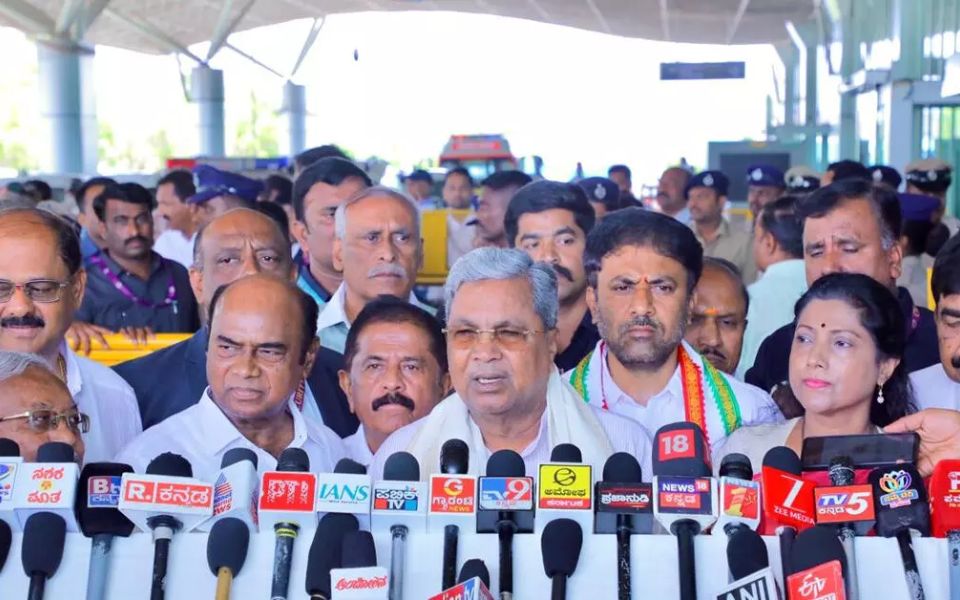
Mysuru (Karnataka) (PTI): Karnataka Chief Minister Siddaramaiah on Monday accused Prime Minister Narendra Modi of adopting a “double standard” on women’s reservation, alleging that the Centre had delayed implementation despite having the opportunity to act earlier.
Addressing reporters here, Siddaramaiah said the BJP and Modi had earlier opposed welfare guarantees and were now replicating them, while also questioning the timing and intent behind the women’s reservation move.
“That’s what I call double standards. Narendra Modi is not for social justice. If he was, this would have been done long ago. How many years has he been in power? It’s been 12 years. Why hasn’t it been done so far?” he asked.
The Chief Minister reiterated that the Congress had consistently supported women’s reservation and accused the Centre of "politicising" the issue.
“We spoke about women’s reservation. The Prime Minister asked me what our stand was. I said we are in favour of women’s reservation,” he said, referring to recent discussions with the PM.
He maintained that delimitation should only be carried out after a fresh Census to ensure equitable representation among states.
“In my view, delimitation should be done after a new census. That is why we opposed it. We have not opposed women’s reservation. We have always supported it,” he said.
Highlighting Congress’ past role, he said, “Who brought the 73rd and 74th amendments? Rajiv Gandhi and the Congress party. Those amendments ensured 50 per cent reservation for women in local bodies. Why would we oppose it?”
Siddaramaiah further questioned the union government’s delay in implementation. “Narendra Modi indulged in politics and got it passed in 2023. Why didn’t he implement it immediately? Then why did he wait so long? He could have implemented it immediately. If he is committed to women’s reservation, he should have implemented it,” he said.
On the linkage between delimitation and reservation, he asked, “Why did the Centre link it with delimitation? Why did it go for a constitutional amendment?” adding that such a move could disadvantage southern states that have successfully controlled population growth.
“Southern states have controlled population well, but northern states haven’t. Naturally, it benefits them and disadvantages us,” he said.
Responding to BJP’s criticism that women would “teach Congress a lesson,” Siddaramaiah said, “They are doing politics. If Modi had brought this earlier, who would have opposed women’s reservation?”
On electoral prospects elsewhere, he said he had no direct information on Tamil Nadu but was optimistic about ruling DMK's victory.
"According to the information I have, DMK and its alliance are likely to win,” while asserting that Kerala would also be won by the opposition.
In a major setback to the BJP-led Central government, a Constitution Amendment Bill to implement 33 per cent reservation for women in legislatures in 2029 and increase the number of Lok Sabha seats to 816 was defeated on Friday, with the ruling dispensation asserting that the struggle to give the rights to women will continue.
While 298 members voted in support of the bill in Lok Sabha, 230 MPs voted against it. Out of 528 members who voted, the bill required 352 votes for a two-third majority.
According to the Constitution (131st Amendment) Bill, Lok Sabha seats were to be increased to 816 from the current 543 to "operationalise" the women's reservation law before the 2029 parliamentary polls, following a delimitation exercise based on the 2011 Census.
Seats were also to be increased in state and Union territory assemblies to accommodate 33 per cent reservation for women.