Army deployed to stop infiltration of Rohingyas: Rajnath Singh
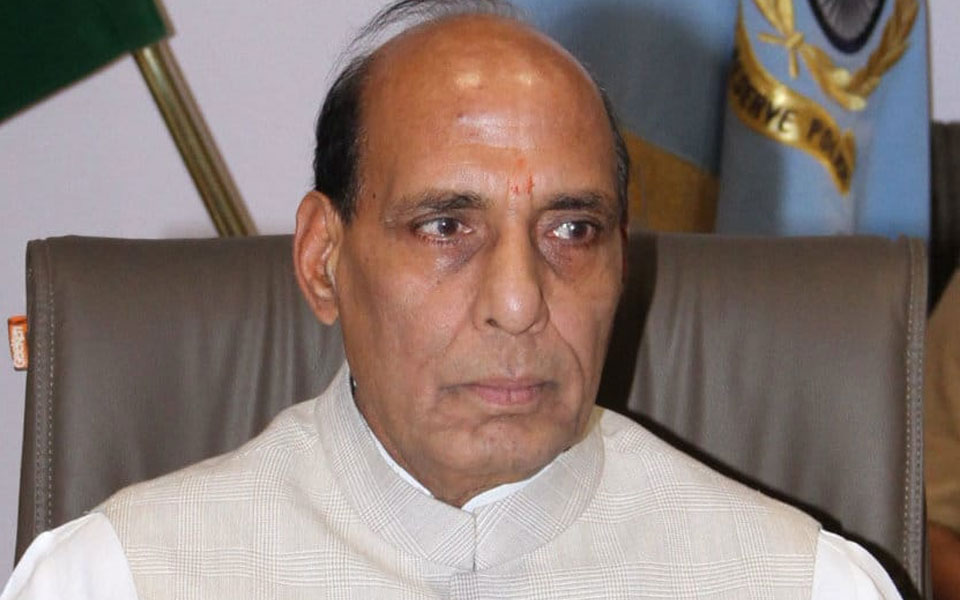
New Delhi, July 31 : The Centre on Tuesday said that the Army has been deployed to stop Rohingya Muslims' infiltration into the country and has also directed the states not to let them spread.
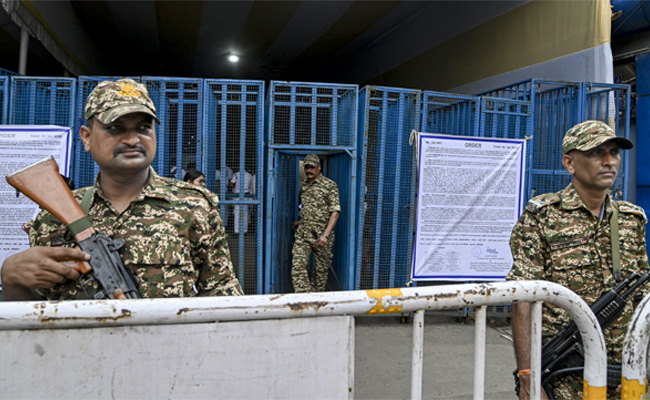
"The Border Security Force (BSF) and the Assam Rifles are deployed to stop further infiltration of the Rohingyas," Union Home Minister Rajnath Singh told the Lok Sabha during the Question Hour.
He also said he has issued an advisory to states to monitor those who have already infiltrated. "They have been asked to keep them in one place and not let them spread. States also have the right to deport them," Rajnath Singh said.
Trinamool Congress member Sugata Bose raised the issue that the Ministry of External Affairs is carrying out "Operation Insaniyat" (Operation Humanity) in Bangladesh while on the other hand it started the process of deportation of Rohingyas from the country.
"External Affairs Ministry is conducting operation insaniyat (humanity) for Rohingyas in Bangladesh. There are about 40,000 Rohingyas in India," Bose said.
"Will we show insaniyat for only those who are in Bangladesh?" Bose asked.
The Trinamool member also questioned whether the country was prepared to abide by all international law. He said it was the Indian tradition to give refuge to people.
Responding to Bose's remarks, Minister of State for Home Affairs Kiren Rijiju said: This is an unfortunate statement by him. India is probably the only country which has adopted such a soft approach to refugees.
He said that despite being not in the UN treaty to receive refugees, India has given shelter to millions. "Still, thousands of refugees are staying in India. India has been very soft towards immigrants but that doesn't mean that there will be no system to regularise it. Our priority is taking care of our citizens first," Rijiju said.
"Our government created refugee camps in Rakhine province. But instead of lauding the works of the government you are defaming the country," he said. It even offered help to Myanmar to assist in their resettlement.
"Rohingya population is highest in Jammu and Kashmir but they cannot be allowed to become a burden," the minister added.
Bharatiya Janata Party member Jugal Kishore Sharma alleged that in February the Sunjuwan army camp attackers came via Rohingya Muslims' houses in Jammu and Kashmir.
Let the Truth be known. If you read VB and like VB, please be a VB Supporter and Help us deliver the Truth to one and all.
Modi govt rattled by Rahul’s Great Nicobar visit; project concerns need Parliament debate: Cong

New Delhi (PTI): The Congress on Sunday flagged in detail concerns related to ecology, tribal rights, transparency and security, over the Great Nicobar project, and asserted that these considerations must be debated in a parliamentary forum.
The opposition party claimed that the Modi government is "rattled" and in damage control mode after Leader of Opposition in the Lok Sabha Rahul Gandhi's visit to Great Nicobar last week.
In a statement, Congress general secretary in-charge communications Jairam Ramesh said, "The Modi Government, clearly in damage control mode after the hugely impactful visit of the Leader of the Opposition in the Lok Sabha, Rahul Gandhi, to Great Nicobar on April 28 2026, issued a press note on the Great Nicobar Island Development Project three days later."
This press note does not address any of the serious concerns that have been raised on it by local affected communities, environmentalists, anthropologists, academics, civil society experts and other professionals, Ramesh said.
"These concerns had already been conveyed in detail by me to the Union Minister of Environment, Forests & Climate Change on September 10, 2024 and in a follow-up on September 27, 2024," the former environment minister said.
During his visit to Great Nicobar, Gandhi last week alleged that the Great Nicobar project at Campbell Bay in Andaman and Nicobar Islands was "one of the biggest scams and gravest crimes against the natural and tribal heritage of the country".
The government on May 1 released a detailed statement with answers to FAQs (frequently asked questions).
"The Great Nicobar Project is a strategic initiative to strengthen India's presence in the Andaman Sea. It seeks to balance port-led growth with calibrated environmental safeguards. Protection of indigenous communities remains central to its planning," the government statement had said.
"The project combines strategic, economic, and ecological priorities. This ensures that development is sustainable, inclusive, and aligned with national interests," it had said.
In his four-page detailed statement, Ramesh spelt out the key concerns over the Great Nicobar project.
Flagging ecological concerns, Ramesh said the Great Nicobar is unique and distinctly different from all other islands in the Andaman and Nicobar group.
"The Government's claim that only 1.82% of the total land of the island group is being used for the project is irrelevant and misleading. It ignores the ecological and biological richness of the Great Nicobar ecosystem, which is unique both in the island group and in the world," he said.
"Galathea Bay, the site of the port, is unequivocally a Coastal Regulation Zone (CRZ) is a site where port construction is not allowed. As per records of the Zoological Survey of India, Galathea Bay is home to more than 20,000 coral colonies, a key marker of a CRZ-1a categorisation. Similarly, the beach here is the most important nesting site of the Giant Leatherback turtle in the Northern Indian Ocean," Ramesh said.
The recently concluded turtle nesting season saw record turtle nesting at Galathea Bay, he pointed out.
Ramesh alleged that institutions like the Wildlife Institute of India (WII) and Zoological Survey of India (ZSI) were literally coerced to play a key role in the environmental clearance and related process for the project.
"These very institutions have now been awarded projects for biodiversity research and monitoring in Great Nicobar. There is a clear conflict of interest here," he argued.
In addition, a couple of reputed and independent-minded institutions that have been very critical of the project have been blacklisted by the Modi government, he said.
Similar is the case with the high-powered committee (HPC) constituted by the National Green Tribunal (NGT) in the matter of the challenge to the project's environmental clearance granted, he said.
All the HPC's members either represented the project proponents or agencies which granted the clearances, Ramesh said.
He said the proposal for compensatory afforestation in Haryana is a travesty of ecological principles.
Flagging tribal rights concerns, Ramesh said the Nicobarese Tribal community has expressed concerns multiple times about the project and its impact on their forests, rights, and way of life.
"In November 2022, they withdrew the NoC they had granted for forest diversion saying that they were rushed to sign by concealing the extent of tribal areas to be affected by the project. Representatives of the Nicobarese community also stated in a recent press conference that they were being forced to voluntarily surrender their land for the project," he pointed out.
The claims stand even more exposed in the matter of the Shompen, a Particularly Vulnerable Tribal Group (PVTG), that lives a life of hunting and gathering in the deep forests of Great Nicobar, Ramesh said.
The Shompen are a primarily uncontacted community and there are no non-Shompen speakers of their language, he pointed out.
"It is not clear then how the project authorities have taken their informed consent, which is both ethically appropriate and legally mandated," Ramesh said.
Pointing out that government release has claimed that the airport in Great Nicobar will eventually handle 10 million passengers annually, Ramesh said this appears prima facie to be a huge over-estimation given that the current airport at Port Blair handles 1.8 million passengers annually.
"The deliberations of the Forest Advisory Committee for granting the project's forest clearance were not made public. The report submitted by the High-Powered Committee that examined the clearance granted to the project was kept confidential. The field report prepared by the National Centre for Sustainable Coastal Management (NCSCM) that pronounced the status of the site of the port from CRZ-1A to CRZ-1B overnight, remains confidential," he pointed out.
Ramesh also flagged security concerns about the project, saying no less a person than the courageous former Chief of Naval Staff Admiral Arun Prakash (Retd) himself has argued in an article that "the security capabilities of ANC (Andaman & Nicobar Command) need to be addressed separately and must have no linkage with the developments contemplated for GNI (Great Nicobar Island)."
"There is thus no need to link India's legitimate security imperatives with the so-called 'development project' - complete with a township, high-end tourist infrastructure, and large transshipment terminal - that the Modi Government is intent on bulldozing through and on which it is now trying to muzzle genuine and much-needed debate hiding behind "security considerations", he said.
"These considerations must, at the very least, be discussed and debated in a Parliamentary forum," Ramesh said.