Army should be brought in Ayodhya, if required: Akhilesh Yadav
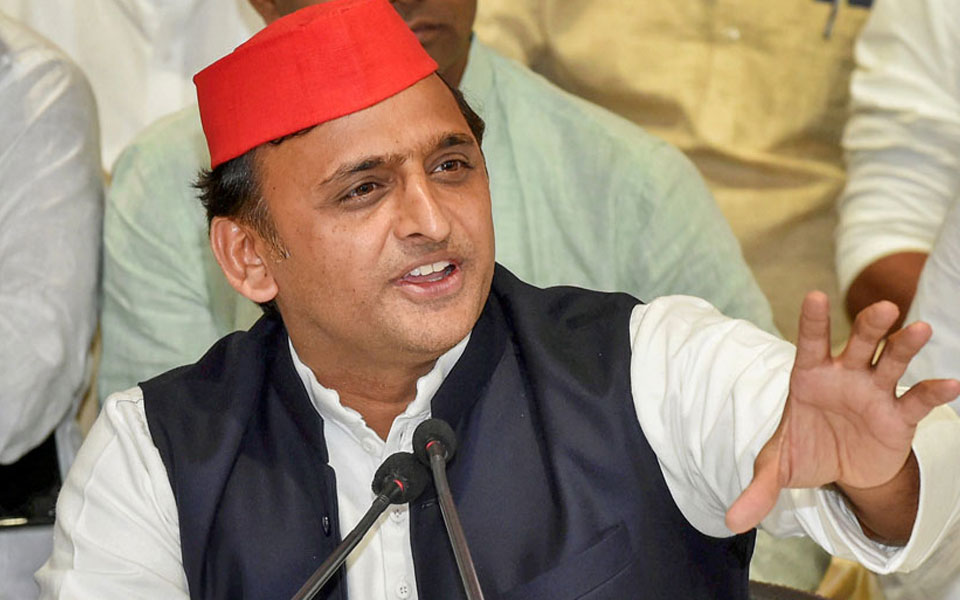
Ayodhya, Nov 24 : Ahead of the Dharam Sabha being held in Ayodhya Sunday to push for the construction of a Ram temple, Samajwadi Party chief Akhilesh Yadav has said if required the Army should be deployed in the town.
Thousands of people have started gathering in the town ahead of the Vishva Hindu Parishad event.
Shiv Sena leader Uddhav Thackeray has also arrived here Saturday for a separate programme.
Talking to reporters Friday, Yadav had said, "The Supreme Court should take notice of the situation in Uttar Pradesh. It should seriously consider the matter and bring in the Army, if required... as the BJP and its allies can go to any extent," Yadav told reporters.
Uttar Pradesh Deputy Chief Minister Keshav Prasad Maurya dismissed Yadav's claims, saying his remarks simply showed his frustration as it was a Dharam Sabha and the Army was not needed for it.
When asked that a significant section of the Muslim community was feeling apprehensive about the event, he tried to allay the fears.
"No one needs to fear (anything) as there is peace in Uttar Pradesh. The government has made elaborate security arrangements to ensure that no untoward incident takes place," he told PTI.
Referring to the firing on unarmed karsewaks in 1990, Maurya said, "If Akhilesh Yadav is thinking that a 1990-like situation will prevail, then this will not happen under the government headed by Yogi Adityanath. We will provide adequate security to all and take all necessary action."
"This is a Dharam Sabha, and there is no need to deploy the Army, and Akhilesh Yadav must understand this," the UP deputy Chief Minister said.
On the eve of the VHP's Dharam Sabha, the temple town was virtually turned into a fortress will multiple layers of security and deployment of drones.
A UP Police spokesperson said one additional DGP, one deputy inspector general (DIG), three senior superintendents of police (SSPs), 10 additional SPs, 21 deputy SPs, 160 inspectors, 700 constables, 42 companies of PAC, five companies of RAF, ATS commandos and drones were deployed here.
The Dharam Sabha is being touted as one of the largest congregations of Lord Ram devotees after December 6, 1992, when the Babri Masjid was demolished, but some Muslim leaders view it as a move to polarise the voters ahead of the 2019 Lok Sabha elections.
Some members of the community had recently said they felt insecure as they remembered the attacks on Muslims in 1992 after the demolition on Babri Masjid.
Mohammad Umar a plaintiff in the Ram Janmabhoomi-Babri Masjid title suit, said, "Ayodhya is our birthplace, we have been here from many generations, but we still remember how the VHP and Shiv Sena activists attacked Muslims after the demolition of the mosque on December 6."
Another plaintiff, Haji Mahboob, had said, "It is a fact that the Muslim population here is in a grip of fear over a possible attack by activists. They are feeling quite insecure."
Ayodhya Municipal Corporation Mayor Rishikesh Upadhyay said there was not fear or apprehension among the Muslims.
"Some vested interests, who seeing that all their plans may fail to reap political dividends, have started spreading rumours," he said.
The mayor said the environment in Ayodhya was peaceful and harmonious and the people were going about their daily routine.
"Dharam Sabha and Dhara Sansad had been held here earlier as well. There are a handful of self-proclaimed leaders, who were trying to take this as an opportunity to realise their political interests but, their plans did not materialise," he said.
Elaborating on the security arrangements, Upadhyay said adequate arrangements were made by the police and district administration.
"As many as 13 parking slots were provided for the event. Shiv Sena leaders took part in aarti and met seers in the temple town. No permission was given to them by the government to hold a rally," the Ayodhya mayor said.
The co-convenor (organisation) of the Muslim Rashtriya Manch, which is the affiliate of the Rashtriya Swayamsevak Sangh (RSS), dismissed the reports of fear among the Muslims as false.
"A large number of Muslims have pledged to construct a Ram temple in Ayodhya. As many as 500 programmes will be held across the country from November 20 to December 2 to spread this message," the co-convenor Moraridas said.
He said a campaign had also been started that "we (Muslims) are not minorities, we are the 'maalik' of Hindustan".
Let the Truth be known. If you read VB and like VB, please be a VB Supporter and Help us deliver the Truth to one and all.
Trump says EU has until July 4 to approve last year's trade deal or it will face higher tariffs
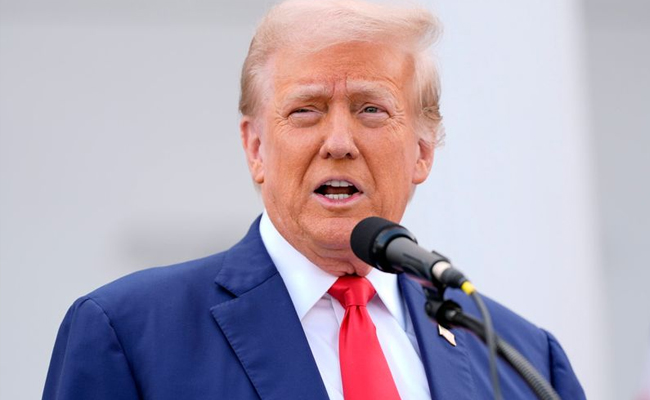
Washington (AP): President Donald Trump has said in a social media post that goods from the European Union would face higher tariff rates if the 27-member bloc fails to approve last year's trade framework by July 4.
The announcement on Thursday appeared to be a deadline extension after the president said last Friday that EU autos would face a higher 25 per cent tariff starting this week. Trump made the updated announcement after what he described as a "great call" with European Commission President Ursula von der Leyen.
Still, the US president was displeased that the European Parliament had yet to finalize the trade arrangement reached last year, which was further complicated in February by the US Supreme Court ruling that Trump lacked the legal authority to declare an economic emergency to impose the initial tariffs used to pressure the EU into talks.
"A promise was made that the EU would deliver their side of the Deal and, as per Agreement, cut their Tariffs to ZERO!" Trump posted. "I agreed to give her until our Country's 250th Birthday or, unfortunately, their Tariffs would immediately jump to much higher levels."
It was unclear from the post whether Trump was implying that the tariff rates would jump on all EU goods or the increase would only apply to autos.
His latest statement indicates he might be backing away from his earlier threat on EU autos by giving the European Parliament several more weeks to approve the agreement.
Under the original terms of the framework, the US would charge a 15 per cent tax on most goods imported from the EU.
But since the Supreme Court ruling, the administration has levied a 10 per cent tariff while investigating trade imbalances and national security issues, aiming to put in new tariffs to make up for lost revenues.