Army soldiers in uniform sit at feet of Dhirendra Shastri who vows to turn India into Hindu Rashtra
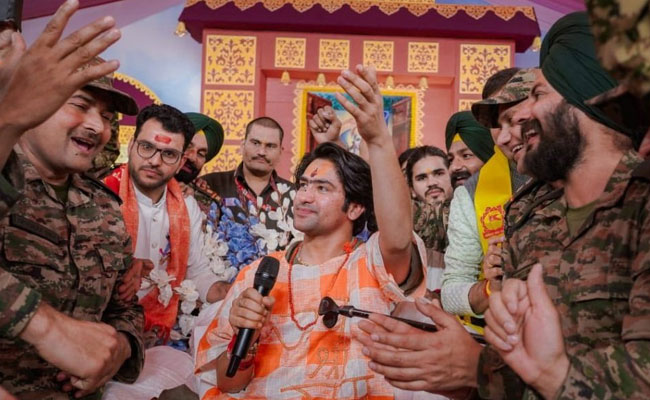
Chandigarh: Videos circulating widely on social media showing Indian Army soldiers in uniform attending a religious event in Kota, Rajasthan, have triggered serious concern within military circles, The Wire has reported. The ceremony was led by self-styled Hindu godman Dhirendra Krishna Shastri, popularly known as Baba Bageshwar, and took place just days ahead of Republic Day.
According to The Wire, the video clips, which have gone near-viral online but have not drawn any official acknowledgement so far, show soldiers from the 14 Sikh unit stationed in Kota, as identified by local media reports, seated among followers of the godman.
The footage shows the soldiers offering obeisance to Shastri, the head priest of the Bageshwar Dham temple in Madhya Pradesh, who is known for claiming divine mind-reading abilities. The soldiers are seen presenting offerings before sitting at his feet, many with folded hands, listening to his sermon. The Wire reported that local news sources claimed the unit’s commanding officer publicly felicitated Shastri on behalf of the Indian Army and later shared a video clip of the event.
Responding to queries, the Indian Army spokesperson in New Delhi told The Wire that he was not aware of the Kota event and clarified that it had not been officially organised by the army. He added that while visiting places of worship in uniform is not prohibited for military personnel, the event itself did not have official sanction.
During the gathering, Shastri addressed a congregation that included a large number of soldiers. As reported by The Wire, he urged citizens to salute the armed forces on Republic Day, invoking familiar narratives about their sacrifices along India’s borders and in the Himalayan region. “We sleep comfortably at night because soldiers remain alert, risking their lives for our safety,” he said. “Do not see them as servants, but salute them as veer, the brave, who guarantee our security.”
However, The Wire noted that what has unsettled many retired officers is not the praise of soldiers, but the context in which it was delivered and received. Veterans said that the visual of uniformed soldiers seated at the feet of a godman effectively positioned him as a symbolic intermediary between faith, nation and the military.
Calling the Kota event “blatantly performative and highly avoidable”, Major General A.P. Singh (retd) told The Wire that it embedded soldiers within a religious narrative shaped by a self-proclaimed Hindu godman. He said such conduct ran directly counter to the ethos of a secular army, where even overt religious symbols like tilaks were once actively discouraged. Singh warned that such displays blurred the carefully maintained separation between the personal faith of soldiers and their professional identity.
A wide range of other senior veterans, speaking to The Wire on condition of anonymity, echoed these concerns. They said that when soldiers and officers are seen publicly offering obeisance to a controversial religious figure, particularly one associated with ideological mobilisation, it risks reframing the army not as a constitutionally grounded institution but as an adjunct to a cultural or religious project.
These veterans warned that overt religiosity of this kind, which they said has grown sharply in recent years, undermines the army’s secular foundations and threatens its internal cohesion. The timing of the event, so close to Republic Day, and its wide circulation on social media further deepened these anxieties, The Wire reported.
More fundamentally, they argued that respect and gratitude for the Indian Army require no religious mediation. National appreciation, they said, does not demand ritualised reverence before godmen.
“The Indian Army draws its legitimacy from the Constitution, not from religious sanction,” a retired three-star officer told The Wire. When this distinction is blurred, whether deliberately or through thoughtless spectacle, the implications extend well beyond a single event or viral video. It strikes at the core principle of a professional military accountable only to the republic it serves, he said, declining to be named for fear of repercussions.
A retired one-star officer based in Chandigarh told The Wire that uniformed soldiers engaging in such public displays of religious obeisance was deplorable. He added that the situation became even more troubling given the questionable credentials of the godman involved.
Dhirendra Krishna Shastri, also known as Bageshwar Dham Sarkar, has risen to prominence less through recognised spiritual authority and more through spectacle and controversy. He has built a mass following by claiming divine mind-reading abilities and miracle cures, practices widely criticised for promoting superstition rather than genuine religious belief.
His influence extends beyond religion into open political advocacy. Shastri has called for India to be declared a Hindu rashtra and has participated in religious conversion campaigns, while also cultivating proximity to political power. In January 2023, he faced scrutiny after avoiding a public challenge from a rationalist to substantiate his divine claims. He has also drawn criticism for controversial statements, including opposition to the Bollywood film Pathaan.
According to The Wire, Shastri routinely frames Hindu faith as inseparable from nationalism, presents religiosity as a marker of cultural loyalty, and portrays what he calls a “Sanatan awakening” as a civilisational obligation. Critics have often been dismissed by him as anti-national, while distinctions between faith, citizenship and political belonging are repeatedly blurred in his public speeches.
A former colonel told The Wire that associating uniformed soldiers with such a figure not only compounded the impropriety of the Kota episode but raised serious questions about institutional judgement and the enforcement of boundaries governing military conduct. Allowing such activity, he said, clouds the line between personal belief and professional duty, between national service and political or religious messaging.
Veterans also flagged the timing of the event as particularly troubling. Republic Day, they said, commemorates constitutional values, not religious mobilisation. Soldiers appearing in such settings risk alienating minority personnel within the force, weakening cohesion and reinforcing perceptions of politicisation, The Wire reported.
Equally concerning, veterans pointed out, was the absence of any immediate corrective action or visible command accountability. Army regulations and long-standing norms exist precisely to prevent such incidents, one former officer told The Wire, warning that their apparent erosion signals a troubling institutional drift and the normalisation of conduct once considered unacceptable.
The Wire also recalled comments made by retired Lieutenant General D.S. Hooda in The Tribune last December. Hooda had said that while senior officers may visit religious institutions in private, there was no justification for officially publicising such visits on social media, a trend he noted was becoming increasingly common.
Hooda had warned that even the appearance of endorsing a single faith risks damaging the trust that binds a diverse military together. He described the blurring of the line between private belief and institutional endorsement as deeply corrosive to the army’s secular and professional character.
The Wire noted that Hooda’s comments came amid criticism over footage showing Army Chief General Manoj Dwivedi, dressed in saffron attire, praying at the Mahakaleshwar Jyotirlinga temple in Ujjain last December alongside defence minister Rajnath Singh. While Opposition leaders criticised the visuals, the BJP defended them.
Former Union minister and BJP leader Rajeev Chandrashekhar told Times Now that nobody should object to the defence minister or the Army Chief practising their faith, adding that those who did should “look for a hole and bury themselves in it”.
Months later, shortly after Operation Sindoor in late May, General Dwivedi visited spiritual leader Jagadguru Rambhadracharya at his ashram in Chitrakoot, Madhya Pradesh, once again publicising the visit. The Wire reported that this prompted fresh questions about senior military leaders undertaking personal religious engagements in uniform.
Following that meeting, Rambhadracharya told PTI that he had initiated the Army Chief into the Ram Mantra and later claimed that he had asked for Pakistan-occupied Kashmir as dakshina. He said the Army Chief responded by saying India was prepared to give Pakistan an appropriate response.
For many veterans quoted by The Wire, the Kota episode is not an isolated lapse but part of a larger pattern. They see it as evidence of rules being bent, majoritarian symbolism being indulged, and the army’s apolitical ethos being steadily weakened.
Some warned that while such incidents may not cause immediate crises, they quietly corrode the moral and professional foundations of a force that has long drawn its legitimacy from standing above religion, politics and ideology.
Veterans stressed that restraint within the armed forces is not a denial of belief but a duty owed to the institution and the nation. “The strength of the Indian Army has always lain in its ability to subsume individual identities into a shared national purpose,” Major General Singh told The Wire. Left unchecked, he cautioned, such episodes risk normalising conduct that chips away at the apolitical and inclusive foundations on which the army has stood since independence.
देश के प्रति अपना जीवन समर्पित करने वाले वीर सैनिकों का पूज्य सरकार के प्रति अपार श्रद्धा pic.twitter.com/PLesCRvLLQ
— Bageshwar Dham Sarkar (Official) (@bageshwardham) January 24, 2026
Let the Truth be known. If you read VB and like VB, please be a VB Supporter and Help us deliver the Truth to one and all.
Assam Police at Pawan Khera's residence in national capital, Delhi Police assisting

New Delhi (PTI): An Assam Police team on Tuesday is at the Delhi residence of Congress leader Pawan Khera for questioning in connection with a case linked to allegations made against Assam Chief Minister Himanta Biswa Sarma and his family, official sources said.
The team formally informed Delhi Police upon arrival, following which a local police team joined and is assisting in the proceedings, the source said.
The development comes amid a political tussle after Sarma alleged that the Congress used "false information" sourced from a Pakistani social media group to level charges against his wife regarding multiple passports and overseas assets. He termed the allegations an attempt to influence the Assam elections and a punishable offence.
Khera had recently sought clarifications on Sarma's wife's alleged foreign assets, prompting a complaint and subsequent police action.