Army to send pics of 'Yeti' footprints to domain experts
New Delhi, Apr 30: The Indian Army will send pictures and videos of large "mysterious footprints" captured by its personnel in the higher Himalayas to domain experts, sources said on Tuesday, a day after its claim suggesting the presence of the mythical Yeti close to Makalu Base Camp in Nepal earlier this month.
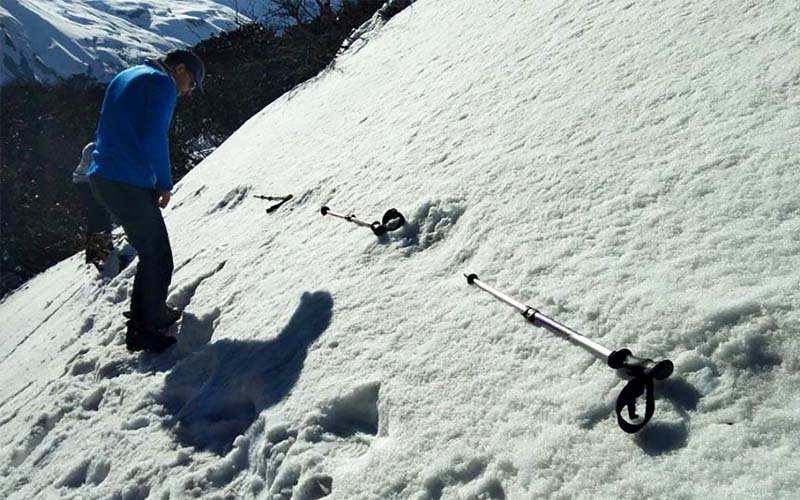
On Monday, the Army claimed its mountaineering expedition team in Nepal found mysterious large footprints in the snow that they believe belong to the Yeti, or the abominable snowman.
In Nepali folklore, Yeti is a mythical ape-like creature taller than an average human that is said to inhabit the Himalayas, Siberia, Central and East Asia.
"For the first time, an #IndianArmy Mountaineering Expedition Team has sited (sic) Mysterious Footprints of mythical beast 'Yeti' measuring 32x15 inches close to Makalu Base Camp on 09 April 2019. This elusive snowman has only been sighted at Makalu-Barun National Park in the past," the Army tweeted on Monday night.
The Army also released photos showing large footprints in the snow which they claim belong to the creature.
An Army team of 18 personnel led by Major Manoj Joshi embarked on an expedition to Mount Makalu in Nepal on April 2. On April 9, the team spotted "my
sterious footprints" measuring 32 X 15 inches to close to the Makalu base camp, the sources said.
They said the pictures were sent by the team using satellite communication.
"We will share the photos and videos with domain experts to understand more about this," the sources said.
They did not elaborate on which domain experts they will approach.
The team is expected to be back in India next month.
Makalu is the fifth highest mountain in the world at 8,485 metres. It is located in the Mahalangur Himalayas, some 19 kilometres southeast of Mount Everest, on the border between Nepal and Tibet, China.
Stories of the Yeti first emerged as a facet of Western popular culture in the 19th century.
Given the lack of evidence of its existence, the scientific community has generally regarded the Yeti as a legend.
In one genetic study, researchers matched DNA from hair samples found in the Himalaya with a prehistoric bear from the Pleistocene epoch.
Though the hunt for the mythical beast stretches back centuries, tales of a wild hairy beast roaming the Himalayas captured the imagination of climbers in Nepal in the 1920s, prompting many, including Sir Edmund Hillary, to go looking for the creature.
Sightings have been reported for centuries. Footprints have been spotted and stories have been passed down from generation to generation.
A 2017 DNA study of purported Yeti samples from museums and private collections provided insight into the origins of this Himalayan legend.
The research, published in the journal Proceedings of the Royal Society B, analysed nine Yeti specimens, including bone, tooth, skin, hair and faecal samples collected in the Himalayas and Tibetan Plateau.
Of those, one turned out to be from a dog. The other eight were from Asian bears one from an Asian black bear, one from a Himalayan brown bear, and the other six from Tibetan brown bears.
Our findings strongly suggest that the biological underpinnings of the Yeti legend can be found in local bears, and our study demonstrates that genetics should be able to unravel other, similar mysteries, said lead scientist of that study, Charlotte Lindqvist, an associate professor at the University at Buffalo College of Arts and Sciences.
Lindqvist's team was not the first to research the Yeti DNA, but past projects ran simpler genetic analyses, which left important questions unresolved.
This study represents the most rigorous analysis to date of samples suspected to derive from anomalous or mythical hominid'-like creatures, Lindqvist and her co-authors wrote in their paper.
Let the Truth be known. If you read VB and like VB, please be a VB Supporter and Help us deliver the Truth to one and all.
Sujit Nair raises concerns over speculation of DMK-AIADMK understanding to block TVK

Chennai: Journalist and political commentator Sujit Nair has expressed concern over speculation that the Dravida Munnetra Kazhagam and the All India Anna Dravida Munnetra Kazhagam could explore a post-poll understanding to prevent Vijay-led Tamilaga Vettri Kazhagam from forming the government in Tamil Nadu.
In a social media post, Sujit Nair said the election verdict in Tamil Nadu reflected a clear public demand for political change and argued that the mandate should be respected irrespective of political preferences.
Referring to reports and political discussions surrounding a possible understanding between the DMK and AIADMK, he said he hoped such developments remained only speculative conversations and did not turn into reality.
Nair stated that if such an alliance were to take shape, it would raise serious questions about ideological politics in the country. He said TVK had emerged through a democratic electoral process and that the legitimacy to govern in a parliamentary democracy comes from the people’s verdict.
According to him, attempts to prevent an electoral winner from forming the government through unexpected political arrangements may be constitutionally valid, but many people could view them as politically opportunistic.
He further said that such a move could particularly affect the political image of the DMK, which has historically projected itself around ideology, social justice and opposition politics. Nair said that in ideological terms, the DMK appeared closer to TVK than to the AIADMK, and joining hands with its long-time political rival only to remain in power could weaken its broader political narrative.
He added that the same questions would apply to the AIADMK as well, as the party had spent decades positioning itself against the DMK and such an arrangement could create discomfort among its cadre and supporters.
Drawing a comparison with Maharashtra politics in 2019, Nair said he had expressed similar views when the Shiv Sena formed an alliance with the Indian National Congress and the Nationalist Congress Party after the Assembly elections.
He said post-poll alliances between long-standing political rivals often create a public perception that ideology and electoral mandates become secondary when political power equations come into play.
Nair also said such developments increase public cynicism towards politics and reinforce the belief among voters that ideology is often sidelined after elections.
He maintained that the Tamil Nadu verdict was emphatic and said respecting both the spirit and substance of the mandate was important for the credibility of democratic politics.