Arnab Goswami’s Republic Bharat faces criticism for spreading misinformation, hate
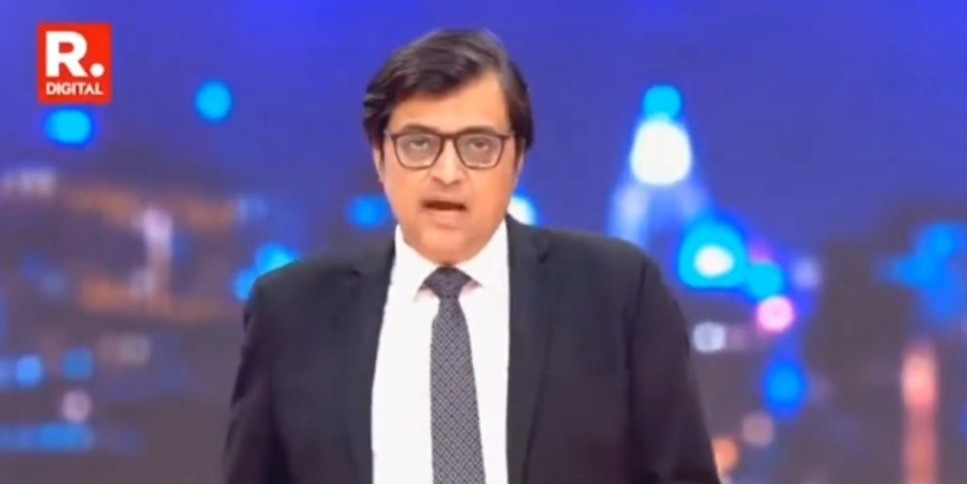
New Delhi: Republic Bharat, Arnab Goswami’s news channel, has come under fire for broadcasting alleged misinformation and engaging in communal propaganda. Several recent incidents have raised questions about the channel’s credibility and accountability.
One of the recent controversies involves Republic Bharat airing a fabricated story claiming that former US President Donald Trump called Indian Prime Minister Narendra Modi, pleading for help to control wildfires in California. The channel claimed that Modi sent helicopters to assist the US. The story was widely criticised for its lack of evidence, with even the Ministry of External Affairs remaining silent on the matter. Critics questioned the plausibility of helicopters being dispatched from India to the US, labelling the report as absurd.
In another instance, the channel broadcasted visuals using AI-generated images of Trump, Russian President Vladimir Putin, Elon Musk, and Hollywood celebrities like Will Smith and John Cena purportedly taking a dip in the Ganga during the Kumbh Mela. The video also claimed that Muslim countries were alarmed by these developments, further stoking communal tensions. Viewers and media experts have slammed such content as "sensationalist and baseless."
Once a dominant player in the Indian news market, Republic Bharat has witnessed a significant decline in TRP ratings, now ranking fifth behind channels like News18, Aaj Tak, and India TV. To revive its viewership, the channel appears to have resorted to old tactics such as inviting Pakistani panellists on debates to provoke controversies. In one such debate, a Pakistani panellist insulted and mocked the late Indian Army Chief General Bipin Rawat. Arnab Goswami did not intervene during the remarks, which sparked outrage online but failed to elicit a substantial response from authorities or the public.
Republic Bharat has also been accused of perpetuating anti-Muslim propaganda through its coverage. Analysts argue that the channel consistently airs narratives designed to spread hatred against Muslims, often relying on unverified or fabricated claims. Many believe this contributes to a divisive atmosphere in the country.
These controversies have further tarnished the reputation of Republic Bharat. Media observers have criticised the channel for stooping to sensationalism and misinformation, with some calling it a "low point in Indian journalism." Critics argue that such practices undermine the trust and integrity of the press.
Despite the widespread backlash, Republic Bharat continues its operations without any regulatory intervention giving birth to concerns about the lack of accountability for spreading misinformation. Many viewers are now calling for stricter action against channels that prioritise sensationalism over truthful reporting.
For past year there were hardly anyone watching Arnab's News Channel @republic or @Republic_Bharat
— Mohammed Zubair (@zoo_bear) January 17, 2025
To revive his channel's viewership, he has adopted old tricks.
1. Arnab invites Pakistanis for debates so that they can abuse Indians, In this particular debate, The pakistani… pic.twitter.com/zIl8wq78xW
Let the Truth be known. If you read VB and like VB, please be a VB Supporter and Help us deliver the Truth to one and all.
Vijay secures majority support, set to stake claim to form Tamil Nadu govt
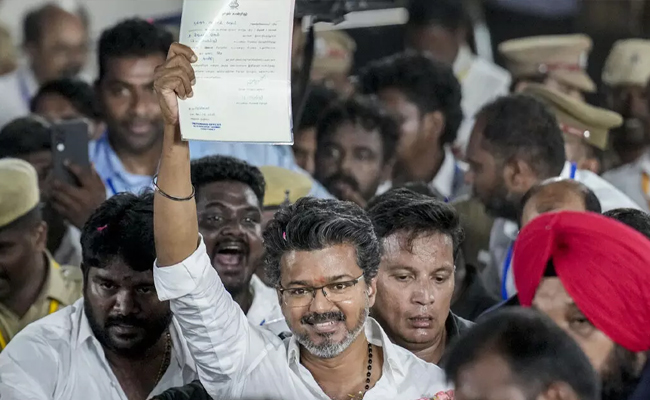
Chennai: After four days of political uncertainty and intense negotiations in Tamil Nadu, actor-politician Vijay is learnt to have secured the numbers required to form the government, sources said.
Supporters gathered outside Vijay’s residence in Chennai on Friday evening, raising slogans in support of Tamilaga Vettri Kazhagam soon after reports emerged that the party had managed to secure majority support.
Sources said Vijay is expected to meet Tamil Nadu Governor R. V. Arlekar on Friday evening to stake claim to form the government. The meeting is likely to take place around 6 pm.
In its electoral debut in the Tamil Nadu Assembly elections, TVK won 108 out of the 234 seats, dealing a major blow to the 62-year political dominance of Dravida Munnetra Kazhagam and All India Anna Dravida Munnetra Kazhagam.
However, Governor Arlekar had reportedly made it clear that the party would not be invited to form the government without proving a clear majority. Even after two rounds of discussions on Wednesday and Thursday, the Governor is learnt to have maintained his stand that letters of support from at least 118 MLAs must be submitted in the 234-member Assembly.
Apart from Vijay, TVK had the backing of 107 MLAs. Vijay had contested from Tiruchy (East) and Perambur constituencies and won both seats, meaning he would have to resign from one seat before taking oath. This increased the need for additional support.
Amid the political developments, five MLAs from the Congress party, which reportedly moved away from the DMK-led alliance, extended support to Vijay. Vijay also held discussions with leaders of Viduthalai Chiruthaigal Katchi, Communist Party of India (Marxist) and Communist Party of India.
The VCK, CPI(M) and CPI had so far been allies of the DMK. At the same time, political discussions intensified in the state over speculation that the DMK could even explore a post-poll understanding with its long-time rival AIADMK to prevent an alternative government from taking shape.
Reports had been circulating since Friday afternoon that the VCK and Left parties were likely to support Vijay. Sources later said that the VCK, CPI(M) and CPI agreed to extend the support of two MLAs each, helping TVK cross the required majority mark.
All eyes are now on the Governor’s next move and the official announcement regarding the formation of the new government in Tamil Nadu.