Around 32 lakh unmapped voters to be called in phase 1 of SIR hearings from Dec 27 in Bengal
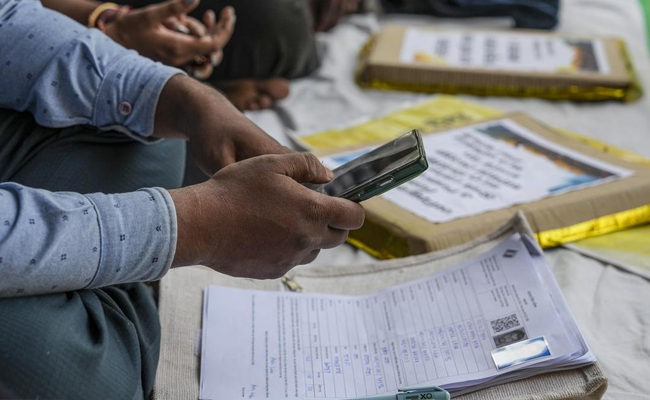
Kolkata (PTI): Around 32 lakh unmapped voters will be called in the first phase of hearings under the Special Intensive Revision (SIR) of the electoral rolls, officials said.
Hearings for this category, in which voters could not link their names with those of family members in the 2002 electoral rolls, will begin from December 27, he said.
"We have started sending notices to around 10 lakh such voters from today, while the same will be issued to another 22 lakh voters from Tuesday," the official at the office of the West Bengal Chief Electoral Officer told PTI.
During the enumeration phase, a total of 31,68,424 unmapped voters were identified across the state, he said.
He said that the proceedings will be conducted at district magistrates' offices, sub-divisional offices, various government departments, as well as in schools and colleges.
Voters with logical discrepancies will be taken up in the next phase, for which guidelines have been sought from the Election Commission, another official said on Monday.
Each hearing will be conducted under the supervision of a micro-observer, he said.
Training for 4,000 micro-observers will be held in two phases on December 24 in Kolkata, he said, noting that all the micro-observers are officials from the state.
Trinamool Congress supremo and West Bengal Chief Minister Mamata Banerjee on Monday alleged that the micro-observers lack knowledge of the local Bengali language.
Meanwhile, a delegation from the Election Commission will visit the state to review the progress of the SIR of the electoral rolls, sources in the office of the state CEO said.
"The commission's Principal Secretary SB Joshi and Deputy Secretary Abhinav Agarwal will arrive in the state to assess the progress of the hearing phase under the SIR process," he said.
The officials will also attend the training programme for micro-observers on December 24, he added.
Let the Truth be known. If you read VB and like VB, please be a VB Supporter and Help us deliver the Truth to one and all.
Vartha Bharati–Sankalp predictions align closely with Karnataka bypoll results
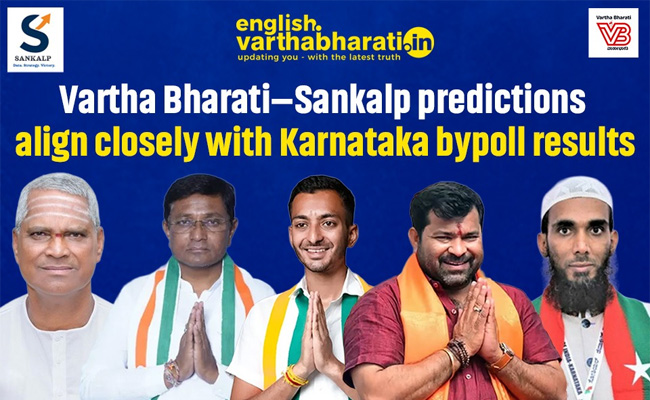
Bengaluru: The Vartha Bharati–Sankalp election analysis has shown a high level of accuracy in predicting the outcome of the recent Karnataka Assembly by-elections held in May 2026, correctly calling winners in both constituencies and closely estimating vote share trends.
The by-elections were held in Bagalkot and Davanagere South, drawing significant political attention as both seats were seen as key tests for the ruling Congress and opposition BJP.
According to the analysis, Vartha Bharati–Sankalp had made three major projections ahead of the results the winning party, vote share percentages, and margin of victory.
In both constituencies, the platform accurately predicted that the Congress would emerge victorious. The outcome matched the projections, with Congress candidates winning in Bagalkot and Davanagere South.
In terms of vote share, the predictions were largely in line with the final results. In Bagalkot, the BJP’s vote share was forecast in the range of 40 to 46 per cent, while the actual figure stood at 42.9 per cent. The Congress vote share, however, exceeded expectations, with the party securing 55.4 per cent against a projected range of 43 to 48 per cent.
The margin of victory in Bagalkot turned out to be significantly higher than anticipated. While the projection had placed the margin between 2,000 and 3,500 votes, the final margin was around 22,332 votes.
In Davanagere South, the predictions also remained largely accurate. The Congress vote share was projected between 43 and 51 per cent, and the final figure stood at 43.9 per cent. The BJP was expected to secure between 42 and 50 per cent but ended with 40.3 per cent.
The analysis had also identified the role of SDPI as a potential spoiler in the constituency. While its vote share was estimated around 6 per cent, the party eventually secured around 12 per cent of the vote.
The margin of victory in Davanagere South was predicted to be between 1,500 and 2,600 votes. The actual margin was higher at around 5,708 votes, though the contest remained relatively close as anticipated.
Overall, the performance of Vartha Bharati–Sankalp stood out for correctly identifying the winning parties in both seats and maintaining close accuracy in vote share estimates, with only limited deviations in specific cases.