As COVID ravages human lives and economies, Buddha's message serves like beacon: President Kovind
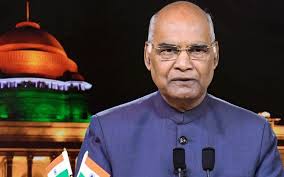
New Delhi: As the coronavirus pandemic ravages human lives and economies across the world, Lord Buddha's message of shunning vices like hatred and violence to find happiness serves like a beacon, President Ram Nath Kovind said on Saturday.
"We all know that the moment the virulence of coronavirus slows down, we have a far more serious challenge of climate change before us," he said at a virtual event organised by the International Buddhist Confederation at Rashtrapati Bhavan. President said the world seems full of suffering, in short term as well as in long term.
"There are many stories of kings and affluent people suffering from acute depression who took refuge in Buddha to escape cruelties of life," the president said. He said the life of Buddha challenges earlier convictions as he believed in finding deliverance from suffering in the midst of this imperfect world.
"Today, as the pandemic ravages human lives and economies across the globe, Buddha's message serves like a beacon. He advised people to shun greed, hatred, violence, jealousy and many other vices to find happiness. Contrast this message with the hankering of an unrepentant mankind indulging in the same old violence and degradation of nature," President said.
The president said that India is proud of being the land of the origin of 'Dhamma'. "In India, we see Buddhism as a fresh expression of the sublime truth," he said at the event organised on the occasion of the Dharma Chakra Diwas.
President said Lord Buddha's enlightenment and subsequent preaching by him for over four decades were in line with India's tradition of respect for intellectual liberalism and spiritual diversity. In modern times, two exceptionally great Indians, Mahatma Gandhi and Babasaheb Ambedkar, found inspiration in the words of the Buddha and went on to shape the destiny of the nation, he said.
"Following in their footsteps, we should strive to hear the call of the Buddha, to respond to his invitation to walk the noble path," the president said. The International Buddhist Confederation or IBC, with its presence in 36 countries, is holding the celebrations around the world.
"We, however, are in the midst of a virulent pandemic that has overwhelmed the entire humanity. Perhaps no part of the world remains untouched by this calamity that adversely affects every individual. As a precaution, we have to follow certain discipline and maintain physical distance," he said.
The IBC is, therefore, holding the events virtually, Kovind said, adding that such an effort is praiseworthy, because this makes it possible for a far larger number of people, from all corners of the world, to participate in them. "The world has suffered much this year, and I sincerely wish that this sacred day heralds a new ray of hope and grants a glimpse of happiness. I also pray that it lights the lamp of wisdom in the heart of everyone," the president concluded.
Let the Truth be known. If you read VB and like VB, please be a VB Supporter and Help us deliver the Truth to one and all.
Putin meets Iran's FM Araghchi, says Russia ready to do its best to help bring peace to West Asia
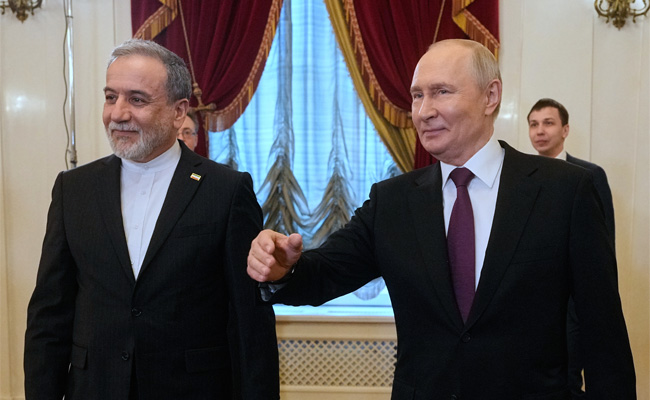
Moscow (PTI): Iran's Foreign Minister Abbas Araghchi on Monday met Russian President Vladimir Putin, who hailed the Iranian people for fighting bravely and heroically for their sovereignty and said Moscow is ready to do its best to help bring peace to West Asia as soon as possible.
Araghchi, who held talks with Omani and Pakistani leadership before arriving in Russia, met Putin in St. Petersburg and thanked him for supporting Iran, state-owned TASS news agency reported.
"Russia is ready to do everything in its power to ensure that peace in the Middle East is achieved as soon as possible," Putin said during his meeting with Araghchi, which was also attended by Russian Foreign Minister Sergey Lavrov.
Revealing that he received a message from Iranian Supreme Leader Mojtaba Khamenei last week, Putin asked Araghchi to convey his "gratitude for this message and best wishes for his health and well-being."
He praised the Iranian people for fighting "bravely and heroically" for their sovereignty, Iran's state-run PRESS TV reported.
"We really hope that, based on the courage and desire for independence, the Iranian people, under the guidance of the new leader, will weather this difficult period of trials and peace will come,” Putin said.
He also stressed that Russia “intends to maintain” its strategic relations with Iran.
Araghchi said that the world witnessed Iran’s strength in countering the US during the recent war, and that the Islamic Republic is a "stable and powerful establishment."
"With their courage, the Iranian people succeeded in resisting the US aggression and will be able to endure it,” he said.
He said that it became clear that Iran has “great friends and allies” like Russia, and conveyed “warmest greetings” from Supreme Leader Mojtaba Khamenei and President Masoud Pezeshkian to the Russian leader.
Araghchi said relations between Moscow and Tehran represent a “strategic partnership at the highest level” and will continue to develop "regardless of circumstances."
"We are grateful to you for the solid and strong positions in support of the Islamic Republic of Iran," he said.
Foreign Minister Lavrov said that the talks between President Putin and the Iranian Foreign Minister were "useful and constructive."
Kremlin Spokesman Dmitry Peskov later said that Russia is "ready to provide any good offices, any mediation services that are acceptable to the parties."
"We will be ready to do everything so that ultimately peace ensues, guaranteed peace, and that there is no return to hostilities," Peskov was quoted as saying by TASS.
He was asked how Moscow can assist in future negotiations on the Iranian settlement.
Araghchi arrived in Russia after his whirlwind trip to Islamabad, which, according to him, was “very productive” and involved “good consultations" with Pakistan's Army Chief Field Marshal Asim Munir, amid uncertainty over the second round of peace talks to resolve the war in West Asia.
"We held good consultations with our friends in Pakistan. The trip was successful. We assessed the outcome of our recent (meetings) and discussed in what direction and under what conditions talks can move on,” Araghchi said in a video posted on his Telegram channel upon his arrival in St Petersburg.
Referring to the second round of talks between the US and Iran to resolve the conflict in West Asia, Araghchi said: "Developments have taken place in the negotiations."
"Despite some progress in earlier rounds, the talks failed to reach their objectives due to the Americans' approach, the excessive demands they made, and the wrong approaches they adopted. Therefore, it was necessary to consult with our friends in Pakistan to review the latest situation,” Iran's official news agency IRNA quoted him as saying.
He said that the trip to Pakistan was a good opportunity to review developments related to the US-Israeli war against Iran, expressing confidence that “these consultations and coordination between the two countries will be highly significant.”
Araghchi arrived at St. Petersburg's Pulkovo Airport early Monday, where he was welcomed by Russian officials and Iran’s ambassador to Russia, Kazem Jalali, the report said.
The first round of peace talks between Iran and the US, held on April 11 and 12, failed to bring the desired result for the parties to the conflict.
The Iranian minister arrived in Islamabad for the second time on Sunday after a short visit to Oman, where he held talks with Sultan Haitham bin Tariq al-Said on security in the Strait of Hormuz and diplomatic efforts to end the Iran-US conflict.
After Araghchi left Pakistan for Oman on Saturday, President Donald Trump announced that US negotiators Steve Witkoff and Jared Kushner would no longer be going to Islamabad for talks with Iran, contending that Washington held all the cards on the matter.
Trump on Sunday reiterated that the US and Iranian officials can talk by phone for a peace solution to the conflict.
On Tuesday, Trump extended the two-week ceasefire with Iran indefinitely to give Tehran more time to prepare a unified proposal to end the war, just hours before the truce was set to expire.
The war began when the US and Israel jointly attacked Iran on February 28, killing Iranian Supreme Leader Ayatollah Ali Khamenei and several top commanders. The retaliation by the Islamic Republic extended the war to the entire Gulf region.