As Uddhav-Raj reunion buzz gains traction, Sena (UBT), MNS leaders say it's easier said than done
_vb_44.jpeg)
Mumbai (PTI): With speculations about rapprochement between Uddhav Thackeray and his estranged cousin Raj Thackeray gathering steam, leaders of the Shiv Sena (UBT) and Maharashtra Navnirman Sena (MNS) have said that though it is a promising prospect, personal ties and organisational synergy are hurdles that need to be overcome.
The Thackeray cousins have sparked a buzz about a possible reconciliation, with statements indicating they could ignore "trivial issues" and join hands nearly two decades after they parted ways.
While MNS chief Raj Thackeray has said uniting in the interests of Marathi manoos is not difficult, former Maharashtra chief minister Uddhav Thackeray has said that he was ready to put aside trivial fights, provided those working against the state's interests were not entertained.
The Sena (UBT) on Saturday put up a cryptic post on its social media handles, saying, "Time has come to unite for the sake of Mumbai and Maharashtra. Shivsainiks are ready for the protection of Marathi asmita (pride)."
The cousins are currently abroad. Raj is expected to return in the last week of April, and Uddhav in the first week of May.
The reunion buzz has also come at a time when both parties have reached a nadir with regard to their electoral performance and are going through their toughest political phase.
The Sena (UBT) won 20 seats, while the MNS drew a blank in the 2024 assembly polls.
Leaders of both parties have, however, said that though Uddhav's response to Raj's call may have sparked speculation, it is easier said than done.
A Sena (UBT) leader said both cousins are of different temperaments.
The past baggage over more than two decades has resulted in mistrust towards each other — Raj had quit the Shiv Sena in 2005 and blamed Uddhav for it. He has made it clear several times that he could work under no one but Bal Thackeray.
Last week, Shiv Sena (UBT) leader Sanjay Raut said family relations are not severed because of politics.
But personal ties are not just restricted to two individuals — it is also about their immediate families, especially the sons of both the cousins — Aaditya (Uddhav) and Amit (Raj) — who are being groomed to helm the organisation eventually.
This will be different, unlike the alliance between the undivided Shiv Sena, Congress and the undivided NCP in 2019, said Prakash Akolkar, the author of "Jai Maharashtra", a book on the history of Shiv Sena.
"The fight between Uddhav and Raj is personal and a family feud, where both brothers are vying for the family assets. The assets are not always monetary. Here, the asset is Bal Thackeray's legacy," Akolkar said.
He said Bal Thackeray's wife Meena was the family's matriarch and played a critical role in the party behind the scenes.
"Now, the spouses (of Uddhav and Raj) are matriarchs of their parties and will play a similar role if there is any possibility of reconciliation," Akolkar added.
Maharashtra Minister and BJP leader Nitesh Rane had last week questioned if Uddhav Thackeray had consulted his wife Rashmi before responding to Raj's statement that triggered speculation of an alliance.
A Sena (UBT) leader acknowledged that coming together of the two parties is more difficult than it appears.
The prospect of the two cousins coming together has enthused supporters of both parties, but it might not be the case with a section of cadres and party leaders.
"When we discuss seat-sharing agreements in Mumbai, how will the seats be divided? How will the winnable and non-winnable seats be divided? What about areas like Dadar and Worli, where both parties have a strong base? What about other cities where Sena (UBT) and MNS have their strength," an MNS leader said.
He also raised the question of ideologies.
While Raj is fashioning himself into a Marathi-Hindutva leader, Uddhav has focused on making the party more inclusive, especially warming up to the Muslim community.
"If Uddhav has asked us to sever ties with the BJP, will he do the same with the Congress?" asked the MNS leader.
Last week, MNS spokesperson and party's Mumbai president Sandeep Deshpande asked if Uddhav would apologise to 17,000 MNS activists who were slapped with police cases for protesting against loudspeakers outside mosques when he was the chief minister.
Let the Truth be known. If you read VB and like VB, please be a VB Supporter and Help us deliver the Truth to one and all.
EC role, Hindu vote consolidation among factors for BJP win in Bengal polls: J-K CM Omar
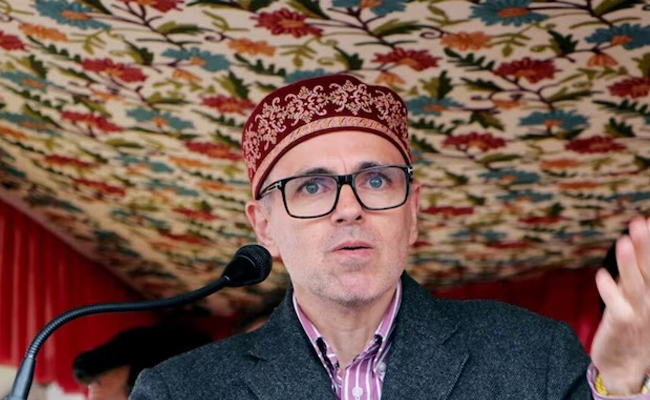
Srinagar (PTI): Jammu and Kashmir Chief Minister Omar Abdullah on Tuesday attributed the BJP's West Bengal win to a "significant role" played by the Election Commission (EC), alongside a consolidation of Hindu votes and a fractured minority mandate.
Abdullah also said the INDIA bloc needs to define its role in the political landscape of the country and make it clear whether the opposition alliance was limited to the parliamentary elections or extended to the state elections as well.
Talking to PTI Videos, Abdullah hinted that the EC has compromised its neutrality by conducting the Special Intensive Revision (SIR) in West Bengal and linked it to the BJP's gains in the state, claiming large-scale deletion of legitimate voters.
On the performance of the BJP in the just concluded assembly elections, Abdullah said the saffron party has almost nothing to show in southern states.
"So then you look at West Bengal and Assam. Yes, the BJP improved its tally in Assam. There are various reasons for that. You know as well as I do, what those are. West Bengal, I think we need to look at the results very carefully," he said.
"The easiest explanation for the West Bengal result is the serious curtailing of voter list," Abdullah said.
"Voters found their names deleted. People who served in uniform and fought for this country on the borders, who were considered Indian citizens all their lives, were suddenly held to a higher standard and not allowed to vote. Something is not right," he said.
While alleging that the EC played a "significant part" in the results, the chief minister admitted the outcome was multifaceted and noted a consolidation of over 60 per cent of the Hindu vote towards the BJP and a "significant fracture" in the minority vote, particularly in seats where Muslims constitute over 50 per cent of the population.
"There is no doubt that the role of the Election Commission played a significant part in the results but we will also have to look at the other factors," he said.
He said the results of West Bengal cannot be compared to those in other states. "The situation was unique to West Bengal. The SIR that was done, the way in which the voter lists were changed, the sort of minute scrutiny that the Election Commission subjected West Bengal to, the role of the central investigative agencies.
"All of these are situations that at least in recent electoral history of India are unique to West Bengal. So to suggest that we can learn lessons from West Bengal and implement them in other parts of the country, I think would not be correct," he said.
Abdullah had recently said that if the West Bengal results throw a surprise, the role of EC will come under scrutiny.
However, during Tuesday's interview, the chief minister said he still maintains that electronic voting machines (EVMs) do not lead to vote theft.
"What we saw in West Bengal...I know there are a lot of people who believe that the EVMs themselves are flawed. I am not a proponent of that conspiracy theory.
"But I do believe that the Election Commission has done itself no favours in the way in which it has gone about both the process of delimitation and the process of finalisation of electoral rolls," he said and cited the example of delimitation exercise in Jammu and Kashmir or Assam.
"These are clear examples of how the process was done to benefit one party or in the case of Jammu and Kashmir, one party and its allies. And the results speak for themselves. You created seven new seats in Jammu and Kashmir and out of those six seats were won by the BJP. You redrew assembly constituencies to benefit one particular party or its allies. And the same is true for West Bengal as well," he said.
Referring to the INIDA bloc, he said the election results were no new message for the alliance.
"We need to decide what the INDIA bloc is for. Is it only for Parliament or for state elections as well?" he asked.
"What happened in West Bengal is unfortunate. The Congress and TMC fought against each other. Now the Congress agrees with Mamata Banerjee that 100 seats were stolen, but the fact is they fought each other," he said.
Despite the friction, Abdullah reaffirmed the "pre-eminent position" of the Congress within the opposition alliance, dismissing the idea of any other party assuming the mantle.
"The Congress is the only party other than the BJP with a pan-India presence. All of us acknowledge this," he stated.
"To suggest someone else can assume a leadership role would be incorrect. Kharge Sahib is the president of the Congress, and by virtue of that, he assumes leadership of the INDIA bloc meetings. That is the way it should be," the chief minister said.
Abdullah said any 'Common Minimum Programme' would depend on whether the opposition alliance decides to fight state assembly elections collectively, noting that he would share his specific views with the bloc internally rather than through the media.