Ashwini Vaishnaw, Anil Kapoor are among Time magazine’s 100 most influential people in AI

New York, Sep 6: Union Information Technology Minister Ashwini Vaishnaw, Infosys co-founder Nandan Nilekani and actor Anil Kapoor are among Indians who have been honoured in Time magazine's prestigious list of the 100 "Most Influential People in AI 2024".
The list, released on Thursday, features 15 Indian or Indian-origin people. Among them are Sundar Pichai of Google, and Satya Nadella of Microsoft.
Writing about 54-year-old Vaishnaw, the magazine said under his leadership, India hopes to become one of the top five countries for semiconductor manufacturing-a key component for modern AI systems within the next five years.
"Yet, Vaishnaw faces significant challenges in realising these ambitions. India's tech sector struggles with low private R&D investment and a lack of advanced manufacturing ecosystems. Its educational system is also catching up to produce the specialised workforce needed for cutting-edge AI and semiconductor development," it said.
India- the world’s fifth largest economy- is trying to become a major player in the world of AI, it said.
Kapoor, 67, has been included in Time’s AI list after a landmark victory in September 2023 over unauthorised AI use of his likeness.
The actor took up the case after a large number of distorted videos, gifs, and emojis bearing his likeness began circulating online.
Nilekani, 69, is Co-founder of Infosys and co-founder & chairman of EkStep.
"Nilekani, the billionaire co-founder of Infosys, has spent fifteen years in and out of government developing digital public infrastructure for the world’s most populous country, earning him nicknames like 'India's Bill Gates'," the magazine wrote about the entrepreneur.
"Nilekani led India’s Aadhaar programme, the world’s largest biometric identity card programme. He promoted the programme as a salve to welfare fraud, alongside a means to help improve tax collection, and ease bank customer verification, among other benefits," the magazine added.
“If the world of AI was dominated by the emergence of startup labs like OpenAI, Anthropic, and their competitors in 2023, this year, as critics and champions alike have noted, we’ve seen the outsize influence of a small number of tech giants...," TIME Editor-in-Chief Sam Jacobs said.
The 2024 TIME100 AI list features 40 CEOs, founders and co-founders, including Mark Zuckerberg of Meta, Pichai of Google, Nadella of Microsoft and Aravind Srinivas of Perplexity among others.
Amba Kak, Co-executive Director, of AI Now Institute, Arati Prabhakar, Director, of the US Office of Science and Technology Policy and Divya Siddarth, Co-founders, of Collective Intelligence Project, were among the women leaders featured in the list.
Other Indians or Indian-origin leaders in AI in the list include Rohit Prasad SVP and head scientist of Artificial General Intelligence, Amazon, Shiv Rao Co-founder and CEO, Abridge, Anant Vijay Singh Product Lead at Proton, Dwarkesh Patel Host, Dwarkesh Podcast, Amandeep Singh Gill, United Nations Secretary-General's Envoy on Technology, and Vinod Khosla, Founder, Khosla Ventures.
Let the Truth be known. If you read VB and like VB, please be a VB Supporter and Help us deliver the Truth to one and all.
Bengaluru airport introduces AI-based system to enhance safety at vehicle-aircraft intersections
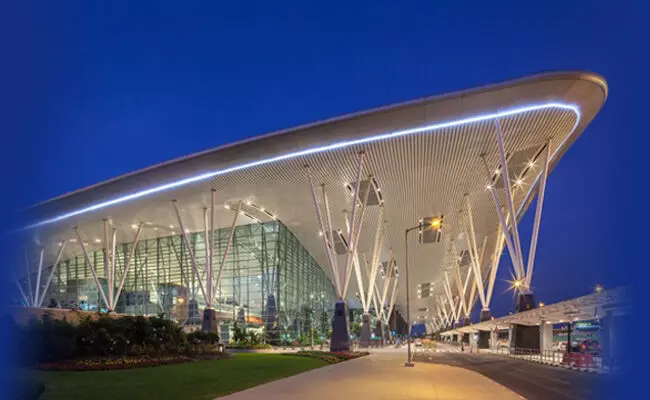
Bengaluru: Bangalore International Airport Limited (BIAL) has introduced an integrated smart airside safety system at Kempegowda International Airport to improve operational safety at key intersection zones.
According to The Hindu, the system has been designed to enhance safety at Cross Service Roads (CSRs), where aircraft and ground vehicle movements intersect.
According to BIAL, the system integrates AI-based computer vision, automation, and centralised monitoring to manage right-of-way movements and reduce the risk of human error.
“CRSs are among the most sensitive areas within airport operations, requiring precise and seamless coordination between aircraft and ground vehicles. Traditionally, right of way protection at these intersections relied on manual or semi-manual inset light activation, creating dependencies on human intervention, increasing the risk of delays and limiting operational visibility,” TH quoted BIAL as saying.
The new system uses real-time detection of vehicle movement, risk assessment, and automated signalling. AI-enabled cameras identify potential conflicts and trigger automated inset light signals to ensure aircraft priority. Normal operations resume once the area is confirmed clear.
“Based on these detections, the system triggers automated inset light activation to protect aircraft right‑of‑way and restores normal signalling once the intersection is confirmed clear. A centralised monitoring and analytics platform digitally logs all events, strengthening governance, compliance, and operational control,” BIAL said.
By embedding technology into operations, the system creates a data-driven separation layer between aircraft and ground vehicles, significantly reducing human error, especially during night and low-visibility conditions.
“Precision-led signal activation improves traffic flow, minimises unnecessary stoppage and enhances turnaround efficiency. It also establishes a scalable foundation for predictive safety analytics, enabling trend analysis, peak-hour optimisation, compliance mapping and risk forecasting to support continuous improvement and stronger airside governance,” BIAL said.