Asia's 1st woman loco pilot Surekha Yadav retires after 36-yr service; 'trailblazing journey' ends
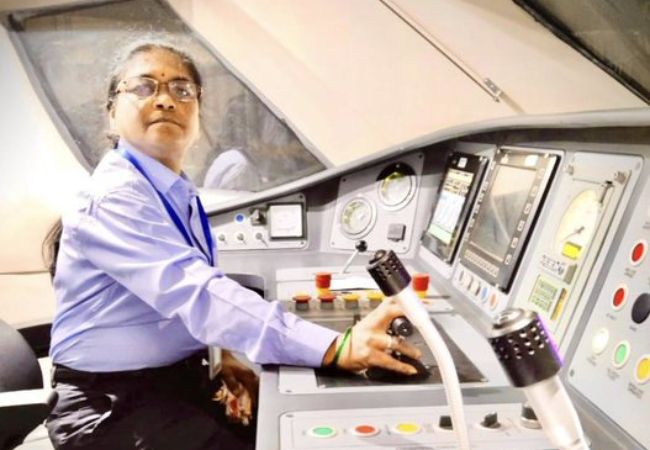
Mumbai (PTI): Surekha Yadav, Asia's first woman loco pilot who helmed several prestigious trains in the country during her career spanning over 36 years, retired on Tuesday, leaving behind a legacy of grit and inspiration.
The Central Railway hailed Yadav's contribution, saying the "trailblazing journey" of the "pioneer" will continue to inspire generations to come, while she said despite her work being challenging and full of responsibility, she enjoyed it thoroughly.
Yadav had joined the Indian Railways in 1989, breaking the barriers in the male-dominated railway sector. In 1990, she became an assistant driver, earning the distinction of being the continent's first woman train driver.
Besides Mumbai's suburban locals, she operated goods trains through India's steepest 'ghat' (mountain pass) sections, and also drove some of the country's most prestigious trains - from the Vande Bharat to the Rajdhani Express.
Born in a farming family in Satara district of Maharashtra on September 2, 1965, Yadav completed her diploma in electrical engineering before taking up her railway assignment.
She gradually rose through the ranks, operating her first goods train in 1996, and was promoted to motorwoman in 2000. In 2010, she qualified as a Ghat driver and later took command of long-distance mail and express trains across various routes.
In a major milestone, she drove the inaugural run of the Vande Bharat Express between Solapur and Mumbai's Chhatrapati Shivaji Maharaj Terminus (CSMT) on March 13, 2023.
Before retirement, she got an opportunity of piloting the prestigious Rajdhani Express on the Hazrat Nizamuddin-CSMT route between Igatpuri and CSMT as a final assignment a few days ago.
In a post on X, the Central Railway said, "Farewell to a Pioneer. Smt. Surekha Yadav, Asia's First Woman Train Driver, bids adieu today after 36 glorious years of service. Her trailblazing journey will continue to inspire generations of railway women and men alike."
Yadav completed all the formalities related to her retirement on the last day. As per the tradition, her colleagues gave her a grand farewell a few days back.
Interacting with reporters, Yadav said, "My journey started from farms and ended at platform number 18 of CSMT station."
She was referring to her last assignment as a loco pilot of Rajdhani Express.
She said her parents were farmers, but whatever she achieved today was due to the education they provided to her.
After her selection as an assistant loco pilot, the railway authorities had asked her if she would be able to do her job as no woman had done it prior to that, to which she replied in the affirmative, he said.
"If no one has done it before, it means someone will do it in future. It is not like if I had not come forward (to accept the job of assistant loco pilot), another girl would not take it up. But I was determined not to give it up if I got the chance," Yadav said.
She said her journey as assistant loco pilot was started from the Kalyan loco shed, during the era of DC (direct current) locomotives, which were later replaced by AC (alternate current) locomotives.
Yadav said that her work was challenging and full of responsibility.
There was neither a fixed timetable nor duty hours, but she enjoyed the job thoroughly, she said.
"Everyday, there used to be different locomotives, different destinations, colleagues and load. We had to be prepared for everything...I respected my job and I did it very well," she said.
According to her, the death of trespassers leaves an adverse impact on the loco pilots and hence people should avoid crossing the tracks.
On April 14, 2000, Yadav piloted the first ladies' special local to Dombivli from the CSMT.
"Mumbai's lifeline being piloted by a woman was a very big thing then," Yadav said.
She added that whatever she achieved is because of support from her colleagues, seniors and most importantly her family members, who always supported her despite there being no fixed duty hours and she had to stay away from home for days.
She said her official retirement function will be held on October 1 due to some technical problems.
"Even though today is my last working day ,official handing over of papers will be on Wednesday at CSMT," she informed.
Let the Truth be known. If you read VB and like VB, please be a VB Supporter and Help us deliver the Truth to one and all.
India, New Zealand ink free trade agreement
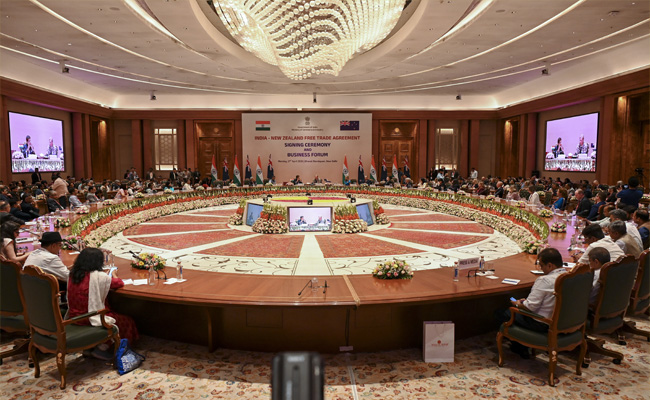
New Delhi (PTI): India and New Zealand on Monday inked a free trade agreement, aimed at boosting two-way commerce and investments.
The pact was signed by Commerce and Industry Minister Piyush Goyal and visiting New Zealand's Trade and Investment Minister Todd McClay.
The FTA provides duty-free access for 100 per cent of India's exports to New Zealand, covering all tariff lines or produce categories, and is expected to significantly boost MSMEs and employment by enhancing competitiveness in labour-intensive sectors such as textiles, apparel, leather, footwear, gems and jewellery, engineering goods, and processed foods.
Earlier, New Zealand maintained peak tariffs of up to 10 per cent on key Indian exports, including ceramics, carpets, automobiles, and auto components.
With zero-duty market access from entry into force as New Zealand's other trade partners, Indian products will be fully competitive in that country, enjoying a level playing field.
ALSO READ: Cal HC urges EC to dispose of TMC complaint over police observer's meeting with BJP nominee
Significantly, India also secured duty-free inputs for its manufacturing sector, including wooden logs, coking coal, and waste and scraps of metals, lowering production costs and enhancing the global competitiveness of the Indian industry.
On the other hand, India has offered tariff liberalisation on 70.03 per cent of tariff lines covering 95 per cent of bilateral trade value, while keeping 29.97 per cent of tariff lines excluded to protect India's sensitive sectors.
The products that are kept in exclusion are mainly -- dairy (milk, cream, whey, yoghurt, cheese etc.), animal products (other than sheep meat), agricultural products (onions, chana, peas, corn, almonds), sugar, artificial honey, animal, vegetable or microbial fats and oils, arms and ammunition, gems and jewellery, copper and articles thereof (cathodes, cartridges, rods, bars, coils), aluminium and articles thereof (ingots, billets, wire bars) among others.
On 30 per cent of tariff lines of New Zealand, India will provide duty elimination on goods such as wood, wool, sheep meat, and leather-raw hides.
Similarly, 35.60 per cent of tariff lines are subject to phased elimination over 3, 5, 7, and 10 years, including petroleum oil, malt extract, vegetable oils, selected electrical and mechanical machinery, and peptones.
New Zealand products which enjoy tariff reductions include wine, pharmaceutical drugs, polymers, aluminum, iron and steel articles, and goods that only 0.06 per cent fall under tariff rate quotas, including Manuka honey, apples, kiwi fruit, and albumins, including milk albumin.
The FTA also includes a commitment to facilitate USD 20 billion in investment into India.
A rebalancing clause is incorporated into the Agreement to provide a framework for addressing any shortfall in investment delivery, thereby ensuring robust and tangible economic outcomes.
Total bilateral trade in goods and services reached USD 2.4 billion in 2024.