Asking govt to account for its work a trend now: Modi
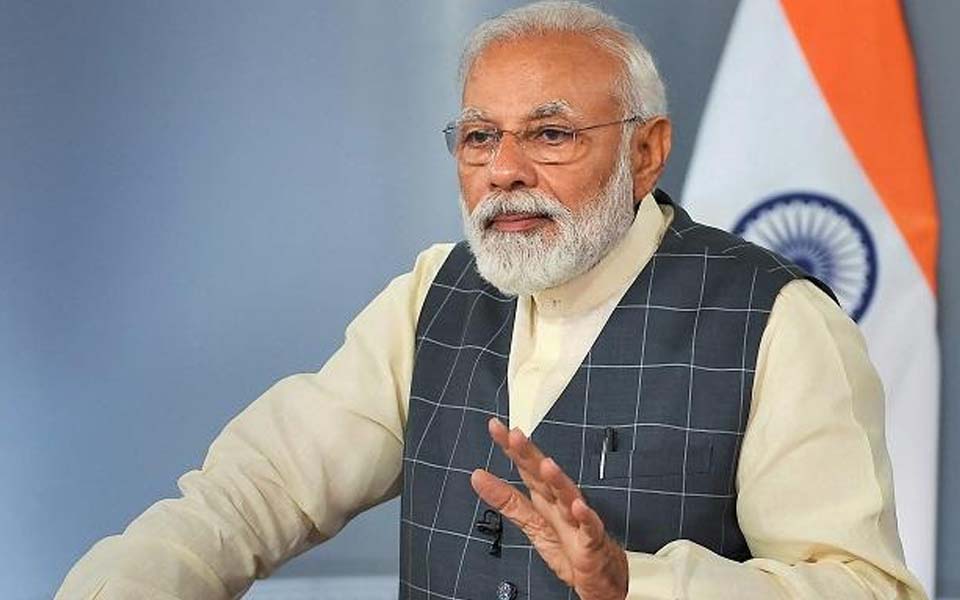
Adalaj (Guj) : Prime Minister Narendra Modi Tuesday said asking the government to account for its work has now become a trend in the country.
He said his government aims to empower the society to conduct more and more social works.
"There is a recent trend of people expecting that everything has to be done by the government. They also seek answers from the government for the works that are not done. This was not a tradition in our country," the prime minister said at the 'pran-pratistha' (idol installation) ceremony at the newly-built Annapurna Dham temple in Adalaj town of Gandhinagar district in Gujarat.
He said the society earlier used to build dharmshalas (guest houses), gaushala (cow shelters), water ponds and libraries.
"All these used to be constructed by the society's strength. Slowly, knowingly or unknowingly, this activity of the society was suppressed and the state took the role of carrying out social work," Modi said.
"Our attempt is that the state should do the administrative work, and society should be empowered so that it can carry out such social works beneficial for the people at large," he said after inaugurating the temple set up by Leuva Patels, a sub-caste of the Patidar community.
The prime minister said it was the Leuva Patel community, led by Sardar Vallabhbhai Patel, which started the Amul movement and benefited people coming from all castes and classes in the villages of Gujarat.
Urging the community members to carry out social works, Modi added, "I will ask you to distribute one plant to each person coming to the temple as 'prasad' and ask him to grow it."
Let the Truth be known. If you read VB and like VB, please be a VB Supporter and Help us deliver the Truth to one and all.
SC to hear on May 4 PIL seeking stringent guidelines for issuing Aadhaar to adolescents, adults
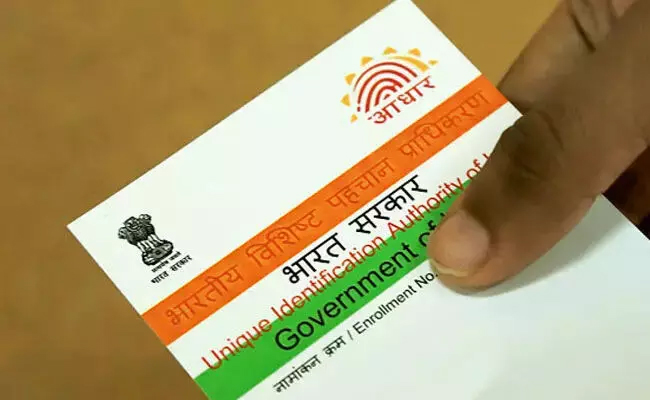
New Delhi (PTI): The Supreme Court is scheduled to hear on Monday a plea seeking a direction to the Unique Identification Authority of India to issue new Aadhaar cards only to citizens up to the age of six years, and frame stringent guidelines for its issuance to adolescents and adults to stop infiltrators from masquerading as Indian citizens.
As per the apex court's causelist of May 4, the plea would come up for hearing before a bench of Chief Justice Surya Kant and Justice Joymalya Bagchi.
The Public Interest Litigation (PIL) filed by lawyer Ashwini Upadhyay has also sought a direction to the authorities to install display boards at common service centres stating that the 12-digit unique identification number is only a "proof of identity" and not a proof of citizenship, address or date of birth.
Besides all the states and Union Territories, the plea has made the UIDAI -- which is the authority that issues Aadhaar -- and the Union ministries of home, law and justice, and electronics and information technology as parties.
The plea, filed through advocate Ashwani Dubey, said Aadhaar, originally intended as a proof of identity, has increasingly become a "foundational document" enabling individuals to obtain other identification documents, such as ration cards, domicile certificates and voter identity cards.
"The UIDAI has issued 144 crore Aadhaar and 99 percent Indians have been enrolled. Therefore, the petitioner is filing this writ petition as a PIL under Article 32, seeking a direction to UIDAI to issue new Aadhaar to children only and frame new stringent guidelines for adolescents and adults, so as to stop infiltrators from getting it and masquerading as Indian citizens," the plea said.
It said the need to file the plea arose when the petitioner came to know the manner in which infiltrators are able to procure Aadhaar through a verification process that is weak and can be easily manipulated.
"Foreigners apply for Aadhaar under the 'foreign' category. But infiltrators apply for Aadhaar under the 'Indian citizen' category and get it easily made. Thereafter, they obtain a ration card, birth and domicile certificate, driving licence, et cetera, essentially becoming indistinguishable from Indian citizens…," it said.
Besides seeking other directions, the plea has raised legal questions, including whether the Aadhaar Act 2016 has become "temporally unreasonable" for failing to keep up with the legislative intent of distinguishing foreigners from Indian citizens.
It said the alleged misuse of Aadhaar undermines targeted welfare delivery and leads to diversion of public resources.