Assam-arunachal Pradesh sign border pact ending decades-old disputes
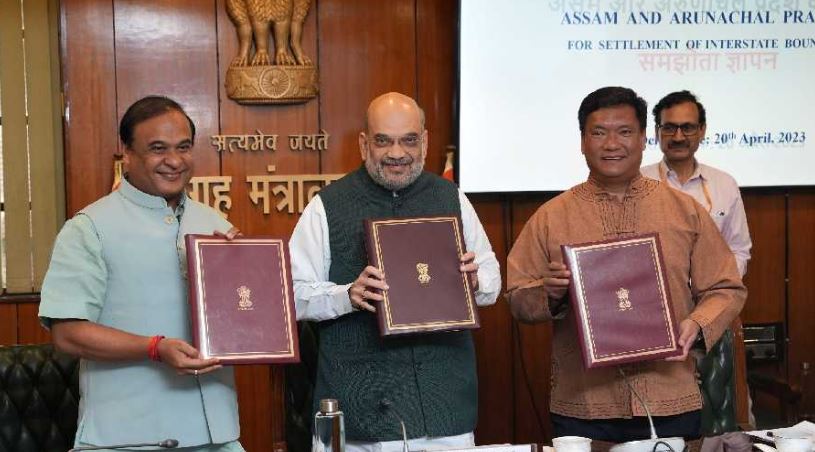
New Delhi, Apr 20: Ending their over 50-year-old border dispute, Assam and Arunachal Pradesh on Thursday signed an agreement in the presence of Union Home Minister Amit Shah here which will bring settlement to 123 villages located along areas the two northeastern states share.
Assam Chief Minister Himanta Biswa Sarma and his Arunachal Pradesh counterpart Pema Khandu signed the agreement.
Assam and Arunachal Pradesh share an 804.1-km-long border which has been in dispute since the latter was made a union territory in 1972. It was upgraded to state in 1987.
Shah said the dispute over 123 villages on both sides of the inter-state border has been resolved once and for all at a time when the country is celebrating its 75th year of Independence.
He said it was a historic event for both Assam and Arunachal Pradesh resolving their long boundary dispute amicably.
Shah exuded optimism that the boundary settlement would usher in all-round development and peace in the Northeast as the agreement ended the border dispute which has been lingering since 1972.
"It is a big moment for the entire northeastern region which has been witnessing all round development ever since the Narendra Modi government came to power in 2014," he said.
The home minister said Modi has been actively promoting the growth of languages, literature and culture of the Northeast and the recent record-breaking performance of Bihu dance was a shining example.
He said that the report of the Local Commission on the border dispute kept circling around for decades, which has now been accepted by both the states. Shah said today's agreement will prove to be a milestone in the direction of realising Modi's dream of a developed, peaceful and conflict-free Northeast.
Shah said that since 2018, the central government has signed several accords including with Bru tribals, insurgent groups NLFT and some belonging to Assam's Karbi Anglong and established peace and ended violence in the Northeast.
He said as compared to 2014, there has been a 67 per cent reduction in incidents of violence, 60 per cent reduction in the number of deaths of security forces and 83 per cent reduction in the number of civilian deaths in the Northeast, which is a big achievement.
The home minister said the Modi government has withdrawn the Armed Forces (Special Powers) Act from most of places in Assam, 15 police stations in 6 districts in Manipur, all but 3 districts in Arunachal Pradesh, 7 districts in Nagaland, and entire Tripura and Meghalaya.
Assam chief minister Sarma termed the signing of the MoU as historic and said the deal would be a harbinger of peace and prosperity.
He said after 51 years, one of India's longest running inter-state disputes comes to a decisive end and this breakthrough has been possible due to the prime minister's blessings, guidance of the union home minister and unstinted support from Arunachal Pradesh chief minister.
"Today's agreement with Arunachal Pradesh is in line with similar efforts made with Meghalaya in last two years. This will boost the spirit of bonhomie in the Northeast and strengthen our federal structure as it brings a new paradigm to resolve differences between states," he said.
Arunachal Pradesh chief minister Khandu termed the settlement of boundary dispute as "momentous and historic" and exuded confidence that it would bring about a sea change on the peace and development of both the states.
He said the agreement has been possible due to the initiative and political will of the prime minister and the union home minister and active cooperation of the Assam government led by Sarma.
Out of the 123 villages claimed by Arunachal Pradesh before the Local Commission in 2007, 71 have been amicable resolved so far.
This includes 27 villages resolved through the Namsai Declaration on July 15, 2022 and 34 villages through this MoU.
Out of theee 71 villages, one village will be included in Assam from Arunachal Pradesh, 10 villages will continue in Assam and 60 villages will be included in Arunachal Pradesh from Assam.
Out of the remaining 52 villages, the village boundary of 49 villages is to be finalised by the regional committees in next six months while three villages situation inside the IAF bombing range will require rehabilitation.
Officials said the agreement will end the dispute relating to 123 villages along the border keeping in view the historical perspective, demographic profile, administrative convenience, proximity to the border and the aspirations of the residents.
Under the pact, both the state governments have agreed that it will be final with regards to these 123 disputed villages and neither of the states will make any new claim related to any area or village in future.
After the agreement, a detailed survey will be carried out by the Survey of India in the presence of representatives of both the state governments to determine the boundaries of both the states, officials said.
Sarma said as a goodwill gesture, the Arunachal Pradesh government will hand over a large tract of land under in possession in Assam's Jorhat to the Assam government.
Arunachal Pradesh, which was made a union territory in 1972, has been maintaining that several forested tracts in the plains traditionally belonged to hill tribal chiefs and communities and these were "unilaterally" transferred to Assam earlier.
After Arunachal Pradesh achieved statehood in 1987, a tripartite committee was appointed, which recommended that certain territories be transferred from Assam to Arunachal Pradesh.
Assam contested this and the matter was in the Supreme Court for a long time.
Let the Truth be known. If you read VB and like VB, please be a VB Supporter and Help us deliver the Truth to one and all.
Putin meets Iran's FM Araghchi, says Russia ready to do its best to help bring peace to West Asia
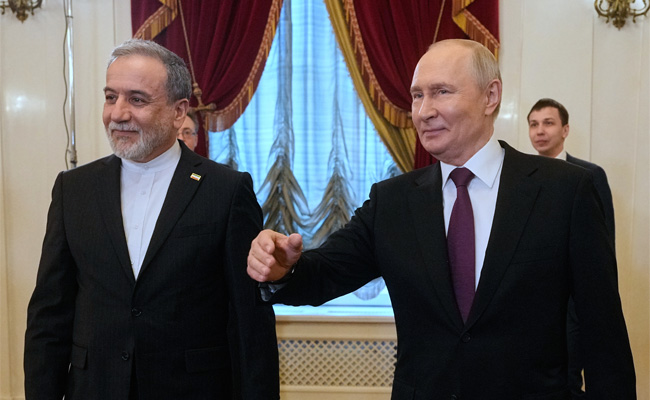
Moscow (PTI): Iran's Foreign Minister Abbas Araghchi on Monday met Russian President Vladimir Putin, who hailed the Iranian people for fighting bravely and heroically for their sovereignty and said Moscow is ready to do its best to help bring peace to West Asia as soon as possible.
Araghchi, who held talks with Omani and Pakistani leadership before arriving in Russia, met Putin in St. Petersburg and thanked him for supporting Iran, state-owned TASS news agency reported.
"Russia is ready to do everything in its power to ensure that peace in the Middle East is achieved as soon as possible," Putin said during his meeting with Araghchi, which was also attended by Russian Foreign Minister Sergey Lavrov.
Revealing that he received a message from Iranian Supreme Leader Mojtaba Khamenei last week, Putin asked Araghchi to convey his "gratitude for this message and best wishes for his health and well-being."
He praised the Iranian people for fighting "bravely and heroically" for their sovereignty, Iran's state-run PRESS TV reported.
"We really hope that, based on the courage and desire for independence, the Iranian people, under the guidance of the new leader, will weather this difficult period of trials and peace will come,” Putin said.
He also stressed that Russia “intends to maintain” its strategic relations with Iran.
Araghchi said that the world witnessed Iran’s strength in countering the US during the recent war, and that the Islamic Republic is a "stable and powerful establishment."
"With their courage, the Iranian people succeeded in resisting the US aggression and will be able to endure it,” he said.
He said that it became clear that Iran has “great friends and allies” like Russia, and conveyed “warmest greetings” from Supreme Leader Mojtaba Khamenei and President Masoud Pezeshkian to the Russian leader.
Araghchi said relations between Moscow and Tehran represent a “strategic partnership at the highest level” and will continue to develop "regardless of circumstances."
"We are grateful to you for the solid and strong positions in support of the Islamic Republic of Iran," he said.
Foreign Minister Lavrov said that the talks between President Putin and the Iranian Foreign Minister were "useful and constructive."
Kremlin Spokesman Dmitry Peskov later said that Russia is "ready to provide any good offices, any mediation services that are acceptable to the parties."
"We will be ready to do everything so that ultimately peace ensues, guaranteed peace, and that there is no return to hostilities," Peskov was quoted as saying by TASS.
He was asked how Moscow can assist in future negotiations on the Iranian settlement.
Araghchi arrived in Russia after his whirlwind trip to Islamabad, which, according to him, was “very productive” and involved “good consultations" with Pakistan's Army Chief Field Marshal Asim Munir, amid uncertainty over the second round of peace talks to resolve the war in West Asia.
"We held good consultations with our friends in Pakistan. The trip was successful. We assessed the outcome of our recent (meetings) and discussed in what direction and under what conditions talks can move on,” Araghchi said in a video posted on his Telegram channel upon his arrival in St Petersburg.
Referring to the second round of talks between the US and Iran to resolve the conflict in West Asia, Araghchi said: "Developments have taken place in the negotiations."
"Despite some progress in earlier rounds, the talks failed to reach their objectives due to the Americans' approach, the excessive demands they made, and the wrong approaches they adopted. Therefore, it was necessary to consult with our friends in Pakistan to review the latest situation,” Iran's official news agency IRNA quoted him as saying.
He said that the trip to Pakistan was a good opportunity to review developments related to the US-Israeli war against Iran, expressing confidence that “these consultations and coordination between the two countries will be highly significant.”
Araghchi arrived at St. Petersburg's Pulkovo Airport early Monday, where he was welcomed by Russian officials and Iran’s ambassador to Russia, Kazem Jalali, the report said.
The first round of peace talks between Iran and the US, held on April 11 and 12, failed to bring the desired result for the parties to the conflict.
The Iranian minister arrived in Islamabad for the second time on Sunday after a short visit to Oman, where he held talks with Sultan Haitham bin Tariq al-Said on security in the Strait of Hormuz and diplomatic efforts to end the Iran-US conflict.
After Araghchi left Pakistan for Oman on Saturday, President Donald Trump announced that US negotiators Steve Witkoff and Jared Kushner would no longer be going to Islamabad for talks with Iran, contending that Washington held all the cards on the matter.
Trump on Sunday reiterated that the US and Iranian officials can talk by phone for a peace solution to the conflict.
On Tuesday, Trump extended the two-week ceasefire with Iran indefinitely to give Tehran more time to prepare a unified proposal to end the war, just hours before the truce was set to expire.
The war began when the US and Israel jointly attacked Iran on February 28, killing Iranian Supreme Leader Ayatollah Ali Khamenei and several top commanders. The retaliation by the Islamic Republic extended the war to the entire Gulf region.