Assam CM questions ‘extent’ of relations between Gaurav Gogoi, his wife and Pakistani advisor
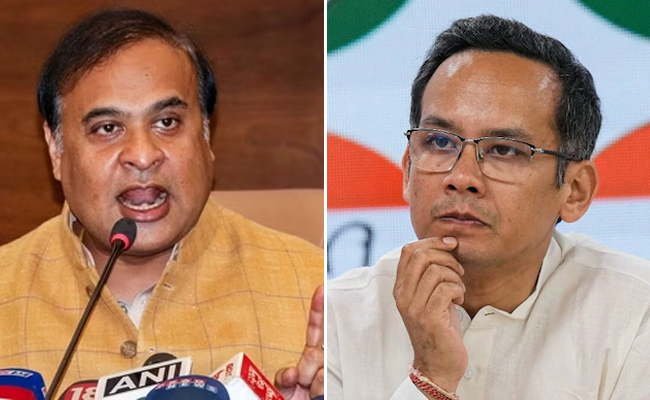
Guwahati(PTI): Assam Chief Minister Himanta Biswa Sarma continued to question Congress MP Gaurav Gogoi’s British wife Elizabeth Colburn’s links with Pakistan, alleging on Saturday that the "network is now emerging as far more significant and deeply entrenched than initially thought".
He shared screenshots of old posts on X by Ali Tauqeer Sheikh, an advisor of the Pakistan Planning Commission and a former colleague of Colburn, and claimed that the relationship between the Gogois and the Pakistani national appeared to be ‘deeply rooted’.
Sarma had also targeted the Jorhat MP over the issue, demanding answers from Gogoi over the allegations of ISI links, "leading young individuals to the Pakistan embassy for brainwashing and radicalisation, and the refusal to take Indian citizenship for the past 12 years", referring to Colburn’s nationality status.
He had also alleged that Gogoi had raised questions in Parliament on sensitive defence matters after his marriage to the British citizen, a charge termed by the opposition leader as a "false accusation".
In his latest charges, Sarma shared a screenshot of a post on X by Sheikh in 2019 in which he commented on the problem of illegal migrants from Bangladesh to India.
“Elizabeth Colburn w/o Hon’ble MP worked under Ali Tauqeer Sheikh in the organisation LEAD Pakistan, which operated under the guise of climate change initiatives,” Sarma wrote, sharing the screenshot.
He claimed that a "closer examination" of Sheikh’s works and articles reveals a deeper and more strategic involvement, particularly in Assam.
“The extent of this network is now emerging as far more significant and deeply entrenched than initially thought,” Sarma maintained, as he tagged the Union Home Ministry in his post.
The CM shared another post by Sheikh from 2020 where the Pakistan national lauds Gogoi and others for raising the Delhi riots issue in the Parliament.
Sarma said, “Pakistan National Ali Sheikh of Lead Pakistan who is Elizabeth Colburn’s colleague and supervisor shared his anti-India propaganda and also tagged and cheered Hon’ble MP when he raised the Delhi Riots 2020 issue in Parliament. Yes, The relationships appear to be deeply rooted.”
The BJP had on Wednesday accused Gogoi's wife of having links with Pakistan and the ISI, a charge rejected by the deputy leader of the Congress in the Lok Sabha as "laughable and entertaining".
Let the Truth be known. If you read VB and like VB, please be a VB Supporter and Help us deliver the Truth to one and all.
Over 17,000 people went missing in Delhi in 2024: NCRB

New Delhi (PTI): A total of 23,058 people, comprising 9,482 men and 13,576 women, were reported missing in Delhi in 2024, according to the latest National Crime Records Bureau (NCRB).
Of the total, 5,491 were children below the age of 18 — 1,571 boys, 3,920 girls.
The city recorded 17,567 fresh adult missing persons cases in 2024, comprising 7,911 men and 9,656 women.
According to the NCRB data, released on Wednesday, 14,637 men, 18,238 women and six transgender persons were still missing from previous years.
At the latest count, in 2024, Delhi had a total of 55,939 missing persons cases — 24,119 men, 31,814 women and six transgender persons.
In 2024, police traced or collected 28,392 missing persons, including 12,182 men, 16,208 women and two transgender persons.
Only half of the men and half of the women who went missing could be traced.
A total of 27,547 missing persons – 11,937 men, 15,606 women, four transgender persons — were yet to be untraced by the end of the year, the data showed.
The data also revealed that 5,352 children from previous years remained untraced at the beginning of 2024.
The number of still missing boys was 1,621, and the number of missing girls was 3,729. Two transgender children were yet to be found.
After adding the pending cases from previous years, the total number of missing children cases handled in 2024 rose to 10,843.
The police traced or recovered 6,762 missing children — 2,030 boys, 4,732 girls.
The recovery rate stood at 63.6 per cent for boys and 61.9 per cent for girls, while no transgender child was traced.
By the end of 2024, a total of 4,081 children remained untraced, 1,162 of them boys, 2,917 girls, and two transgender children.