At 96.2% Kerala tops literacy rate chart; Andhra Pradesh worst performer at 66.4%
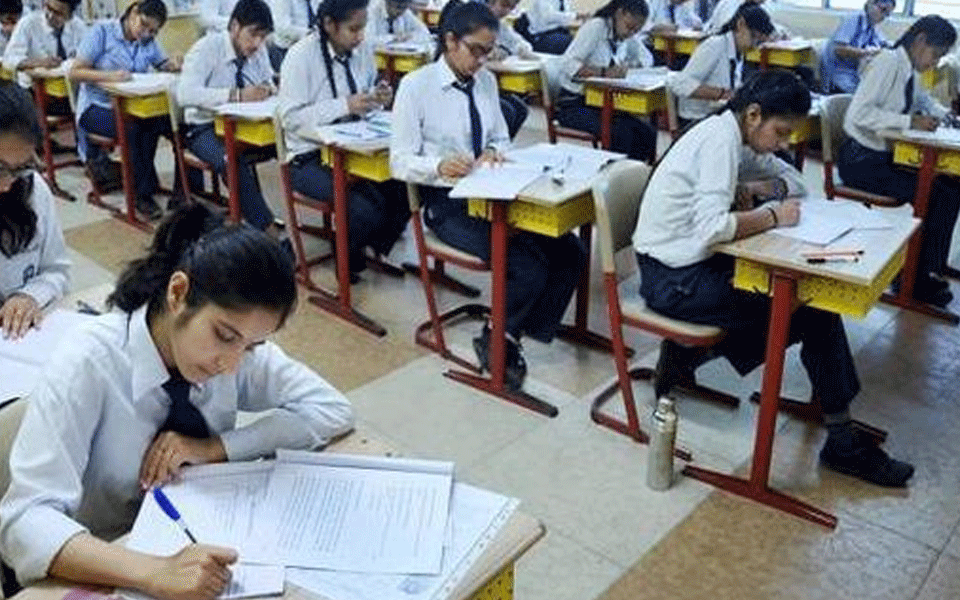
New Delhi: With 96.2% literacy, Kerala has once again emerged as the most literate state in the country, while Andhra Pradesh featured at the bottom with a rate of 66.4%, showed a report based on National Statistical Office (NSO) survey.
The report on 'Household Social Consumption: Education in India as part of the 75th round of National Sample Survey - from July 2017 to June 2018' provides for state-wise detail of literacy rate among the persons aged seven years and above.
According to the study, after Kerala, Delhi has the best literacy rate at 88.7%, followed by Uttarkhand's 87.6%, Himachal Pradesh's 86.6% and Assam's at 85.9%.
On the other hand, Rajasthan is the second worst performer with a literacy rate at 69.7%, followed by Bihar at 70.9%, Telangana at 72.8%, Uttar Pradesh at 73% and Madhya Pradesh at 73.7%.
The study has pegged the overall literacy rate in the country at about 77.7 %. In rural areas, the literacy rate is 73.5% compared to 87.7% in urban areas of the country.
At all-India level, the male literacy rate is higher at 84.7% compared to 70.3% among women.
The survey showed that the male literacy rate is higher than female literacy rate among all states. In Kerala, the male literacy rate is 97.4% compared to 95.2% among females.
Similarly, the male literacy rate in Delhi stood a 93.7% higher than 82.4% among females.
Even in the worst performing states, there was a considerable gap in male and female literacy rate.
In Andhra Pradesh, male literacy rate is 73.4%, higher than 59.5% among females (of the age of seven year or above).
In Rajasthan, the gap was even wider as male literacy rate stood at 80.8% compared to 57.6% of females.
In Bihar, the male literacy rate was also higher at 79.7% compared to 60.5% of females.
A sample of 64,519 rural households from 8,097 villages and 49,238 urban households from 6,188 blocks was surveyed all-over India.
The report also revealed that nearly 4% of rural households and 23% of urban household possessed computer.
Among persons of age 15-29 years, nearly 24% in rural areas and 56% in urban areas were able to operate a computer.
Nearly 35% of persons of age 15-29 years reported use of internet during the 30 days prior to the date of survey. The proportions were nearly 25% in rural areas and 58% in urban areas.
Let the Truth be known. If you read VB and like VB, please be a VB Supporter and Help us deliver the Truth to one and all.
Right to vote under threat, must be made fundamental right: Cong's Jairam Ramesh
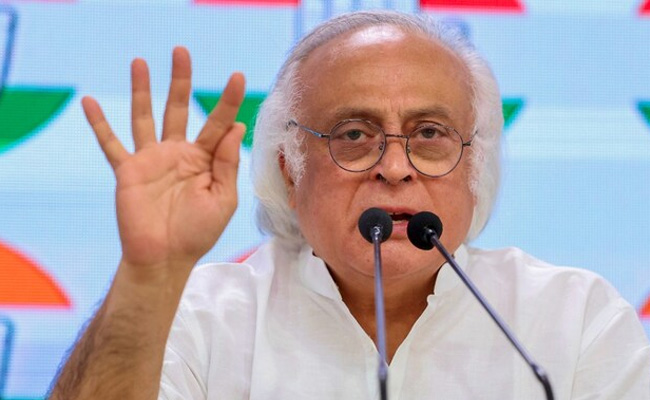
New Delhi (PTI): Congress leader Jairam Ramesh alleged on Thursday that the right to vote is under threat and the time has come when it should be made a fundamental right for citizens.
Speaking with reporters, Ramesh lashed out at Chief Election Commissioner (CEC) Gyanesh Kumar, saying the Election Commission (EC) has never been as compromised as it has been under him.
"The rot started under his predecessor. This man is a player and not a neutral observer," the Congress leader said, slamming Kumar.
Kumar is completely compromised and has become a player in elections, he alleged.
"Home Minister Amit Shah had talked about three Ds -- detect, delete and deport. So we want to know how many non-Indian citizens have been detected, how many have been deleted and how many have been deported," Ramesh said, adding that the right to vote is now under threat.
On opposition parties submitting a fresh notice in the Rajya Sabha, seeking to move a motion for the CEC's removal, the Congress leader said they will continue to make efforts for Kumar's removal as he is "compromised".
Ramesh also batted for the right to vote to be recognised as a fundamental right.
"I believe that the time has come that the right to vote should be made a fundamental right. It is a statutory right, it is not a fundamental right. Fundamental rights are justiciable," he said.
The former Union minister said this was discussed in the Constituent Assembly, but it was eventually decided that it should be made part of the Constitution.
B R Ambedkar and Jagjivan Ram had warned that in the future, governments might try to disenfranchise voters, he added.
"Once and for all, include the right to vote as a fundamental right for Indian citizens," Ramesh asserted.