Ayodhya: SC to pass order on Mar 5 on whether to refer matter to court-appointed mediator

New Delhi : The Supreme Court Tuesday suggested mediation in the Ram Janambhoomi-Babri Masjid land dispute case, saying it was considering the possibility of "healing relations".
The court said it will pass an order on March 5 on whether to refer it to a court-appointed mediator.
A five-judge constitution bench headed by Chief Justice Ranjan Gogoi said that even if one per cent chance of mediation exists in the politically sensitive land dispute matter, it should be done.
The bench also comprising Justices S A Bobde, D Y Chandrachud, Ashok Bhushan and S Abdul Nazeer asked the registry to provide translated copies of all documents within six weeks and said the main matter would be taken up for hearing after eight weeks.
It also directed the parties to examine translated copies and raise objections, if any, within eight weeks.
The apex court said it wanted to explore the possibility of mediation to utilise the period of eight weeks after which the matter would be heard.
While some Muslim parties said they were agreeable to the apex court suggestion for a court-appointed mediator to solve the dispute, some Hindu parties including Ram Lalla Virajmaan raised objections saying earlier also the process of mediation has failed several times.
The bench asked the parties if they can explore the possibility of mediation to resolve the land dispute and said, "Even if there is 1 per cent chance, mediation should be done."
"Do you seriously think that the entire dispute for so many years is for property? We can only decide property rights but we are considering the possibility of "healing relations"," the bench said.
To this, senior advocate Rajeev Dhavan, appearing for a Muslim party referred to Allahabad High Court verdict and said that mediation was tried earlier and was unsuccessful.
Senior advocate C S Vaidyanathan, representing Ram Lalla, said it was averse to mediation and that "We do not want another round of mediation".
At the outset, the apex court said it can proceed with hearing if there is consensus with regard to translation of documents.
"If tranations of documents are now acceptable to all, parties cannot contest translations once proceedings begin," the bench said.
It referred to copies of report filed by the Secretary General of the apex court on the status of documents and sealed records of the case. The CJI asked lawyers of both sides to peruse the report.
Dhavan said he is yet to examine translation of documents and will have to check the veracity of translated documents.
To this, the apex court asked the parties to show the order by which they had agreed to translated documents filed by Uttar Pradesh government.
Vaidyanathan said the translations were verified and accepted by all parties in December 2017.
He said that an order was passed to examine Uttar Pradesh government's translations and now two years later they raise objections to it.
When the CJI asked the Muslim parties as to how much time they need to examine the translations, Dhavan replied "8-12 weeks".
Fourteen appeals have been filed in the apex court against the 2010 Allahabad High Court judgment, delivered in four civil suits, that the 2.77-acre land in Ayodhya be partitioned equally among the three parties -- the Sunni Waqf Board, the Nirmohi Akhara and Ram Lalla.
The five-judge bench was re-constituted on January 25 as Justice U U Lalit, who was a member of the earlier bench, had recused himself from hearing the matter.
When the new bench was constituted, Justice N V Ramana was excluded from the re-constituted bench.
Justices Bhushan and Nazeer, who were included in the newly constituted bench, were part of an earlier bench headed by then Chief Justice of India Dipak Misra (now retired) which had heard the Ayodhya land dispute matter.
The three-judge bench had on September 27, 2018 refused to refer to a five-judge constitution bench the issue related to reconsideration of the observation in the apex court's 1994 judgment that a mosque was not integral to Islam.
Let the Truth be known. If you read VB and like VB, please be a VB Supporter and Help us deliver the Truth to one and all.
4 workers die after being buried under coal slurry in Jharkhand's Dhanbad
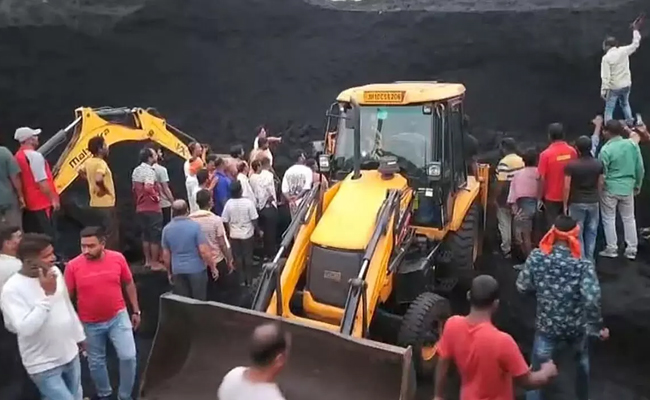
Dhanbad (Jharkhand) (PTI): At least four workers died after being buried under coal slurry in Jharkhand's Dhanbad district on Saturday, a police official said.
The incident took place at Moonidih coal washery in the command area of Bharat Coking Coal Limited (BCCL).
"Bodies of all four workers were dug out of debris during a rescue operation," Putki police station in-charge Waqar Hussain told PTI.
The incident took place when coal slurry was being loaded into trucks by workers, during which a large chunk of slurry fell and trapped several workers underneath, officials said.
The deceased have been identified as Manik Bauri, Dinesh Bauri, Deepak Bauri, and Hemlal Gope.
Meanwhile, the family members of the deceased and local villagers placed the bodies in front of the washery gate and began a protest.
They demanded compensation, jobs for dependents and action against those responsible for the incident.
Police and administration officials are trying to pacify the protesters, an official said.