Babri demolition case verdict on Sept 30; accused Advani, Joshi, others to be present in court
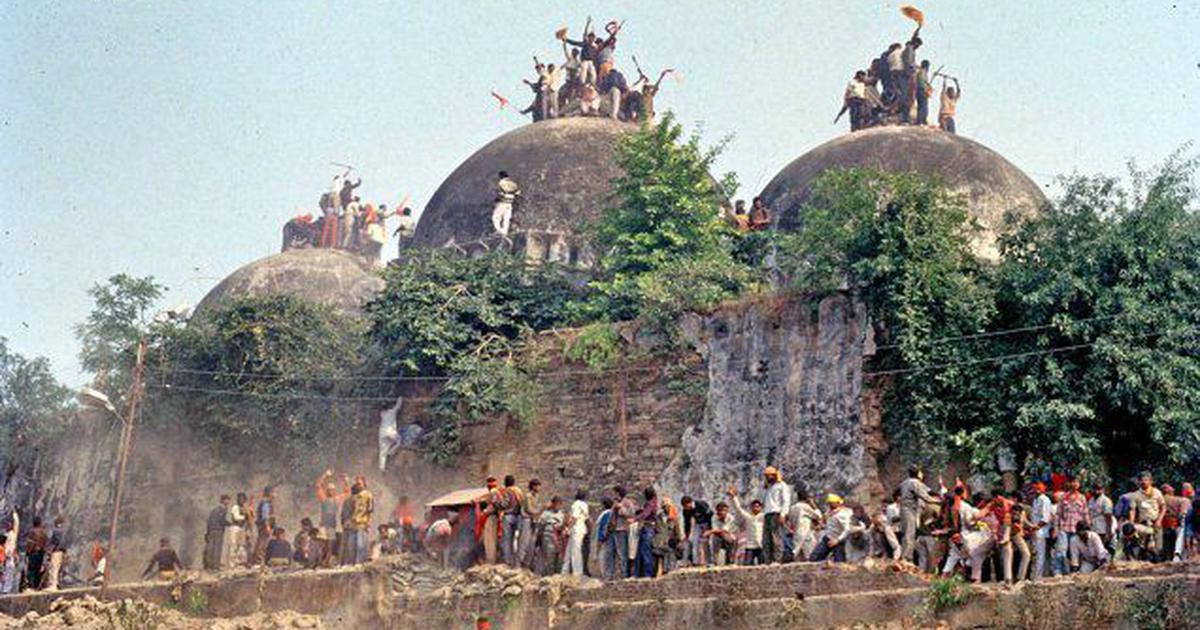
Lucknow: A special court here will deliver judgment on September 30 in the Babri Masjid demolition case, ruling whether BJP veterans like L K Advani and Murli Manohar Joshi were involved in razing the mosque in 1992.
Judge S K Yadav on Wednesday directed all 32 accused to remain present in the court on the day of the judgment.
The accused include former deputy prime minister L K Advani, former Union ministers M M Joshi and Uma Bharti, former Uttar Pradesh chief minister Kalyan Singh, Vinay Katiyar and Sadhvi Rithambara.
The CBI court was working against the month-end deadline set by the Supreme Court for the verdict. The final arguments by the defence and the prosecution were heard by September 1, and then the judge began writing the verdict.
Some of the final submissions by the accused were made through video conferencing.
Issuing the order on Wednesday, the judge said the verdict will be pronounced on September 30 and asked all accused to be present in court.
The Central Bureau of Investigation, which investigated the case, has produced 351 witnesses and about 600 documents as evidence before the court. Charges were framed against 48 people, but 16 died during the course of the trial.
The CBI argued that the accused conspired and instigated the kar sevaks to demolish the 16th-century mosque.
But the accused pleaded that there is no evidence to prove their guilt and claimed they were falsely implicated in the case by the then Congress-led central government as political vendetta.
The mosque was pulled down on Decembe6, 1992 by mobs of kar sevaks who maintained that it was built during the time of the first Mughal ruler at the spot which marked the birthplace of Ram temple.
In a landmark judgment last year, the Supreme Court allotted the disputed site in Ayodhya for the construction of a Ram temple, while calling the demolition of the mosque a violation of the rule of law.
An alternative five-acre site has been found in the city for building a mosque.
Champat Rai, the general secretary of the trust in charge of constructing the temple, is among the 32 accused in the Babri mosque demolition case.
The earlier deadline set by the Supreme Court for the special CBI court to pronounce verdict was August-end. It was extended by a month on August 22.
On July 24, BJP veteran L K Advani recorded his statement before the court through video conferencing, denying any involvement in the conspiracy to demolish the mosque.
He pleaded that he was unnecessarily dragged in the case, claiming that the investigation was conducted under political pressure and the charge sheet was based on fabricated evidence.
Other BJP leaders also took similar pleas.
"The then Congress government at the Centre leveled false and baseless allegations against me and filed a case out of political animosity," Kalyan Singh told reporters after appearing before the court.
"As the UP chief minister, I and my government ensured adequate three-tier security for the disputed structure in Ayodhya," he claimed.
"I was falsely implicated, I am innocent," he had said.
Let the Truth be known. If you read VB and like VB, please be a VB Supporter and Help us deliver the Truth to one and all.
AIITA welcomes Karnataka’s ban on obscene songs in school events
Bhatkal: The Karnataka unit of the All India Ideal Teachers Association (AIITA) has welcomed the Karnataka government’s decision to strictly ban school children from dancing to obscene songs during educational and cultural programmes in government, aided, and private schools across the state.
AIITA Karnataka State President M. R. Manvi congratulated the government for taking what he termed an important step to preserve the sanctity of education.
“Such decisions to safeguard the dignity of school children and uphold the values of education are the need of the hour. This rule should not be limited to government schools alone but must be strictly implemented in all private educational institutions as well,” he said.
He further urged the government to address other concerns within school programmes.
“The government should not only prohibit obscene dances in the name of school anniversaries, but also ensure that plays and dialogues that incite religious hatred are avoided. Schools should be centres of harmony, not platforms for spreading hatred,” he added.
According to a recent circular issued by the Department of School Education and Literacy, obscene dances are adversely affecting the mental health and moral values of students.
In this regard, schools have been advised to use songs that promote nationalism, positive thinking, the greatness of Kannada culture, and value-based traditions instead of inappropriate content during programmes.
The circular also emphasises that students should be dressed in decent attire.
AIITA also backed the department’s warning that disciplinary action would be taken against head teachers if such guidelines are violated. The association has further demanded that district Deputy Directors of Public Instruction strictly monitor the implementation of these rules.