Babri Masjid demolition case: Supreme Court extends deadline till Sept 30 for verdict
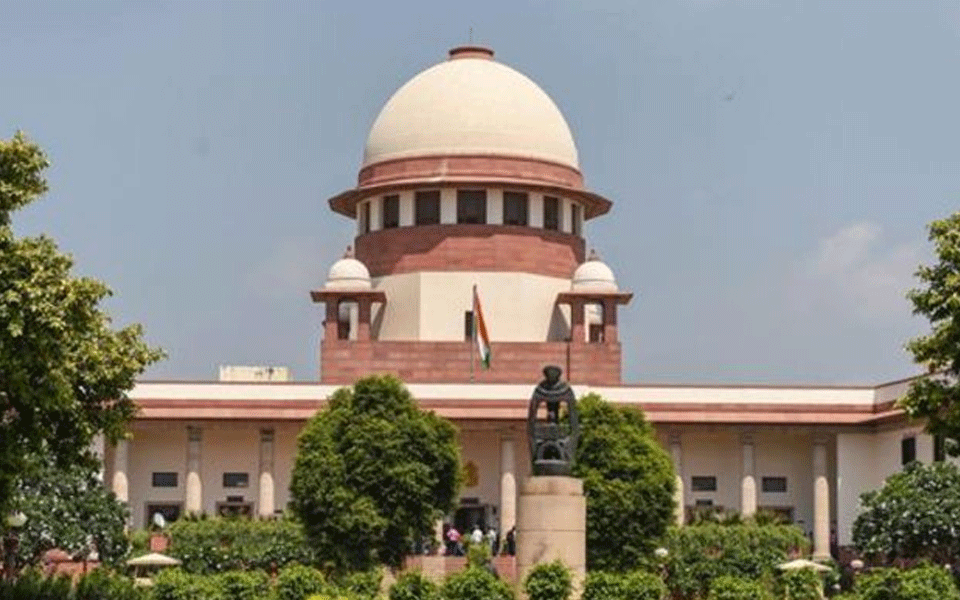
New Delhi: The Supreme Court has extended by a month the deadline for completion of trial in the 1992 Babri Masjid demolition case involving 32 accused, including BJP veterans L K Advani, M M Joshi and Uma Bharti, and said that judgement should be delivered by September 30.
The top court, which had earlier fixed August 31 as the deadline for completion of proceedings including pronouncement of the verdict, took note of the report filed by special judge S K Yadav in the high-profile case.
A bench of justices R F Nariman, Navin Sinha and Indira Banerjee said, Having read the report of Surendra Kumar Yadav, learned Special Judge, and considering that the proceedings are at the fag end, we grant one month's time, i.e., till September 30, 2020, to complete the proceedings including the delivery of judgment.
The order was passed on August 19 and was uploaded on the apex court website recently.
On May 8, the top court had extended by three months the time for completion of trial in the case and said that judgement should be delivered by August 31.
The special CBI court at Lucknow has completed the recording of statements of the 32 accused under section 313 of CrPC in the case.
The mosque in Ayodhya was demolished on December 6, 1992, by 'kar sevaks' who claimed that an ancient Ram temple stood at the same site.
Former deputy prime minister LK Advani and BJP veteran MM Joshi, who were among those leading the Ram temple movement at that time, had deposed before the court through video conferencing.
The court has also recorded statements of BJP stalwarts like Kalyan Singh and Uma Bharti, both of whom appeared in person.
Advani's statement was recorded barely days before the groundbreaking event on August 5 for a Ram temple at Ayodhya.
Last year, a five-judge Constitution bench of the top court had ruled that the 2.77-acre land claimed by both Hindus and Muslims would be handed over to a trust for the building of a temple.
The court had also ordered the allocation of a five-acre land at another site in Ayodhya for building a mosque.
The top court had in May asked special judge S K Yadav to control the proceedings in accordance with law so that the time-frame is no longer breached.
It had indicated to the special judge to avail the facilities of video conferencing to complete recording of evidence and hearing of applications that are filed during the course of trial proceedings.
The top court order was passed after the special judge had written a letter seeking an extension of time granted to him for completing the trial in the politically sensitive case.
On July 19, last year the top court had asked the special judge to deliver the verdict within nine months, which was to end this April.
It had also extended the tenure of the special judge at Lucknow till the completion of the trial and the delivery of the verdict in the case.
Besides Advani, Joshi and Uma Bharti, the accused against whom conspiracy charge was invoked in the case by the top court on April 19, 2017, include former Rajasthan governor Kalyan Singh, BJP MP Vinay Katiar and Sadhvi Rithambara.
Three other high-profile accused - Vishwa Hindu Parishad leaders Giriraj Kishore, Ashok Singhal and Vishnu Hari Dalmia - died during trial and the proceedings against them have been abated.
Kalyan Singh, during whose tenure as chief minister of Uttar Pradesh the disputed structure was razed, was put on trial in September last year after his tenure as governor came to an end.
Exercising its plenary powers under Article 142 of the Constitution, the top court had directed the Uttar Pradesh government to pass appropriate orders in consultation with the Allahabad High Court to extend the tenure of the special judge, who was set to retire on September 30 last year.
On April 19, 2017, the top court had ordered a day-to-day trial in the high profile case and directed the special judge to conclude it in two years.
While dubbing the demolition of the disputed structure as a "crime" which shook the "secular fabric of the Constitution", it had allowed the CBI's plea on restoration of the criminal conspiracy charge against the VVIP accused.
The court had come down heavily on the CBI for the delay of over 25 years in the trial.
Issuing a slew of directions, it had said, "The proceedings (against Advani and others) in the court of the Special Judicial Magistrate at Raebareli will stand transferred to the Court of Additional Sessions Judge (Ayodhya Matters) at Lucknow."
"The court of sessions will frame additional charges under Section 120-B (conspiracy) and the other provisions of the penal code mentioned in the joint charge sheet filed by the CBI against Champat Rai Bansal, Satish Pradhan, Dharam Das, Mahant Nritya Gopal Das, Mahamadleshwar Jagdish Muni, Ram Bilas Vadanti, Vaikunth Lal Sharma and Satish Chandra Nagar," the apex court had said.
The court had termed the Allahabad High Court's February 12, 2001 verdict of dropping conspiracy charges against Advani and others as "erroneous".
Before the 2017 verdict of the apex court, there were two sets of cases relating to the demolition of the disputed structure on December 6, 1992, going on at Lucknow and Raebareli.
The trial of the first case involving unnamed 'Karsevaks' was going on in a Lucknow court, while the second set of cases relating to the eight VVIPs were going on in a Raebareli court.
Let the Truth be known. If you read VB and like VB, please be a VB Supporter and Help us deliver the Truth to one and all.
Huge turnout amidst SIR shadow caps ballistic battle for Bengal
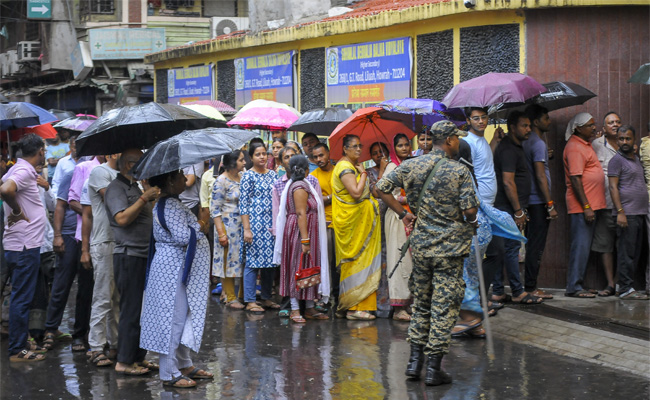
Kolkata (PTI): The West Bengal assembly polls ended on Wednesday with what the election watchdog said was the state's highest-ever voter turnout of 92.84 per cent, leading to mouth-watering anticipation ahead of the announcement of results on Monday as both contenders sounded sanguine about their victory prospects.
Wednesday's second phase saw a 92.48 per cent turnout. The concluding phase covering 142 constituencies in south Bengal appears poised to match the first phase's record voter participation of 93.19 per cent by the time final numbers are collated.
The figures put the combined poll percentage over the two-phases at 92.84 per cent. The first phase of polling was held on April 23.
"This is the highest-ever recorded poll participation since Independence in West Bengal," it said.
The capital Kolkata recorded a turnout of 88.59 per cent, with Purba Bardhaman district topping the charts at 93.78 per cent.
The scale of participation sent out an overarching political message — practically every single eligible voter in the state felt personally invested in the electoral process and its outcome. They turned out in numbers large enough to make every narrative contested and every claim of momentum politically loaded. If the first phase tested whether the BJP could retain its north Bengal citadel, the second and final round was always the real battle for the saffron party on whether it could breach the ruling TMC’s southern fortress of Kolkata, Howrah, Hooghly, Nadia, North and South 24 Parganas and Purba Bardhaman.
At the centre of the larger political fight stood Bhabanipur, no longer merely a south Kolkata constituency but Banerjee’s political refuge, her emotional home turf and the BJP’s chosen psychological battlefield.
Banerjee, 71, seeking a fourth consecutive term after 15 years in power, faced Leader of Opposition Suvendu Adhikari in a prestige battle widely seen as a symbolic rematch of Nandigram, where Adhikari had defeated her in 2021 after crossing over from the TMC to the BJP.
Five years later, the duel shifted to Banerjee’s own bastion. For the TMC, retaining Bhabanipur is about protecting the chief minister’s authority in her own backyard. For the BJP, breaching it would puncture the aura of invincibility around Bengal’s most powerful political figure.
The constituency witnessed nearly 87 per cent polling, sharply up from around 61 per cent in the 2021 assembly polls and 57 per cent in the bypoll that brought Banerjee back to the House.
Banerjee – who usually votes later in the day and prefers staying indoors on the day of polls – broke convention and hit the ground before 8 am, moving through Chetla, Padmapukur and Chakraberia areas following complaints of alleged intimidation of local TMC leaders.
As she sat outside a booth amid heavy deployment of central forces, Adhikari arrived there and declared, "I will not allow any hooliganism." He opposed Banerjee moving around with "50-60 people" with her.
Banerjee accused the BJP of trying to "rig" the election by using central forces, election observers and officials.
"The BJP wants to rig this election. Polls in Bengal are usually peaceful. Is there a goonda raj here?" she said, alleging intimidation of TMC polling agents and late-night visits by CRPF personnel to party workers’ homes.
"The atrocities by the central forces are unprecedented. What is happening is not at all free and fair polls. But despite all this, we have full faith that we will win," she said after casting her vote.
Adhikari dismissed the charges as "frustration", claiming Banerjee had realised that "not a single vote was coming her way".
Tension flared again in Kalighat when Adhikari visited another booth, and TMC workers raised slogans against him. Police resorted to a lathi-charge to disperse the crowd as BJP supporters answered with counter-slogans. Reports of sporadic tension were also received from some other areas amid sights of long queues at polling stations, booth-level flare-ups, and political bickering.
In Kolkata's Entally, BJP candidate Priyanka Tibrewal alleged that the TMC's polling agents tried to assault her after she objected to overcrowding inside a booth and a lack of voter privacy.
In Panihati, BJP candidate and the R G Kar victim's mother, Ratna Debnath, faced protests, while her party colleague in Basanti, Bikash Sardar, alleged that "200 to 250 TMC goons" attacked his vehicle and assaulted his driver.
The TMC, meanwhile, accused the central forces of exercising brute force on the general voters at Falta's Belsingha village, especially women, who were beaten up during a move to disperse a crowd from near a polling station.The party also alleged CAPF high-handedness on women and a four-year-old child at Sathachhia in Howrah and on villagers at Ausgram in Purba Bardhaman district.
"In the name of ensuring security, central force jawans are not sparing even women who were brutally lathi-charged. TMC protests this highhandedness of the male jawans who exercised brute force on unarmed villagers. We draw the EC's attention to such illegal actions of the CAPF and ask the poll body to issue cease-and-desist orders against such use of force. We believe, people of Bengal will respond to this on EVMs," Anirban Banerjee, party spokesperson, said.
The BJP alleged that in several polling stations in Falta, the option to vote for the party was blocked using a tape over EVM poll buttons, and demanded repolls in the affected booths.
The state’s Chief Electoral Officer Manoj Agarwal said repolling was likely to be announced in booths where EVMs were found tampered with. However, the order will only be issued after authorities receive reports from the district election officer or election observers regarding allegations of EVM tampering, such as using tapes or a blot of ink, he said.