Back in India after 7 decades; Plane carrying 8 cheetahs lands in Gwalior
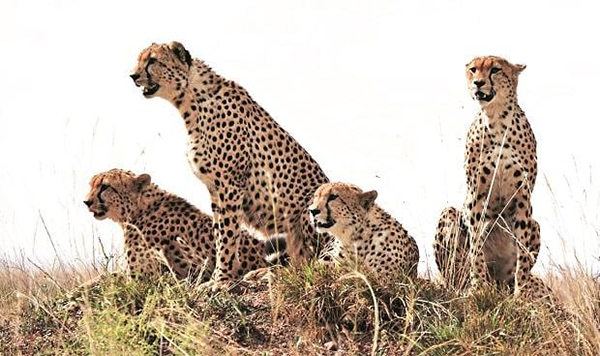
Gwalior, Sep 17: Eight cheetahs from Namibia landed here on Saturday, as part of the programme to reintroduce the feline in India seven decades after it was declared extinct in the country.
The plane landed at the Gwalior airbase shortly before 8 am, an official said
A modified Boeing aircraft, which took off from the African country Friday night, carried the cheetahs in special wooden crates during the around 10-hour journey.
They will be flown to Kuno National Park in Madhya Pradesh, where Prime Minister Narendra Modi, who is celebrating his birthday, will release three of the cheetahs in quarantine enclosures of the park at 10.45 am.
The animals are being flown from Gwalior to Kuno in Sheopur district, 165 km away, in an Air Force helicopter, and the journey will take about 20-25 minutes, an official said.
The cheetahs remained without food during the journey and will be given something to eat once they are released in the enclosures, an official said.
A dais has been set up in the Park under which special cages carrying cheetahs will be kept and Modi will release three of them in an enclosure by operating a lever.
After that, other dignitaries will release the remaining cheetahs in other enclosures, he said.
The cheetahs were brought in a special flight of Terra Avia, an airline based at Chisinau, Moldova in Europe that operates chartered passenger and cargo flights.
The Park is situated on the northern side of Vidhyachal mountains and is spread across 344 sq km.
Officials battled heavy rain, inclement weather and some blocked roads to complete the preparations for Modi's programme to release the big cats in their new home in Kuno.
Two days before Modi's arrival, heavy rain lashed the Gwalior-Chambal region of Madhya Pradesh.
Historic flight ✈️ underway! #Cheetah to be back in Indian 🇮🇳 soil 75 yrs after it was extinct.
— The Chennai Skies (@ChennaiFlights) September 16, 2022
9 cheetahs are on board a Boeing 747 (ER-TRV) of Terra Avia 🇲🇩 from #Windhoek (#Namibia) to #Gwalior (#MadhyaPradesh, #India)
Track: https://t.co/C397jqWQ7I#CheetahIsBack #Aviation pic.twitter.com/Lq25okiSlO
Let the Truth be known. If you read VB and like VB, please be a VB Supporter and Help us deliver the Truth to one and all.
UP man gets life term for electrocuting mentally challenged wife to death in Bareilly
Bareilly (UP) (PTI): A local court here has sentenced a man to life imprisonment for murdering his mentally challenged wife by repeatedly electrocuting her while she was tied to a cot, lawyers said on Thursday.
Additional district government counsel Harendra Singh Rathore said Additional Sessions Judge Avinash Kumar Singh on Wednesday convicted Vinod Kumar (45) for killing his wife, Satyavati, in Chaina village of Bareilly district and imposed a fine of Rs 15,000 on him.
According to the prosecution, he was allegedly frustrated with his wife Satyavati's mental illness and often assaulted her.
Rathore said the prosecution examined nine witnesses to establish the charges against him.
As per court records, on the night of May 1-2, 2022, when Satyavati was asleep, Vinod tied her hands and legs to a cot using ropes and then connected an aluminium cable to an electric board to repeatedly administer electric shocks to her.
"She writhed in pain, but the accused continued to electrocute her until she died," the prosecution said.
The court observed that the murder was carried out in an inhuman manner.
After committing the crime, the accused threw the rope and cable on the roof and left for work at a brick kiln around 2 am to create a false alibi.
He later tried to mislead the police and the victim's family by claiming that Satyavati, whose mental condition was unstable, had accidentally died by suicide after grabbing a live electric wire.
However, the victim's brother, Sanjeev, a resident of Shahjahanpur district, suspected foul play and lodged an FIR under sections 498A (husband subjecting wife to cruelty) and 302 (murder) of the Indian Penal Code at Nawabganj police station.
During the trial, the prosecution relied on the post-mortem report prepared by Dr Faraz Anwar, who stated that multiple electrocution marks found on different parts of the victim's body could not have been self-inflicted.
The police also recovered the rope and electric wire used in the crime on the accused's identification, officials said.