'Bad days ahead,' warns Pakistan's finance minister Miftah Ismail

Karachi, Aug 5: Pakistan's Finance Minister Miftah Ismail on Friday said the government would continue to curb imports for the next three months, as he warned of "bad days" ahead for the cash-strapped country.
Addressing a ceremony at the Pakistan Stock Exchange here, the minister said that the government headed by Prime Minister Shehbaz Sharif was suffering because of the economic policies taken by the erstwhile Pakistan Tehreek-e-Insaf (PTI) regime led by ousted prime minister Imran Khan.
"During the previous Pakistan Muslim League-Nawaz (PML-N) government, the country's budget deficit was USD 1,600 billion, and in the last four years under the Pakistan Tehreek-e-Insaf (PTI) regime, that figure ballooned to USD 3,500," Geo TV quoted Ismail as saying.
No country can grow and be stable with this kind of current account deficit," he asserted.
"When you raise the budget deficit and also increase the loans by 80 per cent, it has an adverse impact on the economy," he explained.
I will not allow imports to increase for three months and, in the meantime, we will come up with a policy. I understand that growth will be reduced for a bit but I have no other choice, the Dawn newspaper quoted the finance minister as saying.
Pakistan's import bill for the previous fiscal year stood at USD 80 billion, while exports amounted to USD 31 billion.
He noted that the current government had to save the country from a possible default and had to take immediate and short-term measures. "Maybe it was unwise in the long-term," he lamented.
"We are on the right track, but obviously we might see bad days. If we control our imports for three months, we can boost our exports through various means," he asserted.
Talking about the exchange rate, Ismail noted that dollar outflows had been surpassing inflows, which is why the rupee had fallen sharply against the greenback over the last month.
The Pakistani rupee appreciated 2.15 against the US dollar for the sixth consecutive session during intra-day trade in the interbank market, to touch 224 against the greenback on Friday.
Since Khan's ouster in April, Pakistan's currency has plummeted to an all-time low of 240, amid uncertainty about IMF assistance.
Last week, New York-based rating agency S&P Global revised Pakistan's long-term ratings from 'stable' to 'negative' due to spiralling inflation and tighter global financial conditions.
Pakistan reached a staff-level agreement with the IMF last month followed by months of deeply unpopular belt-tightening by the government, which took power in April and has effectively eliminated fuel and power subsidies and introduced new measures to broaden the tax base.
The new government has slashed a raft of subsidies to meet the demands of global financial institutions but risks the wrath of an electorate already struggling under the weight of double-digit inflation.
Pakistan had hoped for a quick revival of the bailout, but the IMF has so far not released the much-needed installment.
IMF's Resident Representative for Pakistan Esther Perez Ruiz, following the staff-level agreement, earlier this week said the country had completed the last precondition increasing the petroleum development levy for the combined seventh and eighth reviews.
An original USD 6 billion bailout package was signed by former prime minister Imran Khan in 2019, but repeatedly stalled when his government reneged on subsidy agreements and failed to significantly improve tax collection.
Pakistan desperately needs the IMF loan.
In July, the fund said it would raise the value of the bailout from USD 6 billion to USD 7 billion if approved by its executive board, usually considered a formality.
Sharif has repeatedly blamed the former prime minister's government, alleging that Khan - a former cricket star turned Islamist politician - had deliberately violated IMF's conditions in order to remain popular among followers at home.
Let the Truth be known. If you read VB and like VB, please be a VB Supporter and Help us deliver the Truth to one and all.
KMES Institutions shine in SSLC result, continue four-decade legacy of education in rural Karkala
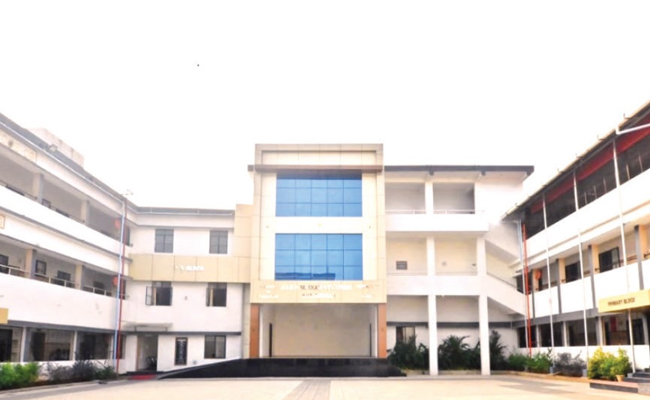
Karkala: KMES Institutions of Education at Kukkundooru in Karkala taluk has recorded outstanding results in the 2025-26 SSLC and PUC examinations, continuing a four-decade educational journey that began with just 22 kindergarten students and no building of its own.
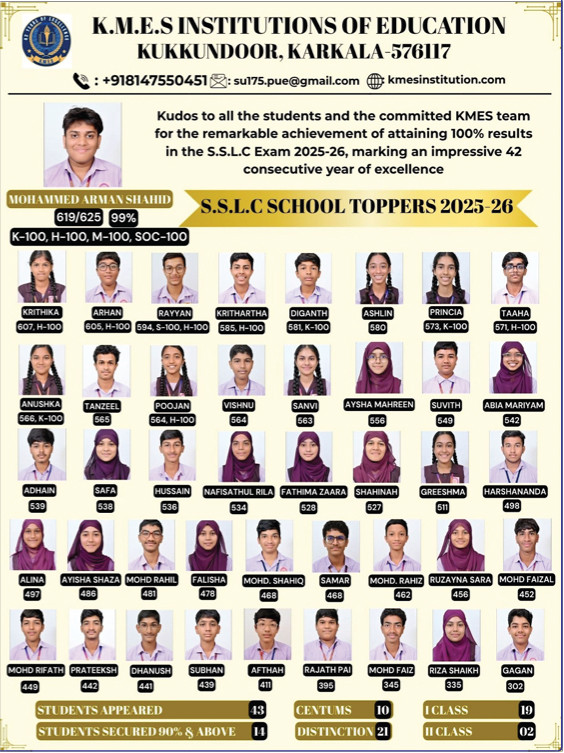
The institution secured a 100 per cent result in the SSLC examinations, with all 43 students passing the examination this year.
Muhammad Arman Shahid emerged as the school topper by scoring 619 marks out of 625, securing 99 per cent and also ranking sixth at the state level. He scored full marks in Kannada, Hindi, Mathematics and Social Science.
Krithika V. Nayak secured the second position in the school with 607 marks and 97.12 per cent, while Arhan stood third with 605 marks and 96.8 per cent.
Out of the 43 students, 21 passed with distinction, 19 secured first class, two students obtained second class and one student passed in third class. Fourteen students scored above 90 per cent.
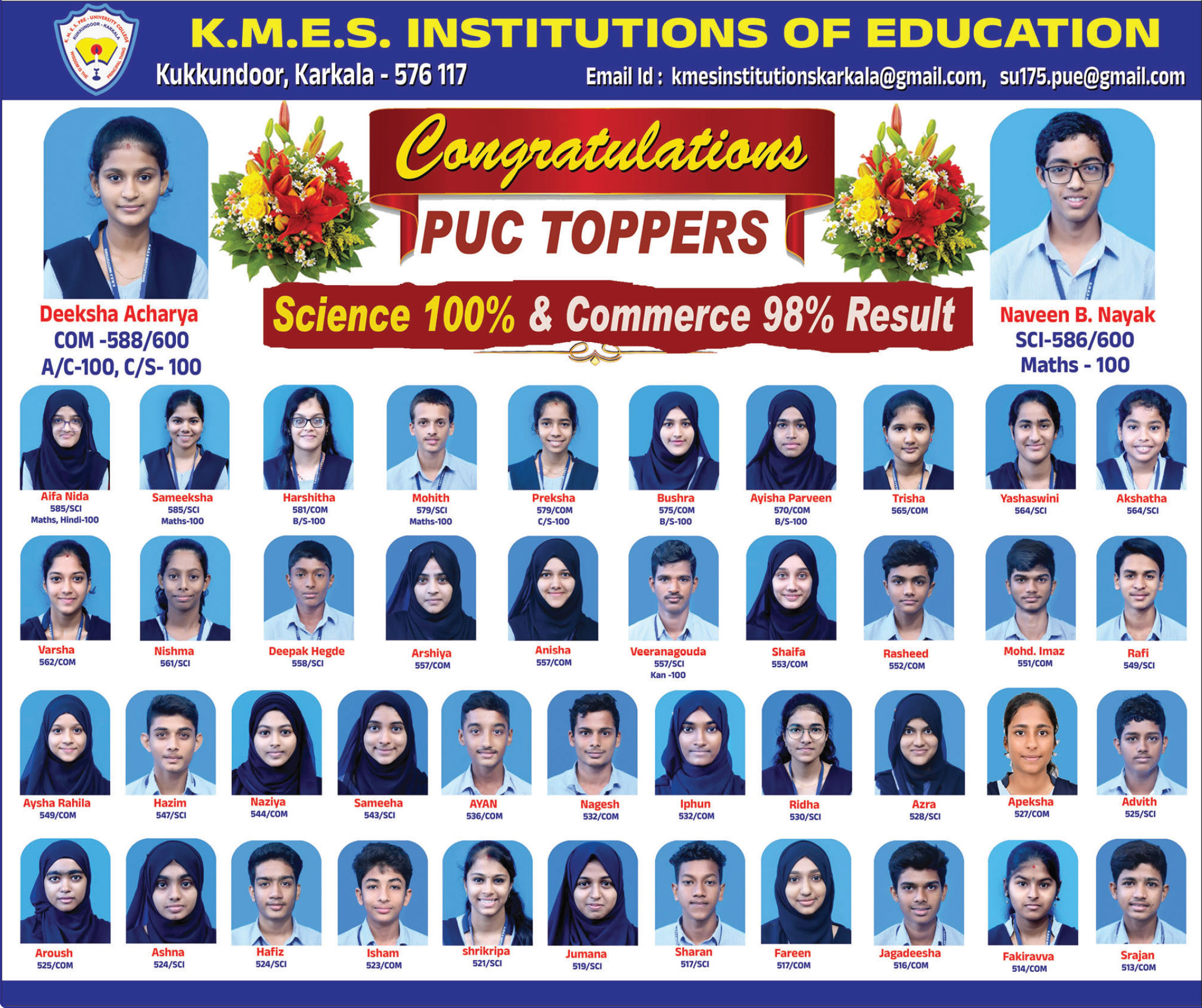
The institution also performed strongly in the PUC examinations. The Science stream recorded a 100 per cent result, with all 44 students passing, while Commerce secured a 98 per cent pass percentage.
Twelve students scored full marks in different subjects, including Mathematics.
In Commerce, Deeksha Acharya topped the college with 588 marks, while Harshitha H. Kini secured the second position with 581 marks.
In Science, Naveen B. Nayak emerged as topper with 586 marks, followed closely by Sameeksha Moily and Aifa Nidha, who both secured 585 marks.
Speaking about the achievement, High School head teacher Shrimati Patkar said the institution has always focused on supporting academically weak students through affordable education and free special classes.
“Our ambition is to provide quality education even to students who struggle in studies. The fees are very low, and free coaching classes are conducted. I have worked here for 28 years and have always found the atmosphere supportive of education,” she said.
Primary School head teacher Lolita Zeena D’Silva appreciated the dedication of the teaching staff and said the school encourages students not only to achieve high marks but also to become role models.
PU College Principal Balakrishna Rao said the institution focuses on value-based education and overall personality development.
“The aim is to help students succeed not only academically but also in cultural activities, sports and leadership. We encourage qualities such as patience, tolerance and discipline,” he said.
Rao also credited the institution’s growth to the support of founders K.S. Mohammed Masood and K.S. Nissar Ahmed, along with President K.S. Imtiaz Ahmed.
Speaking on the occasion, Imtiaz Ahmed said the institution was built on the dream of making quality education accessible to financially backward families in rural areas.
He said the guidance and encouragement of his elder brothers, Mohammed Masood and Nissar Ahmed, along with the contribution of teachers, students and parents, helped transform the institution into a model educational centre.
The KMES Institutions trace their roots back to 1984, when they were founded by senior social activists Haji P.M. Khan, K.S. Nazeer Ahmed and Haji A.S. Rashid Haider.
The institution initially functioned from the Government Urdu School premises as it did not have a building of its own. Classes began with only 22 students in lower kindergarten and two teachers.
Later, under the leadership of K.S. Mohammed Masood and with continuous financial and moral support from non-resident businessman K.S. Nissar Ahmed, the institution gradually expanded.
In 1993, the school shifted to its own building and began conducting classes from LKG to Class 5.
As student admissions increased, Nissar Ahmed personally funded the construction of three additional classrooms to address infrastructure shortages.
The institution’s new school building was completed in 1997, while the PU College building was constructed in 2001.
From humble beginnings in a borrowed building to producing state-level rank holders and consistent academic results, the KMES Institutions have grown into one of the prominent educational centres in the Karkala region.