'Ban' on telecast of consecration ceremony: SC asks TN authorities to act in accordance with law
_vb_74.jpeg)
New Delhi (PTI): The Supreme Court on Monday asked the authorities in Tamil Nadu to act in accordance with the law and not based on any oral instructions on "banning" special prayers and live telecast of the Ram temple consecration ceremony in all temples across the state.
A bench of Justices Sanjiv Khanna and Dipankar Datta, while hearing a plea seeking quashing of an "oral order" dated January 20 banning live telecast of the consecration ceremony at Ayodhya in temples across Tamil Nadu, said no one is bound to abide with the oral orders.
The bench took on record the statement of senior advocate Amit Anand Tiwari for Tamil Nadu that there are no restrictions on 'puja archana' in temples or live telecast of consecration ceremony at Ayodhya.
He said the plea is "politically motivated".
The bench asked the authorities to put on record the reasons and maintain the data of applications which has been allowed for Puja archana' and live telecast of consecration ceremony in temples and those which have been disallowed.
The bench also sought response of the Tamil Nadu government on the plea by January 29. The plea has been filed by one Vinoj in which it has been submitted that the Tamil Nadu government run by the DMK has banned live telecast of the "pran prathishta" of Lord Ram at Ayodhya in all temples across Tamil Nadu.
It is being alleged that the government has also banned all kinds of prayers, and 'annadanam' (poor feeding) 'bhajans' on the occasion.
However, Tamil Nadu Hindu Religious and Charitable Endowments Minister, P K Sekar Babu had said on Sunday that the HR and CE Department has not imposed any kind of ban for conduct of puja for Shri Ram. Also, there is no bar to distribute 'Annadhanam' and 'Prasadam.' He dismissed the claim as false news with ulterior motives.
Let the Truth be known. If you read VB and like VB, please be a VB Supporter and Help us deliver the Truth to one and all.
India achieves major milestone in wind energy; capacity now 56 gigawatts: PM Modi
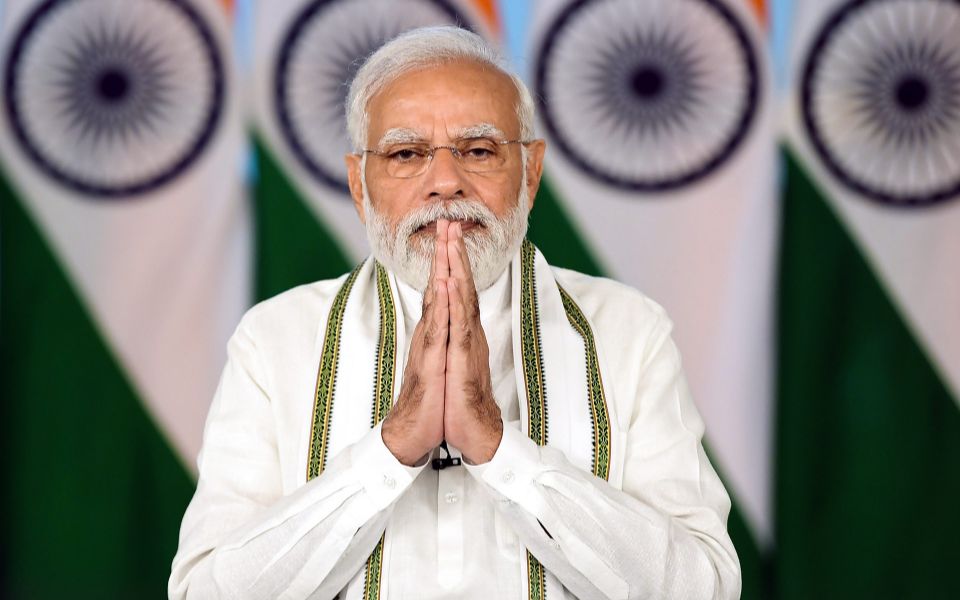
New Delhi (PTI): India has achieved a major milestone in wind energy, with the country's wind energy generation capacity exceeding 56 gigawatts, Prime Minister Narendra Modi said on Sunday.
In his monthly radio address 'Mann Ki Baat', Modi also said the country must save electricity and adopt clean energy.
“India recently achieved a major milestone in wind energy. India's wind energy generation capacity has now exceeded 56 gigawatts. In just the past year, nearly 6 gigawatts of new capacity have been added,” he said.
Underlining that solar and wind energy are essential for India's development, Modi said, “It is not just about the environment; it is about securing our future, and we all have a role to play in it.”
On April 22, Union Minister for New and Renewable Energy, Pralhad Joshi, said that India has recorded its best-ever year in wind energy capacity addition, with a historic 6.1 GW added during 2025-26.
India currently ranks fourth globally in wind energy, with more than 56.1 GW installed capacity and an additional 28 GW under implementation.
Emphasising the vast untapped potential of the sector, Joshi highlighted that India's wind energy potential at 150 metres hub height is estimated at nearly 1,164 GW.
He expressed confidence that with sustained efforts, the country will achieve 100 GW wind capacity by 2030 and 156 GW by 2036, contributing significantly to the net-zero target by 2070.
Joshi also underlined that wind energy plays a critical role in stabilising India's energy system, particularly due to its peak generation during evening and night hours, which aligns with high demand periods.
He noted that nearly 45 per cent of wind power generation occurs during peak demand hours, making it a vital complement to solar energy.