Bank strike on Wednesday, services to be affected
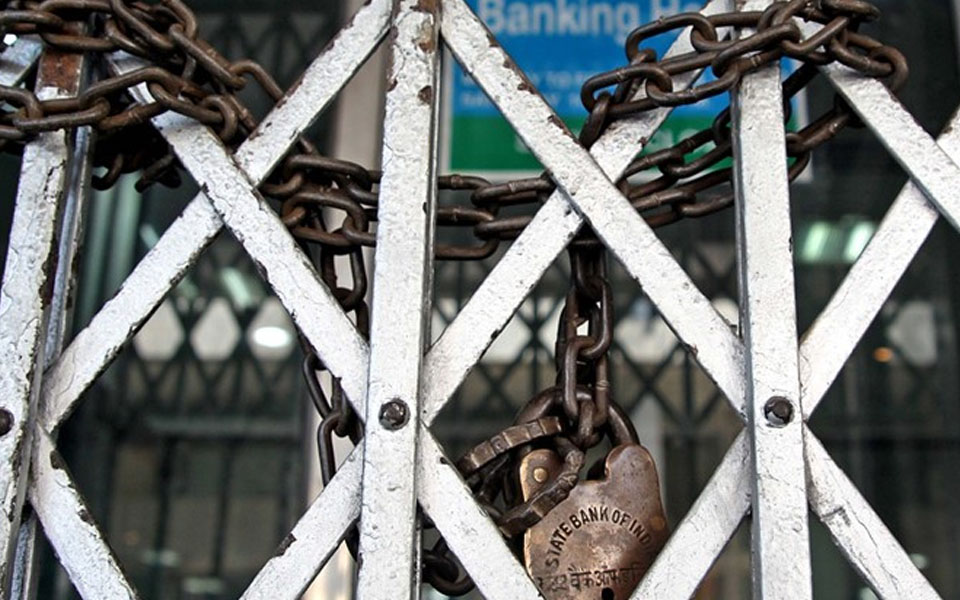
New Delhi, Dec 25: Services of state-owned banks are expected to be impacted Wednesday due to a nation-wide strike call given by unions to protest against the proposed amalgamation of Vijaya Bank and Dena Bank with Bank of Baroda.
This will be the second bank strike in less than a week.
Last Friday (December 21), an officers' union of state-run banks observed a day-long strike to protest against the merger and also demanded immediate settlement of wage negotiations.
Most of the banks have already informed customers about the strike.
Private sector banks will continue to function as usual.
The strike is being organised by the United Forum of Bank Unions (UFBU), an umbrella organisation of nine unions, including the All India Bank Officers Confederation (AIBOC), the All India Bank Employees' Association (AIBEA), National Confederation of Bank Employees (NCBE) and the National Organisation of Bank Workers (NOBW). The UFBU claims membership of 10 lakh officers and staffers.
According to AIBEA General Secretary C H Vekatachalam, the conciliation meeting called by Additional Chief Labour Commissioner did not lead to any assurance and so the unions are going ahead with the strike.
During the meeting, neither the government nor the concerned banks came forward to assure that they will not go ahead with the merger, he added.
The unions claim that the government wants banks to grow in size by such mergers but even if all public sector banks are bundled into one, the merged entity will not find a place among the top 10 globally.
The government in September approved the amalgamation of Bank of Baroda (BoB), Vijaya Bank and Dena Bank -- the first three-way merger in the public sector banking space.
The move follows top lender State Bank of India last year merging five of its subsidiary banks with itself and taking over Bharatiya Mahila Bank, catapulting it to among the top 50 global lenders.
On wage revision, NOBW Vice President Ashwani Rana it is due since November 2017. So far, Indian Banks' Association (IBA) has offered 8 per cent wage hike which is not acceptable to UFBU, he said.
Let the Truth be known. If you read VB and like VB, please be a VB Supporter and Help us deliver the Truth to one and all.
Cong slams Modi govt as 'anti-worker', calls for review of new Labour code
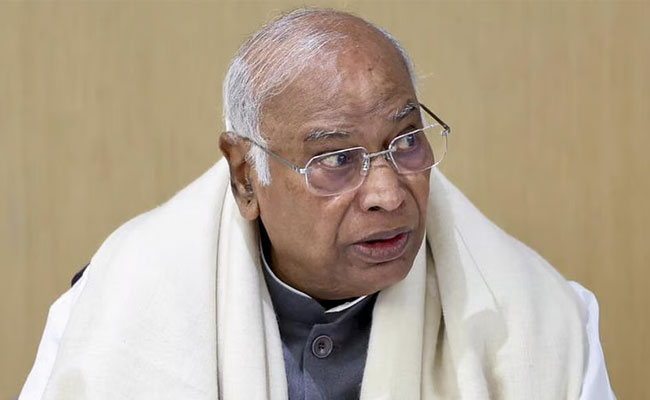
New Delhi (PTI): The Congress on Friday accused the Modi government of being "anti-worker" and demanded that the new labour code be reviewed, MGNREGA be revived as well as a national minimum wage of Rs 400 per day be established.
On International Labour Day, Congress president Mallikarjun Kharge took a swipe at the government and said unemployment in India today is a direct consequence of the 'Hum Do, Hamare Do' policies.
"Driven by the 'Hum Do, Hamare Do' policy, the Modi government implemented an anti-worker Labour Code. As a result, unrest has erupted everywhere - be it in Noida, at the IOCL facility in Panipat, Adani's factory in Raikheda, NTPC Patratu, or the Samsung factory in Sriperumbudur," Kharge said in a post in Hindi on X.
Instead of ensuring job security, this Code promotes policies such as contract labour and 'Hire & Fire' practices, Kharge said and called for a review of the new Labour Code.
The Modi government has effectively dismantled MGNREGA by forcibly pushing legislation through Parliament, he alleged.
"Mr. Modi has shifted 40% of the wage burden onto the State governments. State governments are unable to bear this financial strain and will eventually be forced to stop providing work," he claimed.
The Modi government has compelled workers into a state of unemployment and pushed them towards 'gig work', Kharge said.
Currently, 69% of the workforce is working for wages below the statutory minimum wage, he said.
The Modi government has engineered a crisis of stagnant wages, Kharge alleged.
"When adjusted for inflation, the wages of the majority of India's workers have grown by less than 1% annually over the last decade (from 2014-15 to 2022-23)," he said.
The Modi government has created a massive unemployment crisis among the educated workforce, specifically, among graduates, Kharge claimed and added that jobs have been eliminated through the sale of Public Sector Undertakings (PSUs).
"The government has refused to fill approximately 30 lakh vacant government positions. Furthermore, the government's policy blunders have led to the decimation of Micro, Small, and Medium Enterprises (MSMEs)," the Congress chief said.
The Congress reiterates its five demands for India's workers including revival of MGNREGA and its expansion to urban areas, Kharge said.
He said a national minimum wage of Rs 400 per day should be established, with MNREGA included within its scope.
Kharged demanded that a 'Right to Health' law must be enacted, providing Universal Health Coverage of up to Rs 25 lakh for laborers and workers.
"'Life Insurance and Accident Insurance' coverage must be provided for all unorganized workers. Preventing the contractualization of employment must be made a core priority of the government, and the new Labour Codes must be reviewed," Kharge asserted.