Banks with over 10 branches to have ombudsman: RBI
Mumbai, Sep 3 : The Reserve Bank of India (RBI) on Monday asked all scheduled commercial banks with more than 10 branches to appoint an Internal Ombudsman (IO). It, however, excluded Regional Rural Banks (RRB) from the requirement.
"The IO shall examine customer complaints which are in the nature of deficiency in service on the part of the bank, that are partly or wholly rejected by the bank," the RBI said in a release introducing the Internal Ombudsman Scheme, 2018.
The IO mechanism was set up with a view to strengthening the internal grievance redress system of banks and to ensure that the complaints of the customers are redressed at the level of the bank itself, the apex bank said.
With an IO, the redress will be done by an authority placed at the highest level of bank's grievance redressal mechanism. It will minimize the need for the customers to approach other fora for redressal, the RBI said.
As a part of this customer-centric approach, the banking regulator issued revised directions in the form of 'Internal Ombudsman Scheme, 2018' to enhance the independence of the IO and to strengthen the monitoring system.
The IO Scheme will cover appointment, tenure, roles and responsibilities, procedural guidelines and oversight mechanism for the IO, among other things. Its execution will be monitored by the bank's internal audit mechanism apart from regulatory oversight by RBI.
The RBI had, in May 2015, advised all public sector and select private and foreign banks to appoint IOs as an independent authority to review complaints that were partially or wholly rejected by the respective banks.
Let the Truth be known. If you read VB and like VB, please be a VB Supporter and Help us deliver the Truth to one and all.
Punjab CM Mann meets President Murmu, seeks cancellation of membership of 6 RS members
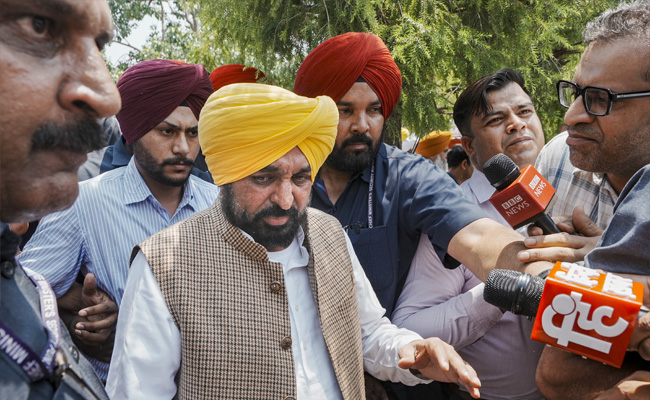
Chandigarh (PTI): Chief Minister Bhagwant Mann on Tuesday met President Droupadi Murmu, demanding the termination of the membership of six Rajya Sabha MPs from Punjab who defected to the BJP and also pressed for the introduction of a constitutional provision allowing for the recall of members.
Accompanied by party MLAs and ministers, Mann visited Rashtrapati Bhavan in Delhi.
This meeting followed a significant setback for the Aam Aadmi Party (AAP) on April 24, when seven of its 10 Rajya Sabha MPs -- Raghav Chadha, Ashok Mittal, Sandeep Pathak, Harbhajan Singh, Rajendra Gupta, Vikramjit Sahney and Swati Maliwal -- quit and merged with the BJP, alleging that the party had strayed from its principles, values and core morals. Six of the seven MPs who left AAP hailed from Punjab.
After he met with the President, Mann addressed the media here, describing the departure of the seven MPs as a "murder" of the Constitution. He stated, "Seven MPs merging with another party is completely unconstitutional. I spoke to Rashtrapati ji in detail."
Mann pointed out that he told the President that the BJP holds only two MLA seats (in Punjab), yet now has six MPs in the Rajya Sabha. He questioned, "How can this be possible? Isn't it a mockery of the Constitution?
"If they are such revolutionaries at heart, then they should have resigned from their six seats. The AAP could have sent someone else," Mann said, taking a swipe at them.
He emphasised the need for a recall provision in the Constitution, referencing MP Raghav Chadha's previous demands for such a measure when members fail to meet public expectations.
"Have you lived up to the expectations of the people?" Mann challenged the MPs during his statement.
Mann also presented a letter to the President, signed by all AAP MLAs. He differentiated between the terms 'elected' and 'selected,' stating, "They were 'selected.' Therefore, their membership should be cancelled."
The President assured Mann that she would consult constitutional experts before responding.
Earlier in the day, Mann, along with party MLAs, departed for Delhi from Chandigarh.
Speaking to reporters in Chandigarh, Mann affirmed that all AAP MLAs stand united with the party. "Only I have been given time for the meeting," Mann said.
"The President is the guardian of the Constitution. She is the constitutional head of the country," he added.
Later in a post on X in Hindi, Mann said, "Our struggle to protect Punjab's rights and interests continues. Today, along with all AAP MLAs, I have left to discuss Punjab's burning issues and present the state's strong voice before the President.
As your public servant, our government remains fully committed to Punjab's prosperity and the safeguarding of the rights of every section of society."
The MLAs and ministers gathered at the chief minister's residence in the morning before heading to Delhi, carrying placards that read 'Punjab Mann De Naal' and 'Punjab's Traitors.'
The legislators left for Delhi in buses.
Mann had previously sought an appointment with the President to meet with party MLAs and demand the "recall" of the Rajya Sabha MPs who defected to the BJP. However, only Mann was given a time slot for the meeting.